Loading...

Ribera, Jusepe de (Lo Spagnoletto)
(Játiva, 1591 - Naples, 1652)
Ribera, Jusepe de. Lo Spagnoletto, Xàtiva (Valencia), 17.02.1591 – Naples (Italy), 03.09.1652. Painter and engraver.
The son of a humble Valencian shoemaker who settled in Xàtiva, he was the couple’s second son, followed by a third son named Juan who would later accompany his brother to Italy.
Details of his early education are unknown, as there is no proof of his apprenticeship under Francisco Ribalta as claimed by early biographers.
What is known however is that at some time between 1607 and 1609 he left for Italy, from whence he was never to return. There are records of his being in the service of the Farnese family in Parma in 1611, where he painted Saint Martin for the church of Saint Prosper, known only from copies, and which was widely celebrated as an important work. In 1613, he attended the Accademia di San Luca in Rome, and in 1615 and 1616, he lived on the Vía Margutta in the house of a Flemish individual, together with his brother Juan and several others Spaniards of whom nothing is known.
He certainly appears to have been in contact with the Nordic artists who followed Caravaggio’s style in those early years, with tight techniques and precise drawing. There are literary testimonies of his life in Rome, especially by Mancini, underlining his extraordinary mastery in imitating nature and his behaviour "un po licenciosetto". Years later, Ludovico Carracci reminisces fondly in a letter about the "young Spaniard who followed the manner of Caravaggio".
In Rome, he painted the Senses series, some of which have been preserved (Sight, Mexico, Franz Mayer Museo; Smell, Madrid, Col. Abelló; Touch, Pasadena, USA, Norton Simon Foundation; Taste, Hardfor, USA Wadsworth Atheneum), creating a very different interpretation of what had been used until then with vulgar models under an intense light, demonstrating his contact with the Nordic Caravaggists.
From August 1616 onwards, he lived in Naples. Soon after his arrival, he married the daughter of the Sicilian painter and sculptor Gian Bernardo Azzolino (ca. 1532-1645), one of the city's most renowned painters, in November, which suggests that he may have contacted Azzolino at an earlier date and had possibly travelled previously to Naples.
From this date onwards, we have frequent documentary evidence of his activity. In 1618, he received commissions from the Duke of Tuscany and was considered the best of the city’s artists.
In the same year he worked on a depiction of the Calvary for the Vicereine-Duchess of Osuna, which corroborates an anecdote by De Dominici that the viceroy's patronage was due to a painting of the Martyrdom of Saint Bartholomew that the painter had left to dry in the Plaza de Palacio. Noticing the crowds that flocked to see it, the viceroy appeared on his balcony and ordered the artist to present himself. On learning that he was Spanish, he extended his patronage to him.
This patronage is well documented by other similarly dated paintings (Saint Jerome, Saint Bartholomew, Saint Peter and Saint Sebastian) in addition to the aforesaid Calvary (1618) in the Collegiate Church of Osuna, gifted by the Duchess in 1627. His prestige increased rapidly and so did his fortune. He purchased a large house with a garden and worked tirelessly on commissions both within Naples and outside the city.
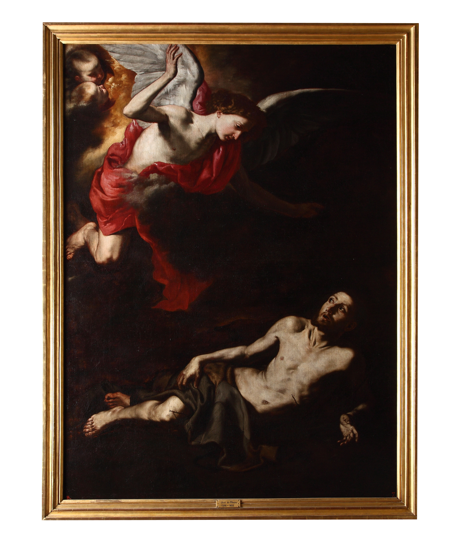
All the works that can be dated to these early years between 1616 and 1625 (The Apostles, Naples, Convento dei Gerolamini; The Burial of Christ, London, National Gallery; Saint Sebastian Tended by the Holy Women, 1621, Bilbao, Fine Arts Museum; Saint Jerome Hearing the Trumpet of the Last Judgment, Naples, Museo di Capodimonte) fall under the tradition of Caravaggio, but have been reinterpreted in a very personal, more direct and sensual means of approaching the represented material.
Between 1620 and 1630 his prestige grew and was boosted by his activity as an engraver who produced some masterful prints, initially based on his paintings (The Martyrdom of Saint Bartholomew, 1624; Saint Jerome Hearing the Trumpet of the Last Judgment, 1621; The Penitence of Saint Peter), and also with the intention of preparing a primer to teach drawing (studies of ears, eyes, mouths, etc.). These contemporary works (Saint Jerome, 1626, Saint Petersburg, Hermitage; The Drunken Silenus, 1626, Naples, Capodimonte; The Martyrdom of Saint Andrew, 1628, Budapest, Museum; Saint Sebastian Tended by the Holy Women, 1628, Saint Petersburg, Hermitage; Madonna and Child with Saints, 1630, Naples, Capodimonte) are crucial to a study of his technical evolution, always striving for greater diffuseness in order to achieve a more rigorous control of the tactile qualities of the objects portrayed. In 1625, he was visited by the painter and writer Jusepe Martínez, who left a precise testimony of Ribera's admiration for Raphael and the Renaissance masters.
In 1626, he was awarded the Cross of Knight of the Order of Christ, a Vatican decoration, for which ceremony, he returned to Rome for a few weeks. His position in Naples became increasingly solid. He forged friendships with the local Spanish nobility and with his Neapolitan colleagues with whom he frequently collaborated on commissions. Several children were born to him: one in 1627, another in 1628, a third in 1630. The patronage he received from the viceroys is also evident, especially Osuna, who was the first to commission works from him, and the Duke of Alcalá, viceroy from 1629 until 1631 who commissioned a series on Philosophers (Democritus, 1630, Madrid, Prado; Pythagoras, Valencia, Museum; An Unknown Philosopher 1631, Tucson (USA), University Museum; Heraclitus, Valencia, Museum) where he depicts them as uncouth and coarse, yet full of severe dignity.
From 1632 onwards, Tenebrist works emulating Caravaggio’s style with coarse models emerging from dense shadows appear alongside other compositions by Ribera with light, silver-toned celestials. His palette became lighter, and his brushstrokes, always thick, became freer. From Jacob with the Flock of Laban (1632, Monastery of El Escorial) onwards, this new aspect of his art became more and more evident, coinciding with the neo-Venetian turn in Roman painting during these years, and with the presence of Flemish art and the works of Rubens and van Dyck in the collections of the Neapolitan nobility. The new viceroy and Count of Monterrey (1631-1637) was Ribera’s best customer for the Salamanca foundation. Similarly, he created the Pietà (1632), the large Immaculate Conception (1635), Saint Januarius in Glory (1636) and Saint Augustine (1636). During these years, which were his most prolific years, Ribera painted the Magdalen in Glory (1636) and Saint Anthony of Padua with the Child Jesus (1636), Madrid, Academy of Fine Arts; Women Duelling (1636), Madrid, Prado Museum; The Blessing of Jacob (1637), Madrid, Museo del Prado; Apollo and Marsyas (1637), Naples, Capodimonte and Brussels, Royal Museums, and several other works, all executed with a refined colourist sensitivity and an unhurried, nervous technique. During the times of the viceroy Medina de las Torres (1637-1644), he worked on the Carthusian Monastery of San Martino (Pietà, 1637; Moses and Elijah, 1638; The Twelve Prophets for the spandrels of the nave arches, 1638 - 1640). The painter was at the height of his artistic powers and his social and financial success meant he could purchase a palatial house with two gardens and a large orchard in the Chiaia district. In 1641 he painted The Adoration of the Shepherds in El Escorial, and in 1641, the series of Penitent Saints in the Prado Museum (Saint John the Baptist, Saint Magdalene, Saint Mary the Egyptian, and Saint Paul the Hermit). The same year he received a commission for the most important location in the city: the chapel of Saint Januarius in the Cathedral, which was in the process of being redecorated. Ribera was commissioned to execute a large painting on silver-plated copper plate depicting Saint Januarius Emerges Unscathed from the Furnace, which would not be finished until 1646 and is one of the artist's most ambitious compositions.
He continued to paint in the 1640’s, creating a number of important works: Saint Francis in Ecstasy, 1642, Monastery of El Escorial; The Boy with the Club Foot, 1642, Paris, Louvre; The Baptism of Christ, 1643, Nançy, Museum of Fine Arts; Christ Crucified, 1643, Vitoria, Museum; The Martyrdom of Saint Bartholomew, 1644; Barcelona, Museum; Saint Simeon, 1647, Madrid, Col. Arango; The Mystic Marriage of Saint Catherine, 1649, New York Metropolitan Museum. At the same time, the participation of his collaborators in a large and well-organised workshop became increasingly evident, as they participated in less important works and made frequent copies and versions of the master's works. Around this time, his health also began to deteriorate.
There are no works signed by him in 1645, which matches the information that he was unable to use his brushes for varying lengths of time and that the works from the studio, even if signed, were the work of his collaborators.
The upheavals in Naples in July 1647 caused by the Masaniello uprising forced him to seek refuge in the Viceroy’s Palace, where he met Prince John Joseph of Austria, the natural son of Philip IV, who had been sent to put down the revolt.
Ribera painted an equestrian portrait of the Prince (1648, Patrimonio Nacional) and an engraving.
There was a rumour that the young prince had seduced one of the painter’s young daughters. It appears, however, that she was not his daughter but his niece, the daughter of his brother John who lived with him. The offspring born of this relationship would join the Descalzas Reales Convent of Madrid years later, where her father founded a sumptuous chapel as an ex-voto.
In 1649, the painter fell ill again, interrupting the commission for a Pietà for Antonio Rufo of Messina and the Communion of the Apostles, a commission for the Carthusian Monastery of Saint Martin, a work in progress since 1638. Correspondence maintained with the Prior of the Carthusian Monastery provides information on the state of his health and the financial problems that burdened him. In 1650 he painted The Adoration of the Shepherds (Paris, Louvre) and in 1651 he completed The Communion of the Apostles and Saints Sebastian and Jerome for the Carthusian Monastery (now in Capodimonte).
In July 1652, he rented a house in the seaside district of Mergelina, where he died on 3rd September of the same year. In the last year of his life, he painted the Miracle of Saint Donatus of Arezzo (Amiens, Musée de Picardie) and the half-length Saint Jerome (Madrid, Museo del Prado), where his unique interpretation of Caravaggio’s style culminated with a divided and loose touch of extraordinary audacity.
Ribera is one of the most outstanding personalities of the 17th century, and his influence may be detected throughout the Catholic world and even in the Protestant Netherlands, reaching as far as Rembrandt. Although Spanish by birth and proud of it - signatures in which the expressions "hispanus", "valentinus" and even "setabensis" (of Xàtiva) abound - his long stay in Naples makes him one of the pioneers of "Neapolitan naturalism", with disciples such as Francesco Francanzano, Aniello Falcone, Salvator Rosa and Luca Giordano.
Source: Royal Academy of History (https://www.rah.es)