The Royal Collections Gallery uses its own and third-party cookies, mainly
for technical purposes, which are necessary to provide our services and provide you with
relevant content. More information in our cookies policy.
Cookies Policy.
ACCEPT to confirm that you have read the information and accepted their installation. You can change your browser settings.
We use own and third party cookies to improve your browsing experience. More information in Cookies policy.
About cookies on this website
close
About cookies on this website
Technical
Technical cookies are those essential and strictly necessary for the proper functioning of the Website and the use of the different options and services it offers, including those that the editor uses to enable the operational management of the website and enable its functions and services. For example, those used for session maintenance, response time management, performance or validation of options, use of security elements, sharing content with social networks, etc. The website cannot function properly without these cookies.
Social networks
Social network cookies
Marketing
Descripcion
Técnica
Las cookies técnicas son aquellas imprescindibles y estrictamente necesarias para el correcto funcionamiento del Sitio Web y la utilización de las diferentes opciones y servicios que ofrece, incluyendo aquellas que el editor utiliza para permitir la gestión operativa de la página web y habilitar sus funciones y servicios. Por ejemplo, las que sirven para el mantenimiento de la sesión, la gestión del tiempo de respuesta, rendimiento o validación de opciones, utilizar elementos de seguridad, compartir contenido con redes sociales, etc. La página web no puede funcionar adecuadamente sin estas cookies.
The Royal Palace of La Almudaina, which dates back to the 14th century, is the Official Residence of Their Majesties the King and Queen of Spain during their stays in Mallorca, where they hold the Annual Reception for representatives of Balearic society. This building and the Palma Cathedral are considered iconic elements within the landscape of the Balearic capital. A palace that reflects successive artistic styles which have endured throughout the island's history.
The Monastery of Yuste is world-famous for being the last place of residence of the Holy Roman Emperor Charles V, and today, it is the venue for the Carlos V European Award Ceremony, an event presided over by His Majesty the King. Situated within an exclusive location that includes natural itineraries, visitors to the Monastery can explore the Royal Chamber, the church, and the Gothic and Renaissance cloisters.
The Royal Palace of El Pardo has been the Official Residence of Foreign Heads of State since 1983, and its origins as a royal hunting lodge are linked to the El Pardo woodlands. It is a building with close links to Spanish history. It was commissioned by Charles V, Holy Roman Emperor, in the 16th century and expanded in the 18th century by order of Charles III. Of especial note are the surrounding woodlands of El Pardo, a natural space of extraordinary value, considered the most important Mediterranean forest in the Community of Madrid.
History and beauty populate every corner of this Royal Site, which is a part of the Cultural Landscape of Aranjuez, a UNESCO World Heritage Site. Surrounded by a total of 111.23 hectares of gardens open to visitors and located in a fertile plain at the confluence of the Tagus and Jarama rivers, the Royal Palace of Aranjuez has been the country residence par excellence of the Spanish Kings.
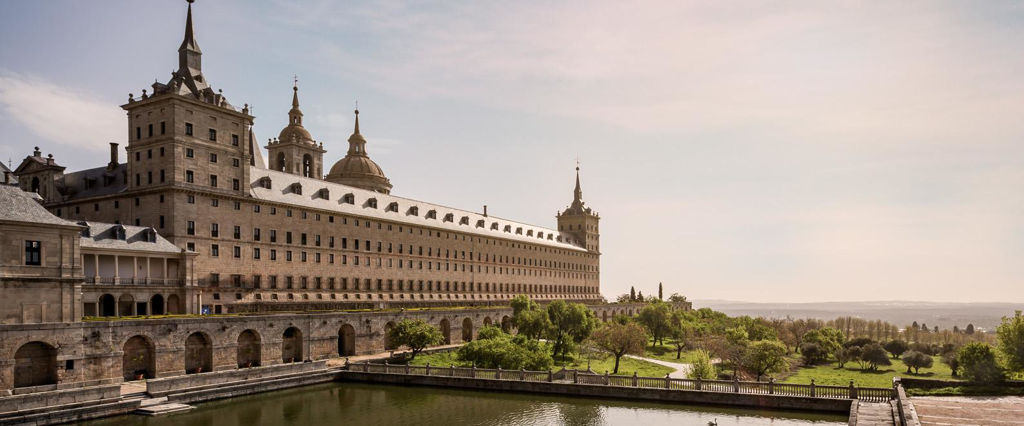
Combining several functions in a single building, San Lorenzo el Real was initially a monastery of the Order of Saint Jerome, whose church would serve as the mausoleum of the Holy Roman Emperor Charles V and his wife, Isabella of Portugal, as well as his son Philip II, his relatives and successors, and where the monks would pray uninterruptedly for the souls of the royals. A palace was also built there to house the king, as patron of the foundation, and his entourage. The college and the seminary completed the Monastery's religious function, and a Library was established to serve these three centres. This plan is still in place today, to some extent. The figure of Charles V was crucial to the establishment of this Royal Site, given his considerable influence on his son’s spirit, ...
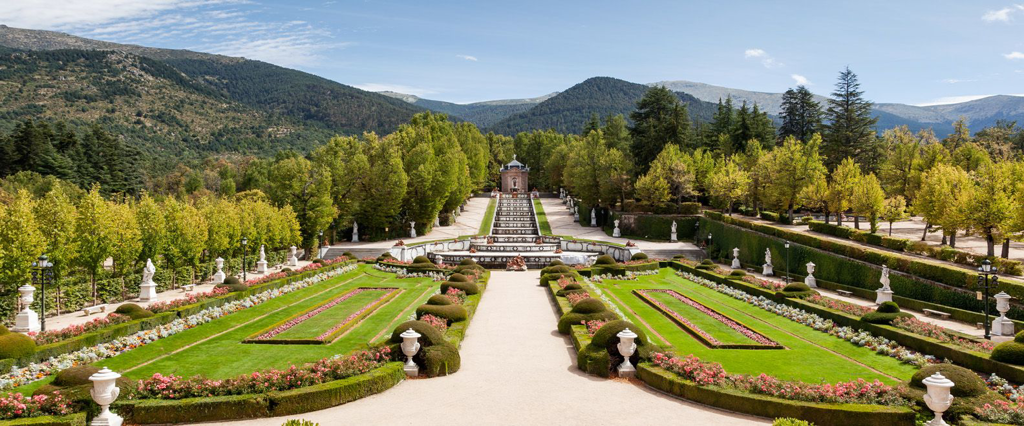
The Royal Site of La Granja de San Ildefonso has been awarded the status of a Historical Monument and it is of the best examples of 18th-century regal splendour. Philip V, the first Bourbon king to rule over Spain, fell in love with this beautiful location in 1717. Such was his "adoration" that he decided to build a palace and gardens there, decorated with sculptures and fountains to remind him of his childhood at the French court of his grandfather Louis XIV. The commissioning of this Royal Site was his great personal project, having found an ideal location in which to retire from the world…
Over 600 hectares of highly biodiverse woodlands surround the Royal Palace of Riofrío. The building is noteworthy for its uniformity of style and its linear, orderly and harmonious appearance, with echoes of classical Roman palaces. In spite of its uniqueness and the beauty of its surroundings, the palace remained uninhabited for more than a hundred years, which makes it one of the least well-known Royal Sites managed by Patrimonio Nacional, but at the same time, also one of the most special.
The Royal Palace of Madrid is the largest royal palace in Western Europe and one of the biggest in the world. It covers a surface area of over 135,000 square metres and has 3,418 rooms which have witnessed centuries of Spanish history. It is one of the few official residences of heads of state that is open to the public. Nearly 2 million visitors come every year to explore its rooms, its works of art, and its treasures that are unique in the world.