Loading...

The Gallery's first temporary exhibition, “In Motion”, takes visitors on a journey through the history of royal carriages.
21/06/2023
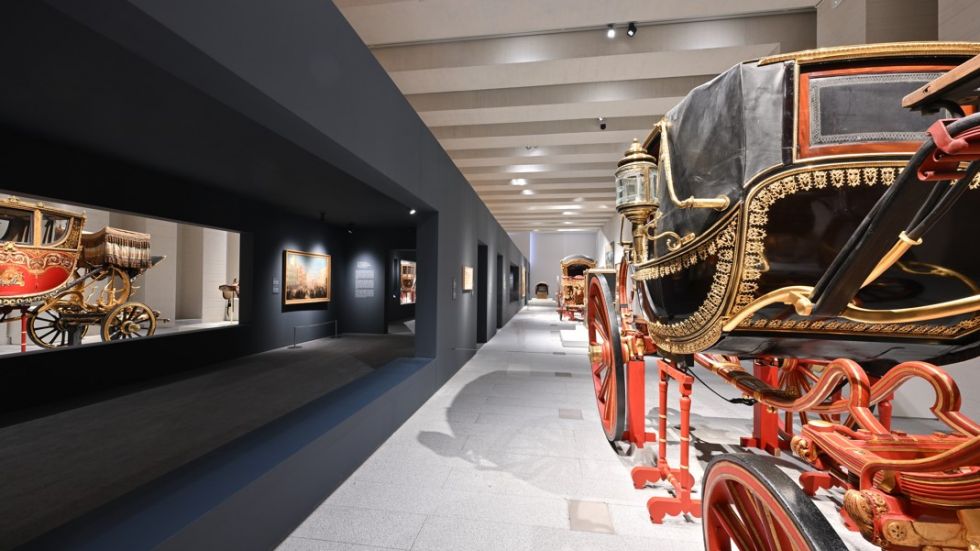
The Royal Collections Gallery opens its temporary exhibition space with the exhibition "·In Motion. Vehicles and Carriages of Patrimonio Nacional". Fifty or so pieces including several carriages, vehicles, sledges and even a sedan chair, which offer visitors the chance to explore the history of the carriage in Spain and its role as a symbol of power from the 16th until the 20th century.
The President of Patrimonio Nacional, Ana de la Cueva, the Managing Director of the Banco Santander Foundation, Borja Baselga, and the exhibition curator, Isabel Rodríguez, have launched the exhibition today, which will remain open to the public until June 2024 on Floor -3 of the Royal Collections Gallery. The visit is included in the general admission to the Gallery.
The launch of the temporary exhibition comes exactly one week after the opening of the Royal Collections Gallery. Ana de la Cueva has emphasised that the title of the exhibition, 'In Motion', "is a metaphor for the Gallery itself and the transformation in the heart of Patrimonio Nacional in terms of visibility, openness and modernity". For his part, Borja Baselga stated that at the Banco Santander Foundation "we are very proud of our commitment to this institution, and very happy to be a part of the inauguration of this spectacular Gallery.
Iconic vehicles of the Spanish monarchy
Patrimonio Nacional boasts one of the best collection of carriages in the world. Their use by Spanish monarchs and the court started in the 16th century, when it became the fashionable way to travel between Madrid and other Royal Sites, as part of the staging of the monarchy's power. Carriages are still used today in official ceremonies, such as when ambassadors present their credentials to the king.
The exhibition includes carriages of singular beauty and advanced technology for their times, such as the mid-18th century Golden Berline, the 1829 Bronze Landau, or the Tortoiseshell Carriage and the Carriage of Cyphers, belonging to Charles IV and María-Luisa of Parma respectively. In addition to their historical relevance, the carriages embody the great quality and refined aesthetics of all artisans involved in their making: cabinetmakers, sculptors, saddlers, gilders and even miniaturists.
A gallery within the Gallery
Its museography plays with the metaphor of the journey, as the exhibition is located in a central gallery where visitors may look through large windows to appreciate the objects from different viewpoints. Touch screens allow visitors to explore the interiors of the vehicles and carriages. The exhibition concludes with an audiovisual presentation of the history of the Royal Stables and explains its current use as an essential part of certain official events.
The curator of Carriages at Patrimonio Nacional, Isabel Rodríguez, has drawn attention to the fact that the exhibit “brings together a series of unique pieces that have not been previously displayed” and manages to "bring us closer to life at the Court and the representative staging of the monarchy through unique, monumental and stunningly beautiful works". "They are authentic works of art that additionally, provide safety and comfort to the passengers inside”, she adds.
The Mercedes-Benz of the collection
Patrimonio Nacional possesses certain unique vehicles that are also on display, such as the children's carriage of Queen Isabella II and two richly decorated wooden sledges, one of them in the shape of a dragon, possibly a gift from Tsar Alexander III to Alfonso XII. Two Mercedes-Benz cars; an all-terrain vehicle manufactured in 1939 and gifted by Hitler to the dictator Franco in 1940, and the classic 1942 'Grosser Mercedes' model; both vehicles, from the Patrimonio Nacional collection, were on display in the Historical Hall of the Royal Guard.
”In Motion” also includes objects related to journeys by the monarchs. On display are two trunks from the Royal Monastery of La Encarnación, similar to those used in their travels. The saddles, saddlebags, stirrups and harnesses came from the harness room of the Royal Palace in Madrid. And the Prado Museum has loaned seven paintings of court scenes in which horse-drawn carriages play a special role.