Loading...

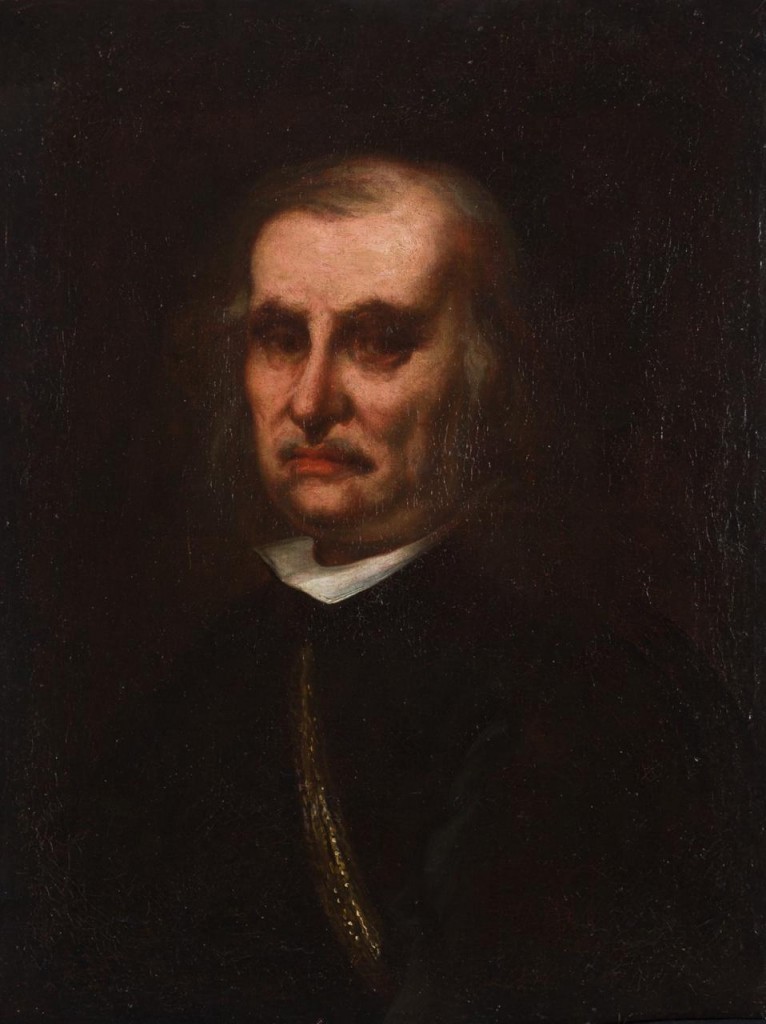
Carreño de Miranda, Juan
(Avilés, 1614 - Madrid, 1685)
Carreño Miranda, Juan. Avilés, 25.03.1614 – Madrid, 03.10.1685. Painter.
Son—possibly natural— of an Asturian nobleman who traded in paintings, and the nephew of Andrés Carreño (c. 1591-1660), a modestly renowned painter established in Valladolid. He moved to Madrid with his father at a very young age, and joined the studio of Pedro de las Cuevas (who died in 1644), a painter who was highly esteemed as a teacher and whose workshop included many of the Madrid painters of the age, such as Antonio de Pereda, Francisco Camilo, Antonio Arias and Juan Montero de Rozas, as students. Afterwards, he joined the workshop of Bartolomé Román, pupil of Vicente Carducho, in order to learn the techniques of colour. The traces of Carducho that can be seen in his earliest works were due to the influence of his new master. There are no surviving examples of his earliest works, but there is evidence that he worked on church commissions from the age of twenty. His first known work is Saint Anthony Preaching to the Fish, currently held at the Prado Museum and dating back to 1646. It already shows a taste for sumptuous colouring and lively, vibrant brushstrokes in the Venetian style, which would be the primary feature of his works throughout his life, coupled with Flemish compositional schemes that pay homage to not only Rubens, but also Van Dyck. In 1649, he completed the Holy Family for the Royal Monastery of San Martin and in 1653, the two large-scale paintings of the Annunciation and the Betrothal of Saint Catherine for the Hospital de la Orden Tercera, the latter inspired by an engraving by Van Dyck. In 1657, he painted the Assumption of the Virgin for the church of Alcorcón and which is currently in Poznan (Poland). According to Díaz del Valle, he was elected mayor of the town of Avilés, a post that his father had already held in 1624, showing that he had not severed his links to his town of origin. But this was undoubtedly an honorary appointment, as there is no record that Carreño was ever absent from Madrid.
In 1658, he testified at the trials to grant the habit of Santiago to Velázquez, stating that he had known him since his arrival in Madrid "almost thirty-four years ago". That same year, he was elected a faithful son of the town of Madrid by the nobles. According to Palomina, when Velázquez saw that he was occupied with things that distanced him from painting, "he told him that he would need it to be of service to His Majesty”, thus commencing his work in the service of the Palace.
His first activity at the Alcázar was to execute the tempera paintings and frescoes of the great hall, under the direction of the Bolognese painters Micael Angelo Colonna and Agostino Mitelli, and in collaboration with Francisco Rizi, who would henceforth be his closest collaborator. While Rizi had been “the King's painter” since 1656, Carreño was not yet officially associated with the Court.
The 60’s would bring him several important commissions. In 1660 he painted the superb St James at the Battle of Clavijo, now at the Budapest Museum, and the portrait of Bernabé de Ochoa Chinchentru, now housed in the Hispanic Society of New York. In 1663, Rizi and Carreño were commissioned to create four paintings for the new chapel of San Isidro, two by each painter. Although they were destroyed in the civil war, photographs of these works have survived and E. Tormo detected the date 1666 on one of them, meaning that progress had been slow. In 1660, they worked together on the frescoes of the church of San Antonio de los Portugueses or San Antonio de los Alemanes, in which Carreño painted the figures and Rizi the mock architectures, urns and festoons, which were retouched by Giordano in 1699 - 1701.
In March 1664 he undertook, in collaboration with Rizi, to execute the tempera painting of the shrine of the Virgin of Atocha in the convent of the same name, which was under royal patronage. That same year, in December, when the work had been completed, on the instructions of Sebastián Herrera Barnuevo, it was decided to replace the tempera decoration with a richer and more extensive fresco. They also undertook a commission for a large painting for the Trinitarians in Pamplona in 1664. This painting, now at the Louvre, was painted by Carreño and paid for in 1660, but the initial sketches of the composition were Rizi's work.
In 1665, as always together with Rizi, Carreño was commissioned to paint frescos on the octagonal dome of the chapel in the cathedral of Toledo. This project would not be finished until 1669, overlapping from 1668 with the work on the Holy Week monument in the same cathedral for which Rizi was commissioned that year. The following year, Carreño was paid for his share of the work. By this time the painter was more self-confident; he had a large number of journeymen who copied his most popular compositions (the Immaculate Conception, for example, of which there are many surviving examples of varying quality), and in 1667 he requested Queen Mariana to honour him with the title of chamber painter "in the absence and illness" of the painter who held this position: Sebastián de Herrera Barnuevo. The response from the palace was categorical in its refusal.
Nevertheless, in 1669 he was appointed painter to the king and granted a salary, and any and all paintings he executed would be appraised and paid for. The same year, he was appointed “Assistant to the Keeper of the Keys”, a palace post that that had also been held by Velázquez when he was the King's painter. Carreño now followed in the footsteps of the erstwhile painter to Philip IV.
In 1670, he received payment for his work on the octagonal ceiling of the chapel and the monument, and in April 1671, after the death of Sebastián de Herrera, he obtained the much awaited office of chamber painter, and by decree of the Queen —proof of her high regard— he continued to receive two salaries: that of the King’s painter and that of chamber painter.
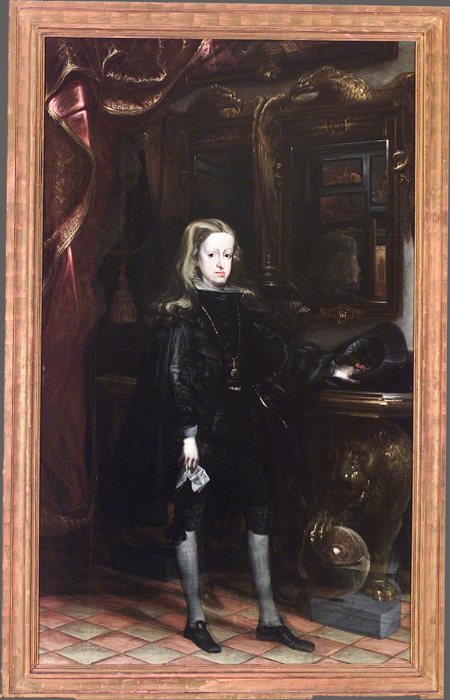
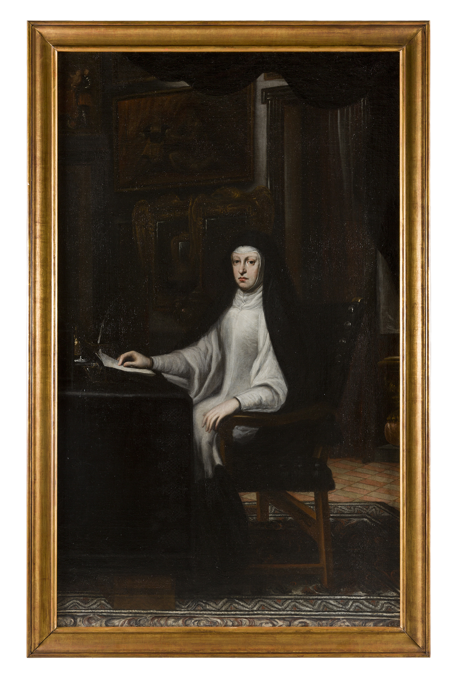
This was the start of his career as the Court’s portrait painter. He painted portraits of Charles II —the first of which is in the Museum of Fine Arts of Asturias in Oviedo, dated 1671 and proudly signed "Pictor Regis" - of Queen Mariana, the ministers Juan José of Austria and Valenzuela, aristocratic figures such as the Dukes of Medinaceli and Pastrana, ambassadors such as Potemkin and the cardinal Savio Millini, dwarves such as Michol, and individuals with abnormal features such as the Monster; an extremely obese girl who was presented to the court in 1680.
At the same time, he worked to restore El Escorial after the fire of 1671. In 1675, he headed to the monastery to undertake the decoration of the King’s chamber and the chambers of Philip II, at the same time creating a copy of Raphael’s Christ Falling on the Way to Calvary which had only just arrived, for the Carmelitas Descalzas Royal Convent in 1674, now hanging in the Academy of San Fernando.
A colourful episode took place during these years. While the exact date is unknown, around 1667, a new-born child was “thrown at his door.” The couple —he had married in 1639— being childless, the little María Josefa, as she was baptised, became their daughter and in his will, Carreño speaks of “the great affection I have for her”.
In 1679, on the occasion of the festivities marking the arrival in Madrid of Charles II’s wife Marie-Louise of Orleans, he was in charge of setting the conditions for the arches, and supervising their construction and pricing of the surplus.
In 1681 and 1682, he acted as the chamberlain when the Royal Court sojourned to El Escorial in summer, and to Aranjuez in spring. Throughout his life he acted as an appraiser for various probate estates, giving proof of his knowledge, as his appraisals are more precise and detailed than those of other appraisers of his time. It was undoubtedly his contact as a youth with his father, who traded in paintings, that made him familiar with personal styles and mannerisms.
On 2nd October 1695, confined to his bed due to illness, he dictated his last will, and died the following day. His will supports Palomino’s description of Carreño as a modest and prudent man, of good temperament and moderation, balanced, artless, and far from all duplicity and pretence, and with a sense of humour. This is further borne out by a series of anecdotes.
His students with whom he undoubtedly maintained a familiar and steady relationship, are the some of the best exponents of Madrid art. Mateo Cerezo, Juan Martín Cabezalero, Francisco Ignacio Ruiz de la Iglesia, Pedro Ruiz González and Jerónimo Ezquerra were all members of his workshop.
When it comes to religious paintings, when the exception of his early works, his style is indebted to the Flemish tradition of Rubens and Van Dyck, albeit with a certain restraint and moderation. His treatment of colour is wholly Venetian, in the style of Titian. His portraits, which constitute a significant part of his oeuvre, emulate the elegance of Velázquez, with a touch of courtly gallantry reminiscent of Van Dyck.
Source: Royal Academy of History (https://www.rah.es)