Loading...

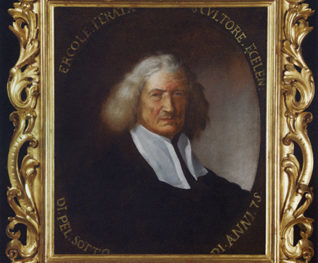
Ferrata, Ercole
(1610 - 1686)
Ercole Ferrata (Pellio Intelvi, 1610 - Rome, 10th July 1686) was an Italian sculptor, one of the greatest exponents of the Roman Baroque.
A pupil of Alessandro Algardi, together with his fellow pupil Domenico Guidi, he collaborated with Algardi to create the Vision of Saint Nicholas for the church of Saint Nicholas of Tolentino in the Gardens of Sallust in Rome.
Ferrata would later gradually move away from the classicism of Algardi and François Duquesnoy towards the more expressive style of Gian Lorenzo Bernini. Around 1660, he created a sculpture of Saint Agnes at the stake and a Martyrdom of Saint Emerenziana for the church of Sant'Agnese in Agone. Under Bernini's supervision, he carved the Angel with the cross for the Sant'Angelo bridge, and collaborated in the carving of the elephant attached to the Obelisk in the Piazza della Minerva in front of the church of Santa Maria sopra Minerva. He created a representation of The Faith for the tomb of Cardinal Lelio Falconieri in the church of San Giovanni dei Florentini. He also worked with Cosimo Fanzago and Giuliano Finelli in Naples. He carved the statue of Saint Catherine in the Chigi Chapel in Siena cathedral, and together with Francesco Aprile, the statue of Saint Anastasia in the church of the same name in Rome, inspired by Bernini's Blessed Ludovica Albertoni.
In 1673, Cosimo III de' Medici, the Grand Duke of Tuscany, put him in charge of the Villa Madama Academy in Rome (with the sculptor Ciro Ferri). He also restored works of classical statuary, including the torso found during the building of the church of Santa Maria in Vallicella, and according to certain sources, also the arm of the Venus de' Medici.
Some of his pupils and collaborators were Camillo Rusconi, Melchiorre Cafà and Giovanni Battista Foggini.
Source: Wikipedia
View on Wikipedia
View in timeline
