Loading...

Houasse, Michel-Ange
(Paris, 1680 - Arpajon, 1730)
Houasse, Michel-Ange. Paris (France), ca. 1680 – Arpajon (France), 30.09.1730. Painter.
Son and pupil of René-Antonine Houasse, a renowned painter who collaborated with Charles Le Brun on decorations at Versailles, including the Grand Trianon, and the Tuileries Palace. He accompanied his father to Rome when the latter was appointed director of the Académie de France in Rome from 1699 to 1705. Upon his return to Paris, he entered the Académie Royale de Peinture et de Sculpture in 1706 to complete his training, was accepted as a member the following year, and appointed “peintre ordinaire du roi” in 1710.
Meanwhile, Philip V, grandson of Louis XIV and King of Spain since 1700, had been seeking new portrait artists for his Court, as the current appointees failed to appeal to his wife, Maria Luisa Gabriella of Savoy, who preferred a French artist more in keeping with the refined tastes of the new dynasty. After several attempts, it was finally Jean de Orry, the French king's financial advisor, who pushed for the appointment of young Houasse as portrait painter to the new Spanish dynasty.
In Madrid, from April 1715 onwards, shortly after Philip V's second marriage to Elisabeth Farnese, Houasse soon began to paint portraits of various members of the royal household, sometimes combining elements of 17th-century Spanish court portraiture with paying special attention to Velázquez, and the details and ornamentation of French portraiture during the late reign of Louis XIV in the style of Rigaud.
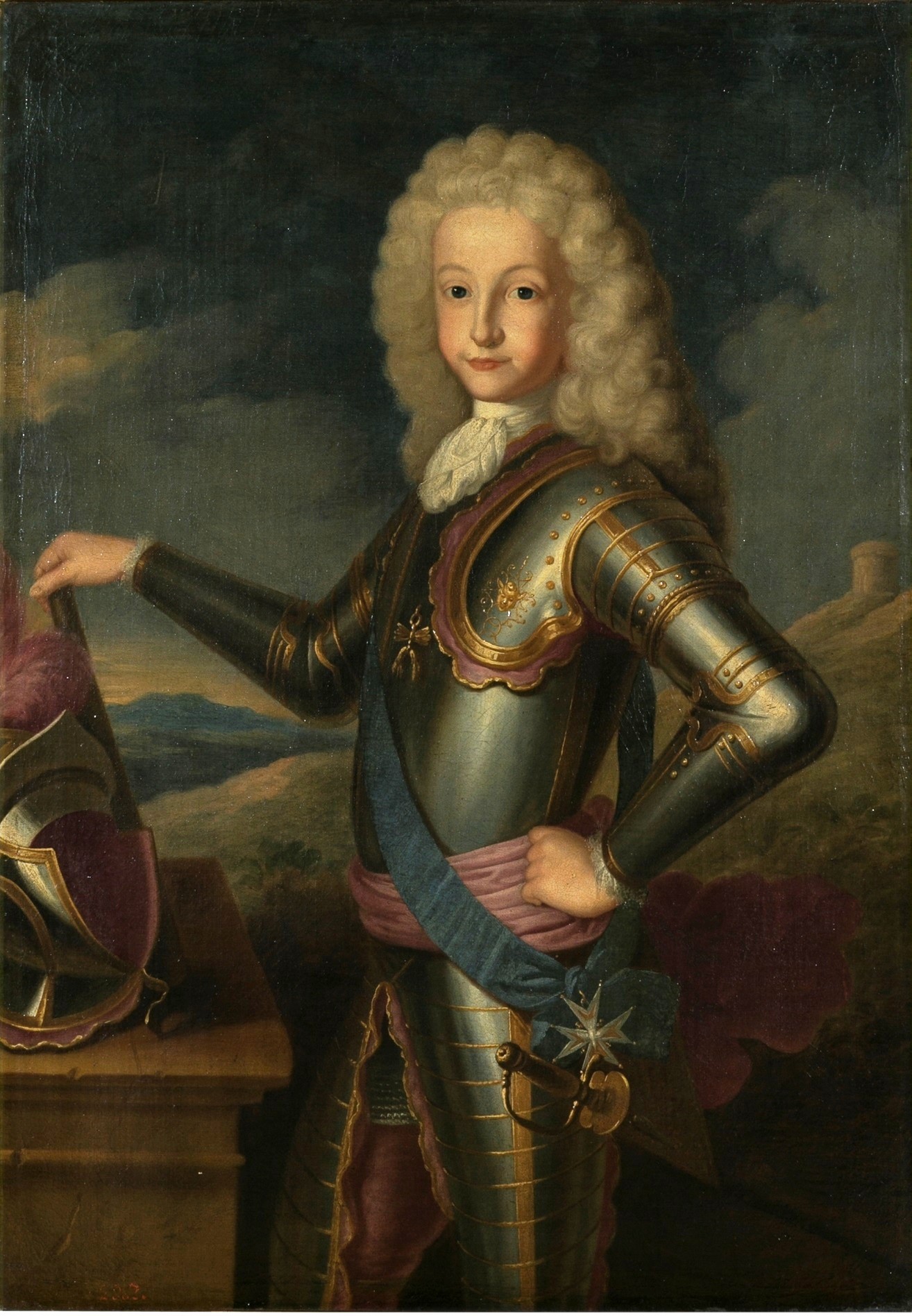
In 1717, he painted Louis of Bourbon, the King's first-born son, who was then ten years old and who, like Louis I of Spain, briefly occupied the throne seven years later when he died prematurely. The portrait depicts the young man in a pose reminiscent of Louis XIV in armour by Rigaud.
Nevertheless, Houasse avoided the excessive ornamentation of the earlier work to depict the heir in garments of delicate shades of silver greys, in complete harmony with the white lace tie, the wig and the youthful face of the sitter, against a neutral background. This delicate image, almost devoid of any decorative device, did not seem to have appealed to the king and queen, as the monarch soon sought other portraitists for this task.
However, Houasse continued in the king’s service, working on various other compositions and genres commissioned from him, from landscapes to tapestry cartoons. Between 1719 and 1720, he painted the Bacchanal and Offering to Bacchus, paintings on Dionysian themes which reveal the influence of Poussin, although Houasse avoids the frenetic dances of Poussin and depicts the figures in more relaxed poses, boldly foreshortening the reclining figures, while a girl with a pitcher on her head and her back to the viewer walks away with a markedly feminine gait.
He was soon commissioned to paint a series of views of the various royal residences for the palace of La Granja. Despite his academic training, he depicted the austere horizon of Castile with extreme realism, far removed from the rigorous geometric landscapes of the official painters who worked in Paris or Versailles, or from the usual repetitive fronds of the fête galantes. His interest in the clarity and lightness of touch of the panoramas near Madrid depicted by Velázquez in his numerous portraits of the Alcázar is evident here.
He depicted landscapes under a diaphanous light, in a distinctive style yet always fully authentic, such as the View of the Palace of El Pardo and the Panorama of Aranjuez. The former is immersed in a green environment of woods and hills, while the latter shows a wide and austere plain where the palace is barely perceptible, next to the poplar grove on the banks of the River Tagus. But Houasse demonstrated his best achievements in the numerous views of El Escorial included in this series. In the Panorama of the Monastery of El Escorial, for example, he visualises the building in the background and at the top, from a grove populated by tiny figures in the foreground, always with more realistic brushstrokes than the stereotypical characters of the aforesaid French landscape artists. But Houasse’s best painting of the series was his famed View of El Escorial with a Monk, which depicts the broad silhouette of the monastery with soft colours against a luminous atmosphere. The figure of the friar in the foreground, wholly immersed in his book, appears to emphasise the religious nature of the building.
Houasse also produced a series of works where figures under the clearest of skies are portrayed against various statues or classical ruins scattered around them, as well as buildings that may be glimpsed in the distance amidst the abundant vegetation. In this regard, works such as Landscape with the Farnese Hercules , A Young Man Sketching Sculptures or Landscape with Women Cutting Flowers are noteworthy examples.
With this large group of landscapes as one of his best works, Houasse revitalised this genre among the artists of his time, thanks to his free and direct technique, even becoming a harbinger of the progress in French landscape painting of the following century.
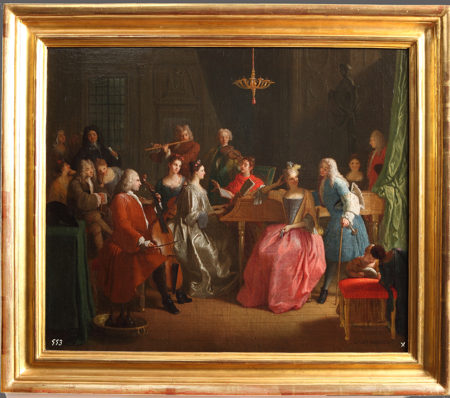
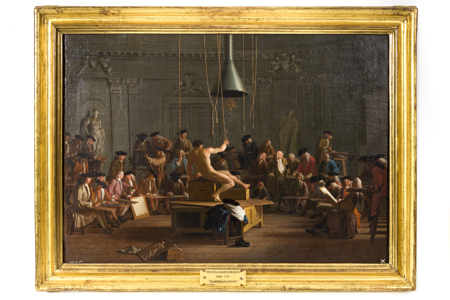
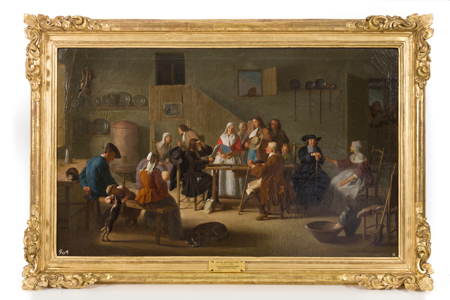
He also sought to depict the leisure world of the elites of his time in works such as the Academy of Drawing, where a group of upper-class students sketch the nude model who is the central focus of the scene, with great naturalism, or The Game of Billiards, displaying figures appear around the green table in a wide variety of poses, or Masks Playing Cards in a Garde, where he achieved an almost Rococo atmosphere. These are scenes where Houasse, with his sense of observation and skill for anecdotes, combined naturalistic elements with those of the fêtes galantes. They are noteworthy for his skilful use of colour and the careful composition of figures and attitudes.
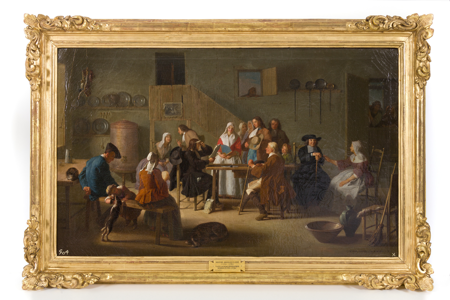
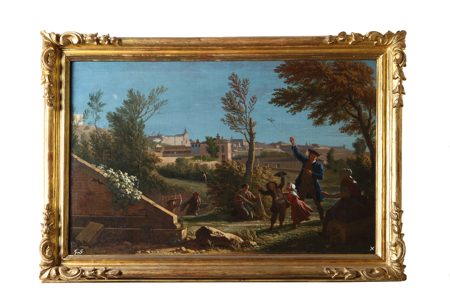
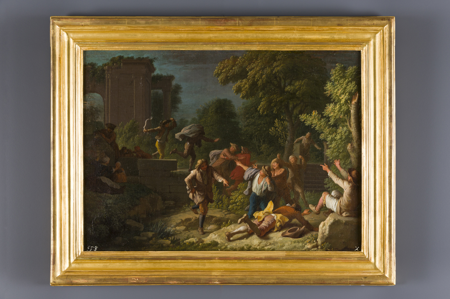
Other scenes of a more popular nature are set in tranquil spots enlivened by dancing figures or people at play, as depicted in the Village Feast or The Villagers and the Wayfarer. But the most outstanding canvas in this group is his View of Madrid with a Bird Seller where the figures in the foreground form a multicoloured, jovial scene, full of harmony and a taste for the commonplace, against a background of buildings on the banks of the River Manzanares. In this way, Houasse was once again ahead of his contemporaries in foreshadowing the future painters of tapestry cartoons at the Royal Tapestry Workshop, such as José del Castillo and Francisco de Goya.
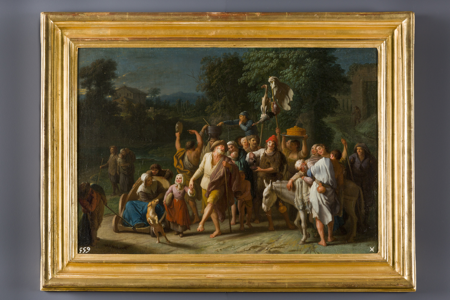
He also painted religious scenes; in The Flight to Egypt, the gentleness of the figures and the bright light emanating from the figure of the Child, breaking the prevailing darkness, recall Le Brun's Adoration of the Shepherds. In the six paintings commissioned for the Jesuit novitiate on The Life of Saint Francis Regis, Houasse reveals himself as a highly capable draughtsman, paying great attention to the use of light to evoke the sense of the supernatural in the scene. The arrangement of the figures and their gestures in some of the canvases of this group, such as the Miraculous Healing of Mother Montplaisant, would directly inspire Goya when painting Saint Francis Borgia Helping a Dying Impenitent at the Cathedral of Valencia, or his Sermon of Saint Bernardine of Siena at the Royal Basilica of San Francisco El Grande.
Returning to mythology, in 1727, the King commissioned Houasse to paint the cartoons for a series of tapestries depicting the adventures of Telemachus to be woven at the Royal Tapestry Workshop of Santa Bárbara. But Houasse only produced one cartoon, Telemachus and Mentor Arriving at the Island of Calypso, a work full of stylised figures, almost evanescent in their delicate gestures, which would give rise to two complementary paintings of this story of the nymph and the son of Ulysses.
Houasse remained in the King's service as a court painter for the rest of his life, always a refined artist capable of cultivating all genres, with his harmonious sense of composition, lively colour and graceful figures, creating luminous paintings of surprising modernity for the royal court of Madrid.
When his health began to fail, he sought and was granted permission to return to France in 1727. He returned to his homeland and died in 1730 in Arpajon, near Chartres.
Source: Royal Academy of History (https://www.rah.es)