Loading...


Lagrú, Joseph
(Valsaín (Segovia), 1760 - Madrid, 1812)
Lagrú, Joseph. Valsaín (Segovia), c. 1760 – Madrid, 1812. Glass engraver.
Master engraver at the Royal Glass Workshop of La Granja de San Ildefonso. The son of Luis Lagrú, a sculptor at the Royal Site Valsaín, where he was born, and the elder of two brothers, Joseph Lagrú began working as an apprentice aged nine in the engraving room at San Ildefonso engraving room, circa 1775. During the six winter months, he attended the Academy of Drawing of San Ildefonso in the evenings to perfect his skills in this area. At the age of twenty-five he was assigned to the general store in Madrid as the official overseer of the engraving room, at the same time attending drawing classes at the Royal Academy of San Fernando. He held this post until 1787, when he returned to San Ildefonso after obtaining the post of second master engraver. In October 1791 he won the post of first master of the engraving room of the general stores in Madrid. The post came with a daily salary of 20 reales.
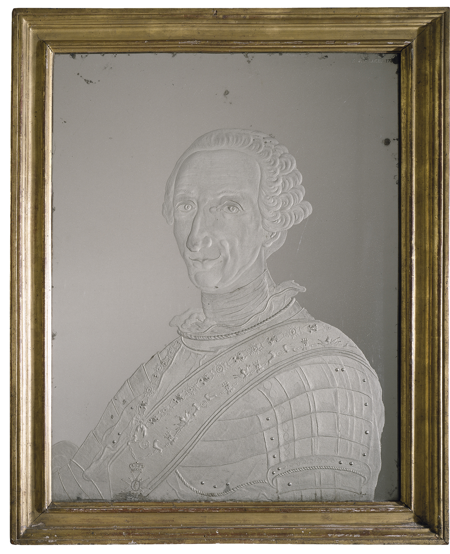
A Royal Order of 27th February 1800 granted him the honours and use of the uniform of chamber engraver, being awarded 12,224 reales, in recognition of his merit as master of the engraving room and other executed works (General Archive of the Palace, Record 599/23). Joseph Lagrú discovered and perfected a new method for etching mercury glass, invented in Germany and still unknown in the Peninsula, which he was able to apply in the examples listed below: Some of his featured works include: a glass engraving of the fountain of the Triumph of Apollo, valued at 1,000 reales; a round mirror engraved with two figures and a cupid, valued at 1,540 reales; a mercury glass engraving of a bull and a bullfighter on horseback; a mirror engraved with the life-size bust of Charles III, copied from the print of a painting by Mengs, now in the Royal Palace in Madrid (1789); a goblet with its saucer engraved with two figures and a figure of the Queen, valued at 800 reales; a mirror measuring eleven by eight French inches, engraved with a crucifix; and finally, a mirror engraved with the image of Saint Francis, now in Cerralbo Museum.
Following the Peninsular War, the Royal Workshops were shut down in 1810.
He died in 1812, leaving his son Pedro Lagrú to work in the general store in Madrid (General Archive of the Palace, Record 2642/2).
Source: Royal Academy of History