Loading...


Maella Pérez, Mariano Salvador
(1739 - 1819)
Maella Pérez, Mariano Salvador. Valencia, 21.08.1739 – Madrid, 10.05.1819. Painter.
The son of Tomasa Pérez and Mariano Maella, a modest painter, he received his first art training from his father at a very early age, soon demonstrating a great aptitude for drawing. His father then took him to Madrid so he could train under Felipe de Castro, with whom he practised drawing and modelling for two years. Given his obvious talent for painting, De Castro himself encouraged Maella to continue his studies at the Academy of San Fernando.
Once he entered the institution in 1752, Antonio González Velázquez, professor of Drawing at the Academy, paid him especial attention for his commitment to learning, not to mention the young artist’s courtship of one of his daughters, María.
In any case, the artist had an impeccable academic career, and in 1753, he received a First Prize for his paintings of The Shepherd Faun and Venus. At the end of his stay in the Academy in 1757, he was awarded the Second Prize for his painting of The Martyrdom of Saint Hermenegild.
In spite of these achievements, his father remained unconvinced of his son’s future as an artist and accompanied him to Cádiz in order to introduce him to some of the firms that traded between Spain and its colonies. Maella did, however, have the chance to paint the effects of the 1755 tsunami on the city for the convent of Santo Domingo, in addition to a portrait of Jerónimo Cavero, dean of the cathedral. These works brought him a certain amount of money and fame, leading his father to finally relent and allow the young artist to travel to Italy, which had been his most earnest desire at that time.
He arrived in Rome at the beginning of 1758 and after several months, applied to the Academy of San Fernando for financial aid, which was granted to him. However, it was on the condition that he, similar to other recipients of official aid, periodically send his work back to Madrid so his progress might be verified. In any case, during his time at the Accademia di San Luca and at Campidoglio, he received five consecutive awards, and in 1762 he was commissioned by the Spanish Barefoot Franciscans to execute a painting for the church of Santi Inocenti. During this years in Italy he also explored the world of fresco painting, with especial interest in the brilliant chromatism of Giaquinto, at the same time, being influenced by academicism, where the coldness of colour prevailed.
Maella returned to Madrid in April 1765 and barely a month later, he was appointed Academician of Merit by the Academy of San Fernando. Meanwhile, Mengs, who was then First Chamber Painter, was quick to note the young painter's manners and professionalism. He brought him into the royal service and took him to the New Palace for the summer, as the Bohemian artist was supervising the ambitious decoration of the building's vaults at the time. There, under his patron who soon regarded him as his favourite assistant, Maella started working on the frescos of three rooms in the palace, a sizeable task that was practically completed in 1766 with the execution of an allegory of Hercules between Virtue and Vice in the Armoury Hall.
At the same time, in an almost frenetic activity, he made copies of five portraits of Charles III, the princes of Asturias and the kings of Naples for the Court, executed years ago by Mengs himself. These murals and oil paintings were highly appreciated at Court, and after his marriage to María González Velázquez in 1767, emboldened him to apply to the King for a raise which was finally granted in 1769, bringing him on par with Mengs. During this time, he was also painting frescoes at the palace of El Pardo, which were no less impressive in terms of workmanship than his work at the palace in Madrid. He decorated the ceiling of the hall with a representation of Justice and Peace and painted another allegory of The Goddess Pallas Vanquishing the Vices, in the assistants' office. Both compositions bore marked traces of Giaquinto's loose brushstrokes and lively tones.
The Italian painter’s influence was, of course, in keeping with his innate ability as a colourist, accompanied by an impeccable drawing in which the powerful neoclassical influence of Mengs could be detected. This endowed his palette with a unique eclecticism, together with a hefty dose of originality, that would be visible throughout his career. Works such as The Circumcision of Christ, from these years, would only draw attention to this fact.
He was appointed director of Painting by the Academy of San Fernando in 1771, with Maella consolidating the post a year later. The Valencian artist introduced important changes to teaching at the Academy over the course of his long career, and many of his drawings from this period served as models for his students for many years.
His Immaculate Conception with Saint Fructus, finished in early 1772 for a side altar at the collegiate church of La Granja, became an unmistakeable prototype of the Virgin that he would repeat with slight variations for years, given its high demand among churches and private clients. It depicts Mary as a young girl who, in the best traditions of Murillo and other Baroque artists, appears with her hands on her chest or joined in prayer by her fingertips, while a crown of twelve stars descends on her head, surrounded by cherubs and angels of youthful appearance. Always immersed in an intense, golden atmosphere, his paintings revived a theme that had apparently been exhausted in Spanish painting.
Appointed First Chamber Painter in 1774, the next year he began working actively in various areas of Toledo Cathedral, such as decorating the lower cloister. He started this commission with two representations of the life of Saint Leocadia, which he completed in 1776. As may be seen in the drawings retained by the cathedral, the numerous figures move within a large space with no dearth of light and chiaroscuro effects. However, the damp in the cloister halted the works and as a matter of fact, the scene of the Martyrdom of Saint Leocadia has almost completely disappeared. Later on, around 1778, he worked on the cupola of the octagonal dome of the Sagrario Chapel, which was initially decorated with paintings by Ricci and Carreño, and which he practically repainted due to the poor state of preservation of the original works. However, he retained the previous iconographic pattern, dominated by an enthroned Virgin as Queen of all saints surrounded by multiple celestial figures.
That same year, the King commissioned him to paint two Immaculate Conceptions for the Royal Palace at Aranjuez, of which the one on the church’s high altar is remarkable for its slenderness and lightness. Both were executed with a luminous style, very close to Rococo aesthetics, and the King was highly pleased with the results, further increasing Maella’s salary by a considerable amount.
When Mengs left for Rome, Maella became the Royal Household’s most favoured portrait painter, as his academic faithfulness and closeness to the erstwhile first court painter were appreciated by Charles III, who always sought to ensure that Court portraits expressly followed the models established by the Bohemian painter. The Valencian artist was also skilled at capturing the different textures of the costumes and surrounding objects, and produced a series of portraits of the Royal Family which were often highly useful in the Palace's relations with various European Courts. In 1778, for example, he painted five full-sized royal portraits intended for the Empress of Russia.
In 1881, he worked on the Palafox chapel in the cathedral of Burgo de Osma, a space designed by Juan de Villanueva and where Maella painted a fresco of the Adoration of the Name of God in the half dome of the corner known as the Chapel of the Immaculate Conception. In this composition, the triangular form of the Holy Trinity is surrounded by a choir of angels. Largely dominated by a radiant sky akin to his Immaculate Conception and executed with rapid brushstrokes, it is an important part of the artist's stylistic progression.
After this break in his palace commissions, he painted the Infante Carlos Domingo, second son of the Prince of Asturias in 1782, with a copy for the Court of Turin. Around the same time, he executed another set of paintings of Charles III and his family members, to be sent to Portugal. At that time he was already able to trace, on his own prototype, the studies of heads that he would later include in the final compositions.
Constantly busy in the service of the King, he was commissioned by Floridablanca, prime minister and promoter of the Bank of San Carlos, to paint the monarch in armour and bearing the sash and Grand Cross of his Order, as well as the princes of Asturias, according to the model established by Mengs. Overworked, Maella suggested that these works be executed in his workshop by one of his best pupils, to which the politician finally agreed in early 1783.
In any case, the Valencian painter’s best known work in this area is the portrait of Charles III dressed in the habit of his Order, an imposing, full-length representation of the monarch in a voluminous cloak edged with a blue stripe and holding a flare in his right hand, while he rests his left hand on a surface bearing the crown and his hat. This portrait of the monarch, with a pose strongly influenced by Mengs, was commissioned in 1884 to decorate the royal bedchamber and is still hanging in the same room, now named after the monarch.
Shortly afterwards he painted the Infanta Carlota Joaquina, daughter of the Prince of Asturias, about to become Queen of Portugal on her marriage to John VI. The portrait was painted in 1785, when Carlota, barely ten years old, was about to depart from the Court. Dressed in blue with a high wig and hat in the Parisian fashion, she holds a bouquet in her right hand and a fan in the other.
A highly regarded portrait thanks to its eighteenth-century gracefulness, Maella painted another similar portrait of her that same year, this time in a wide-hooped dress of delicate pink and with a canary posing on her right hand.
He returned to his religious compositions in 1786 when he painted Saint Charles Borromeo Distributing Communion to the Plague Victims of Milan for the Bank of San Carlos, a composition where the agile figures seem to be immersed in a warm atmosphere reminiscent of Giaquinto. This was followed, a year later, by three oil paintings commissioned for the new chapel in Casa de Campo and now held in the Museum of History of Madrid, such as Child Christ Appearing to Saint Anthony or Saint Francis in Prayer. The traces of Mengs were now highly visible in his works, Maella having softened his palette and using more precise brushstrokes to define the figures.
In 1788, he stayed at El Escorial for several months, working both on frescos as well as easel paintings for the future Charles IV at the House of the Heir Apparent. He thus depicted Ganymede carried by the eagle on the ceiling of the Ivory Room, although the prince's foremost desire was to witness depictions of Spanish victories, such as its triumph over the Muslims, in paintings. This led to titles such as The Battle of Clavijo or the Siege of Tarifa, which were finished in 1789. Maella also painted the military exploits of the monarch, who had reconquered Menorca from the English in 1782, represented, for example, in the Spanish Troops Landing on the Island of Mahón in 1791. The end result was a series of eight oil paintings notable for the dynamic movement of the battles, or the violent attitudes of the figures, making them worthy examples of historical paintings in the 18th-century Spanish art.
Meanwhile, following Charles IV’s ascension to the throne after the death of Charles III in later-1788, Maella painted several portraits of the new king, such as the one commissioned in 1789 by the Casa Lonja in Seville for the festivities marking the proclamation of the monarch, or the portraits of the sovereign and his father, both in the habit of Grand Master of the Order of Charles III, sent in 1792 to the Academy of San Carlos in Mexico.
That same year, Charles IV ordered him to remove from the royal collections any “less honest paintings” and, emulating his father, to burn them for their provocative nature. Maella soon began this thankless task but in time, convinced the monarch that it would better to send the paintings to the Academy so they might be used to teach students. This was also the excuse seized upon by the Chief Steward of the Palace, the Marquess of Santa Cruz, and the Deputy Patron of the Academy, Bernardo de Iriarte, in their appeals to King to spare the works, and in August 1792, the Valencian artist delivered to the Academy some twenty paintings chosen for this purpose, of which some were works by Dürer and Rubens.
In 1793, he sent another four canvases, including Titian's Danae and Rubens's Nymphs Surprised by Satyrs, to the Academy.
On the other hand, after the Immaculate Conceptions painted in 1784 for San Francisco el Grande and in 1789 for the Royal Palace, Maella painted an Assumption of the Virgin more than six metres high, in 1793, for the tabernacle of the cathedral of Jaén, a motif that he had already depicted eleven years earlier, in another large painting for the collegiate church of Talavera de la Reina. Full of light in the skies where the figure of Mary is located, these slender canvases appear to recall, in the arrangement of the figures and their animated gestures, the complex machinery of the Baroque in similar subjects. Later on, in 1794, he focused on religious themes in three smaller oil paintings in the palace of El Pardo, such as Saint Ferdinand prostrate before an image of the Virgin. In these works that are immersed in a penetrating, golden clarity, Maella diversified his palette, as demonstrated by the ethereal figures of the angels in the background.
His royal patronage continuing unabated, in 1795 he was appointed director general of the Academy by broad consensus of its members who remembered his positive handling of the delicate issue of the “unseemly” paintings. Subsequently, and on the strength of his numerous works at Royal Sites, in 1799 he and Goya were sworn in as first chamber painters. In 1797, he painted the fresco of the Apotheosis of Hadrian in the hall of the Official Chamber of the Royal Palace, linking the famous Roman Emperor of Spanish lineage to the Bourbon dynasty. This was a highly complex scene due to its numerous characters and Maella, employing all artistic ranges at his disposal, achieved one of his best works for ceiling vaults.
Between 1798 and 1799, he worked on the recently completed Casa del Labrador palace in Aranjuez, decorating two of its rooms, a task in which he was assisted, given his advanced age, by his brother-in-law Zacarías González Velázquez. On the vault of the Company Hall now called the Room of María Luisa, the two painted The Goddess Cybele Offering Her Produce to the Earth, and in the ceiling of the Ball Room or Grand Hall they depicted Spain, Commerce and Fertility, with the four parts of the world, a complicated allegorical world which, despite the fact that he had received assistance, would prove to be another excellent achievement by the Valencian artist in this field.
Years later, in 1806, he worked with his disciple Juan Gálvez on the Billiards Room, the largest in the building, depicting Apollo in his chariot surrounded by the Four Elements. Much like the previous ceiling frescoes executed by him, this work included figures such as Abundance and Agriculture, which suggests a common programme designed to emphasise the idyllic gardens that surrounded the palace.
At the same time, the King commissioned a series of allegories of the Seasons to replace those made by Girodet for the Platinum Room, a luxurious section of the palace decorated by prestigious craftsmen invited from France. However, the replacement was never actually carried out and the paintings by the Valencian artist finally found a home in the Prado Museum. In any case, the Four Seasons constitute a remarkable ensemble due to the master's skill in modelling the figures, the soft yet rich chromatism of their garments, and the different atmospheres depicted. Characters such as the young Bacchus cheerfully raising his glass, or the sinuous silhouette of Flora, who gazes frankly at the viewer from the lush vegetation that surrounds her, shed light on a Maella once again attracted by the suggestiveness of the world of Rococo.
After the events of 1808, which led to the Royal Family’s departure from Spain and the ascension of Joseph Bonaparte to the throne, Maella remained at the Palace, and was confirmed in his post in 1809. One year later, he sought permission to portray the new monarch in a painting commissioned by the Municipality. In 1811, Joseph I thanked him for his services by decorating him with the Royal Order of Spain or the “aubergine” as it was ironically called due to its purple band.
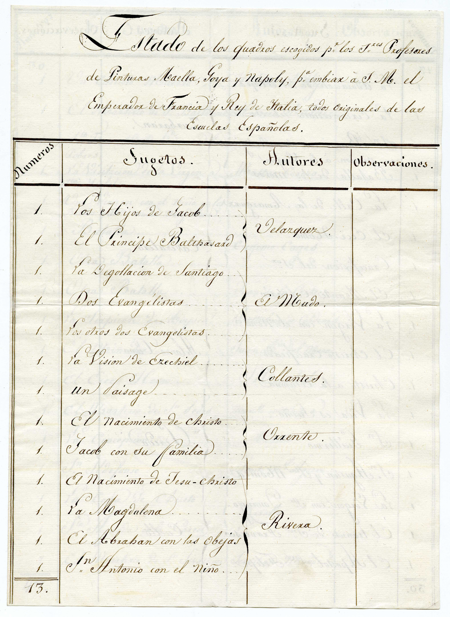
On 26th September 1810, the new King issued a Royal Order for a series of works from the royal collections to be sent to Napoleon as a gift, although he did not specify which ones. Maella, Goya and Nápoli, an Italian painter hired for various restoration tasks, were appointed as experts to choose the paintings, but none of them showed the slightest enthusiasm for the task.
They were eventually replaced by a larger committee, which also included the Valencian painter, and the paintings were delivered in May 1813, almost at the time of the usurper's departure from Madrid.
Upon the return of Ferdinand VII in May 1814, Maella continued in his post for several months and his name was even put forward for the post of director of painting of the proposed National Museum to be set up in the Buenavista palace, with Pablo Recio as museum director. However, in 1815, he was accused of collaborating with the invading government and dismissed from his post, although he was given an annual pension of 12,000 reales. Moreover, the King vetoed his appointment in 1817 as director general of the Academy, instead appointing Vicente López. With the passage of time, the Valencian artist, who had been a widower since the death of his wife in 1812, retired in the greatest solitude to his home in Plaza del Conde de Miranda, where he died in May 1819.