The Royal Collections Gallery uses its own and third-party cookies, mainly
for technical purposes, which are necessary to provide our services and provide you with
relevant content. More information in our cookies policy.
Cookies Policy.
ACCEPT to confirm that you have read the information and accepted their installation. You can change your browser settings.
We use own and third party cookies to improve your browsing experience. More information in Cookies policy.
About cookies on this website
close
About cookies on this website
Technical
Technical cookies are those essential and strictly necessary for the proper functioning of the Website and the use of the different options and services it offers, including those that the editor uses to enable the operational management of the website and enable its functions and services. For example, those used for session maintenance, response time management, performance or validation of options, use of security elements, sharing content with social networks, etc. The website cannot function properly without these cookies.
Social networks
Social network cookies
Marketing
Descripcion
Técnica
Las cookies técnicas son aquellas imprescindibles y estrictamente necesarias para el correcto funcionamiento del Sitio Web y la utilización de las diferentes opciones y servicios que ofrece, incluyendo aquellas que el editor utiliza para permitir la gestión operativa de la página web y habilitar sus funciones y servicios. Por ejemplo, las que sirven para el mantenimiento de la sesión, la gestión del tiempo de respuesta, rendimiento o validación de opciones, utilizar elementos de seguridad, compartir contenido con redes sociales, etc. La página web no puede funcionar adecuadamente sin estas cookies.
Luisa Ignacia Roldán, also called La Roldana, was the daughter of the sculptor Pedro Roldán. She was probably born in August 1652, as her baptismal certificate is dated 8th September of the same year. She was the fourth of nine children born to Pedro Roldán and Teresa de Jesús de Mena y Ortega, who went on to form a large family of sculptors.
Very little is known of her early childhood and youth owing to the lack of surviving documentation. In any case, she was probably trained at her father’s workshop, one of the most important in Seville and which received a large number of commissions. History has traditionally claimed that father and daughter worked together on the sculpture of Saint Ferdinand in Seville Cathedral in 1671, part of the sculptures commissioned to decorate the celebrations organised by the cathedral chapter of the occasion of the saint’s canonisation, however there is no documentary evidence to confirm this.
The large number of commissions he received meant that in addition to his own children, Pedro Roldán had to rely on other apprentices or disciples to finish them. One of these apprentices was Luis Antonio de los Arcos, born in 1652, Luisa's future husband, and who had trained in the workshops of the sculptor Andrés Cansino.
In 1671, aged nineteen, Luisa married Luis Antonio, but for reasons that were never made clear, Pedro Roldán was opposed to the marriage. On 17th December 1671, Luisa Roldán was taken from her parental home by court order and remained in the custody of the master gilder Lorenzo de Ávila until the wedding, which took place on 25th December of the same year in the parish church of San Martín. The marriage record is the only existing legal document signed by Luisa Roldán during her time in Seville. From this moment onwards, Luisa presumably left her father's workshop and together with her husband, began to work independently, although he signed the contracts for the works. By law and with some exceptions, married women could not enter into contracts by themselves.
Once married, the young couple moved to the Navarro de los Arcos family home, in the district of San Vicente, where their first four children were born, baptised and buried, one after the other.
In 1680, the couple moved to the Sagrario district, where they lived in a house in Calle Génova until 1683. In 1681, their second son, Francisco José Ignacio, was born in this new home. In 1684, the couple moved to the district of San Martín, where they appear to have built a house. That same year, their sixth daughter, Rosa María Josefa, was born.
From the professional perspective, the young husband-and-wife team began to take on independent commissions, seeking to gradually make a name for themselves among Andalusian sculptors by signing contracts and executing works in Seville and other Andalusian provinces for churches, convents and brotherhoods. An overwhelming number of sculptures are attributed to La Roldana during this period. These claims however must be approached with caution, as they are based solely on stylistic parameters without any documentary proof.
Therefore, much of her work during this period must be studied in relation to and under the shadow of Luis Antonio's activity.
Precisely during the 1970s and 1980s, and in the company of the master assembler Cristóbal de Guadix, Luis Antonio latter undertook a series of large-scale works for the Brotherhood of the Exaltation of Christ which he undoubtedly executed together with his wife.
To be more precise, it has been pointed out that the Passion angels in this group of works were undoubtedly carved exclusively by Luisa Roldán.
In 1683, Luis Antonio was tasked with creating a series of four cedarwood figures of Saint Joseph with Child, Saint Louis, Saint Francis and Saint Nicholas of Tolentino for the church of San Miguel, which have not made it to the present day.
From the 1980s onwards, they began to receive commissions from Cádiz and other neighbouring areas, which consolidated their reputation. Our first documented work by Luisa dates from 1684. It is the Ecce Homo of the Cathedral of Cádiz, which was carved in Seville by halves with her husband, as demonstrated by the document found inside during the restoration works on the carving in 1984. Given its similarities to this piece, the bust of the Ecce Homo kept in the church of San Francisco in Cordoba and which retains its original polychromy, is also attributed to her, making it an exceptionally important piece. Documents show that the couple were already living in Cádiz as early as 1684. The success of their first works led the city’s cathedral chapter to call on her in 1687 to commission several figures for the new monument for Holy Week. Immediately afterwards the city council asked La Roldana to carve the figures of the city’s patron saints, Saints Servandus and Germanus. The following year, they worked on the carving of Our Lady of Solitude, donated by the artists to the convent of Puerto Real.
This fruitful period covering Seville and Cádiz witnessed many other works held in various churches in Cádiz, including the images of Saint Joseph and Child and Saint John the Baptist in the Church of San Antonio de Padua; the Saint Anthony of Padua in the Church of Santa Cruz, and the Holy Family in the Convent of Las Descalzas de la Piedad. Certain other works have also been recently attributed to her.
With this background and after their success in Cadiz, the couple left Andalusia in 1689 and settled permanently at Court. The first documentary evidence of their life in Madrid is dated 28th February 1689, when a daughter named María Bernarda was baptised. As for her professional activity, the first known work from the Madrid period is The Rest on the Flight into Egypt, from the collection of the Count of San Pedro de Ruiseña dated 1691. While researchers have been unable to distinguish a clear reason for this move, according to Palomino, it may have been due to the patronage of Cristóbal de Ontañón, the valet de chambre of Charles II, who may have acted as a court sponsor. This offered the couple possibilities for economic and social advancement of a kind that could only be achieved by an artist at Court. While La Roldana would create some of her most important wood carvings during this late period of her life and career, what brought her the greatest fame and prestige were her small group figurines in polychromed terracotta. She produced a large number of these, thus taking advantage of the high demand for these small sculptures intended for households.
The following year, she achieved what no other woman has achieved in the history of Spanish art: her appointment as chamber sculptor, first to Charles II and after his death and the subsequent ascension of the Bourbons to the throne of Spain, to the new king, Philip V. Despite the professional recognition garnered by the title, it is almost certain that the appointment was “ad honorem” and she was not assigned the duties or benefits corresponding to said position. This would explain her continuous and forlorn pleas for monetary aid to the Crown which have been recorded in the documentation, as well as Luis Antonio's requests to occupy any position at the palace. Finally in 1695, she appears to been granted the position with its corresponding salary, however, payment was often delayed, which meant that the couple regularly found themselves in straitened circumstances.
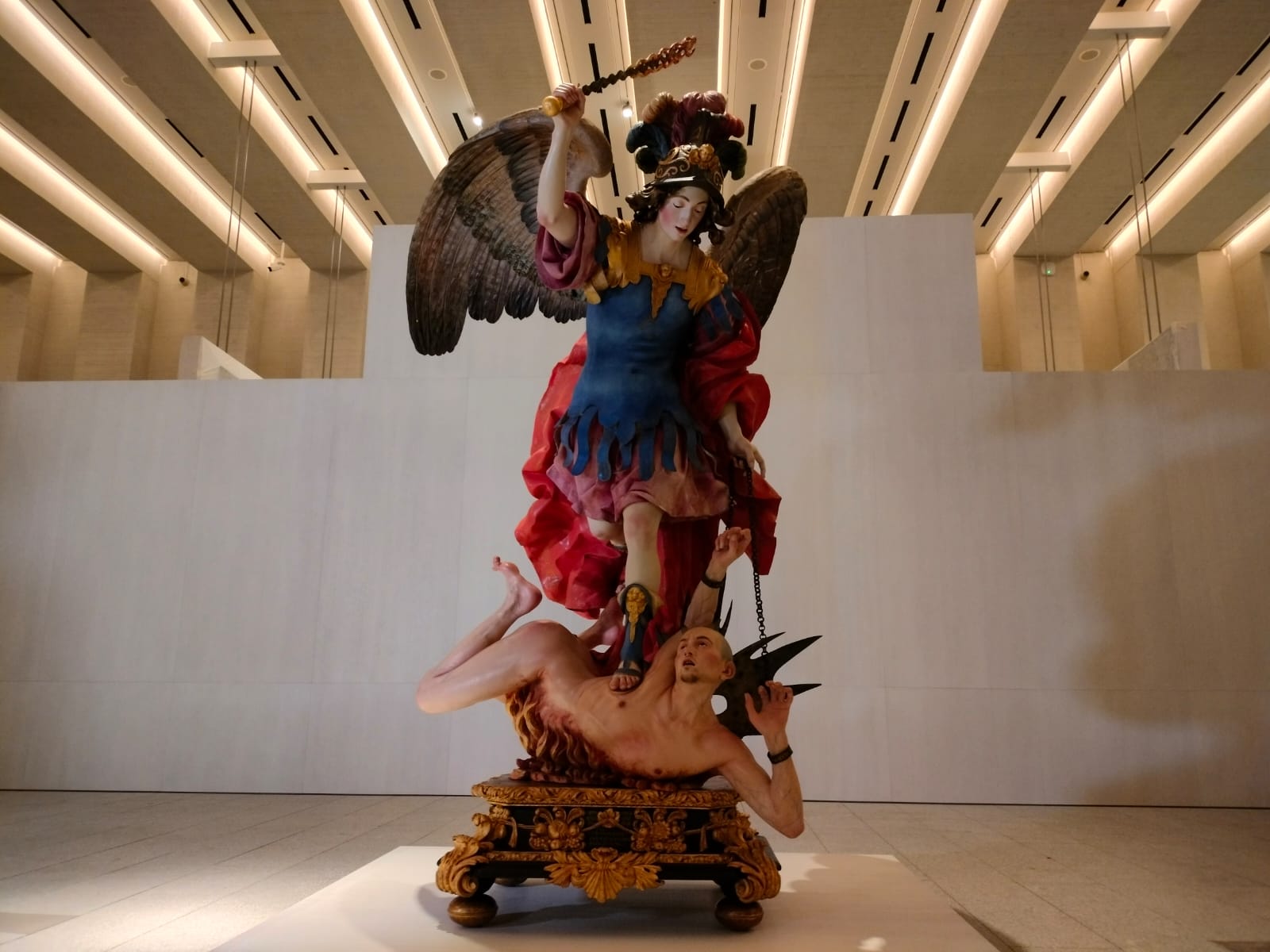
In 1692, when she first received her appointment, she proudly signed two of her most important wood works as a Chamber sculptor: the imposing Saint Michael, executed by order of Charles II himself for the Royal Monastery of El Escorial, and the sculpture of Saint Ginés de la Jara; as well as the terracotta group of The Virgin and Child with Saint John the Baptist.
Other life-size wooden works from this period include The Nazarene from the Convent of the Sisters of Nazareth in Sisante and Saint Joseph with Child from the Convent of Belén de Carmelitas Descalzas in Antequera. They are accompanied by the contentious smaller sculptures of Jesus of Nazareth or the Child Christ With Cross from the Royal Congregation of San Fermín de los Navarros in Madrid. She also produced numerous terracotta sculptures during this period.
Documents from the National Historical Archive record payments for a series of works in connection with the house of the Duke of El Infantado, although none of the works have been located or identified to date.
On 10th January 1706, she achieved an even higher international recognition, one rarely granted to a Spanish artist let alone a female artist, when the Accademia di San Luca in Rome named her an Academician of Merit, on the same day of her death in Madrid. A few days earlier, ill and approaching death, she had appealed to people’s charity for her funeral costs, declaring herself to be in the most profound penury and without any property or goods whatsoever to leave behind in a will. Luisa was survived by her children Francisco and María, both of whom were married in 1708, and by her husband who died in 1711.
Regarding her artistic style, while there is a discernible evolution throughout her career and distinguishing between the two materials in which she excelled, there exists nonetheless a definite continuation of her formal relationship with her father’s style, which may be noted above all in the works she produced in Andalusia.
She learnt the art of carving from him, assimilating his compositional models. Certain formal characteristics of the father's usual style would thus inevitably have been passed on to his daughter, who would not only have been a witness to his work from an early age, but also worked alongside him, thus fully imbibing them. This is evident in the characteristic oval faces, the size and the voluminous hair, the poses of the figures, the slanted eyes, etc. To this we may add what she learnt from other sculptors such as the powerful and monumental modelling technique of the Flemish sculptor Josephe Aerts or José de Arce, as he was called in Spain, which would evolve into the more delicate forms of her Madrid period but without losing its power of expression.
An overwhelming dramatic realism rooted in Pedro Roldan’s style can also be seen in her works from the Seville-Cádiz period, which later acquired softer notes, especially in Madrid, and in her terracotta works. In the same way, Luisa evolved from a certain static portrayal in keeping with her father’s style, to a more marked dynamism in her compositions, culminating in the daring whirlwind of movement in the colossal Saint Michael for the Monastery of El Escorial. Given their subject matter and more quotidian use, in her terracotta figures, the artist depicts profoundly humanised figures where feminine, maternal and childlike aspects are highlighted by means of pleasant forms and complacent expressions, in line with Murillo’s works, as well as soft features and soft fleshy modelling.
Source: Royal Academy of History (https://www.rah.es)