Loading...

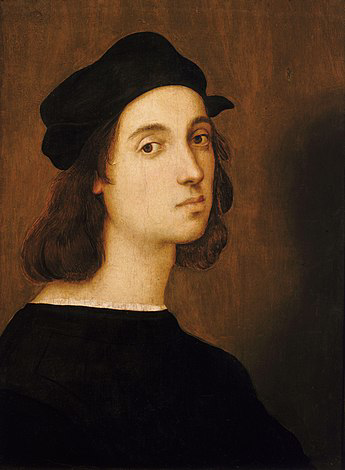
Sanzio da Urbino, Raffaello
(Urbino, 1483 - Rome, 1520)
Raffaello Sanzio (Urbino, 6th April 1483 - Rome, 6th April 1520), was also known as Raphael of Urbino or simply Raphael. He was an Italian painter and architect of the Renaissance. In addition to his paintings which would be admired and imitated for centuries, he made important contributions to architecture and as an inspector of antiquities, was interested in the study and conservation of Greco-Roman remains.
The son of a modestly important painter, he was considered a child prodigy due to his precocious ability and after his father died, he trained in the workshops of several prestigious artists. At the age of 25 he received his first official commission, the decoration of the Vatican "Stanze” or rooms, where he painted frescoes such as The School of Athens, considered one of his greatest works. He is famous for the perfection and grace of his visual arts, excelling in painting and artistic drawing. Together with Michelangelo and Leonardo da Vinci, he forms the trinity of the great masters of the period.
He was born on Good Friday and died on Good Friday on his 37th birthday. He was a highly prolific artist, partly because he ran a workshop with numerous collaborators, and despite his premature death he left an extensive body of work, much of which is still extant. Most of his work is housed in the Vatican Museums, as he painted frescoes in the rooms known as the Raphael Rooms, the most important commission of his career which was left unfinished due to his death and eventually completed by his assistants.
Most of his work dating after his youthful years in Rome, though designed by him, was executed by his workshop, with a considerable loss of quality. He was highly influential in his own time, although outside Rome his work was known mainly through the output of the engraving workshops that collaborated with him. After his death, the influence of his chief rival, Michelangelo, grew until the 18th and 19th centuries when Raphael's more serene and harmonious qualities were once again regarded as superior.
His career is naturally divided into three stages and three styles, as described by Giorgio Vasari: his early years in Umbria, followed by the four-year period in Florence (1504-1508) where he absorbed the artistic traditions of the city, and finally his last and triumphant period of twelve years in Rome where he worked for the popes and their court.
Source: Wikipedia
View on Wikipedia
View in timeline