Loading...


Soria, Narciso Práxedes
(Madrid, 1786 - Madrid, 1854)
Soria, Narciso Práxedes. Madrid, 1786 – 13.11.1854. Goldsmith and diamond cutter.
He belonged to a large family of silversmiths. His father, Narciso Severo Soria, was master to numerous apprentices and one of the wealthiest smiths at the Court. His brothers Fernando and Manuel, and his nephew Victor, also worked as goldsmiths. Three of his sons, Ildefonso, Juan and Antonio, would followed in his footsteps.
He began his training under his father, who applied for his apprenticeship certificate on 30th August 1803. He appeared for his first apprentices' examination on 2nd December 1805, without obtaining any awards. On 28th July 1807, he was granted the title of manciple at his father's request. In the list of officials published by the College of San Eloy on 1st January 1808, he is listed as unmarried and residing at Calle de las Carretas, 21. On 26th April 1813 he took his master's examination, drawing a shuttle ring and executing the medallion marked as No. 14 in the guild's Book of Drawings. On 31st May, he was approved, sworn in, and joined the College.
He also married the daughter of the goldsmith Juan Vilar.
On 9th June 1815, he was appointed gold and silversmith and diamond cutter of the Royal Chamber, replacing his father-in-law who had recently passed away. However, he would not enjoy all the privileges inherent to the position until 1823, when the silversmith Pedro Sánchez Pescador passed away. He was also appointed Head of the Royal Office of Custodians of the Queen’s Jewels, by Fernando VII on 13th November of the same year. Moreover, he held positions in several important bodies. In June 1819, he was elected steward and on 22nd November that year, the director of apprentices' examinations. Likewise, on 9th June 1822, he was appointed approver of the Gold Faculty and in 1829, the treasurer of the College - Congregation.
In 1828, there was a confrontation between Soria and the silversmith Manuel José de Urquiza regarding the execution of the monstrance of the Monastery of El Escorial.
On 3rd July 1840, an Extraordinary Meeting of the College Council was held to deal with the Town Council’s public announcement of the demolition of the church of San Salvador, in which the Corporation had held important assets. On 5th April 1842, he was chosen to form part of the commission drafting the new regulations of the Artists’ Society that was to become the College-Congregation of Saint Eligius by virtue of the Decree of 9th March 1842.
In October 1844, he travelled abroad to learn about new techniques and designs. That year he was granted an annual salary of 10,000 reales and his son Ildefonso was appointed assistant to the Office of Custodians of the Queen’s Jewels.
From the very beginning of his career, he had maintained a shop in Calle de las Platerías (now Calle Mayor), at number 81, and his financial situation flourished, as proved by his contributions to the guild and gifts to the College on the occasion of the apprentices’ competitions.
Although he served Ferdinand VII, most of the jewels he crafted were for the king’s daughters. On 8th March 1843, he was commissioned to execute two diamond and Brazilian topaz sets for the Queen and the Infanta Luisa Fernanda. The sets consisted of a necklace, a pair of earrings and a brooch.
On 16th April of the same year, he created a magnificent bandeau of 348 diamonds and six pearls, and two bracelets with eight strings of pearls each. The jewels were intended for the Queen as a representation of the brilliance and splendour of her royal person at the opening of Parliament.
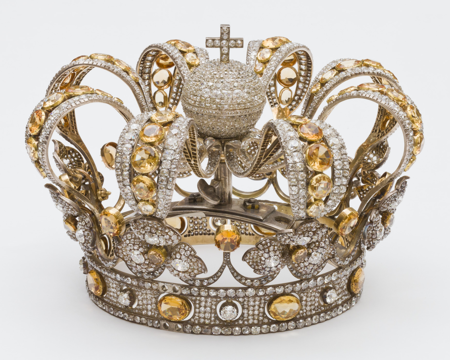
In 1852, he received what would be the most important commission of his career: a crown, headdress and halo for the sculpture of the Virgin of Atocha, and the crown of the Child Jesus, one of the few sets of courtly jewels that have survived to this day and which are currently housed at the Royal Palace in Madrid. They were commissioned by Queen Isabella II as an offering to the Virgin for having escaped the attack by the priest Merino unscathed. He had attempted to stab the Queen in the Palace gallery on 2nd February 1852 when she was heading to the Basilica of the Virgin of Atocha to give thanks for the birth of her daughter, the Infanta Isabella. As a sign of her gratitude, the Queen donated all the jewellery she had been wearing that day. They included a tiara, necklace, bracelets and rings, adorned with diamonds and topazes. Other additions to the Virgin’s set were completed by popular subscription. It consists of a beautiful combination of diamonds and topazes in open and closed settings, on gilded silver base. The crowns of the Virgin and the Child Jesus have a very popular design: a ring with three bands of gemstones, the central one being the widest, and on it, a clover leaf crest with floral motifs. Eight arches rise up from the ring; with a similar design but with two bands of diamonds enclosing one of topazes. They come together in the centre and are topped by a ball and cross. The headdress has a floral design with interlaced openwork rims and a crest at the top. The halo has a floral arch studded with diamonds and nineteen oval topazes. Golden rays emanate from it, adorned at intervals by bands of diamonds. According to F. Martin, the Virgin’s crown and headdress bear an inscription on the back alluding to the donation and the jeweller who made them.
The set was finished with a bouquet of silver-mounted diamonds and a seviné with green enamel and studded with gold-mounted diamonds. Both pieces have vanished. Soria also made a Collar of the Order of the Golden Fleece and a Collar of the Order of Charles III, which are also used to adorn the Virgin on important occasions.
He was aided by his disciple Manuel de Diego Elvira, who had probably worked on this jewellery set with him.
In addition to these jewels, the General Palace Archive holds documents that record a large number of pieces whose whereabouts are unknown, such as a large brilliant-cut diamond valued at 16,000 reales which he delivered, as diamond-cutter, for the dowry of the Infanta Luisa Teresa, Duchess of Sessa, and a bandeau and earrings for the Queen, set with diamonds.
The Duke of Osuna commissioned him to make a set of diamonds and sapphires in an open setting for his daughter Josefa Girón y Pimentel on the occasion of her wedding, valued at 475,715 reales.
His designs were exceedingly beautiful and his work was highly appreciated for its high technical value. One last piece worth mentioning here is the brilliant-cut diamond pin and solitaire ring commissioned by Queen Isabella II to be awarded to the Chamber Painter, Vicente López, in recognition of his success as a reward for the successful portrait that had just been sent to Paris for the queen Maria Christina of the Two Sicilies, mother of Isabella II.
He also worked as a silversmith in his workshop, creating objects such as the toothpick holder in the shape of the Fountain of Cibele.
He was responsible for so many creations for the Palace that upon his death, when his family carried out an inventory of his goods, they found a credit note from the Royal Household for commissions carried out for their Majesties amounting to 1,204,733 reales.
He died on 13th November 1854, having requested permission on several occasions to take the waters at Sacedón (Guadalajara).
Source: Royal Academy of History