Loading...


Van der Goten, Cornelius
(1714 - 1786)
Van der Goten Canyuwell, Cornelius. Brussels (Belgium), 1714 – Madrid, 1786. Master tapestry weaver, draughtsman and director of the Royal Tapestry Workshop of Santa Barbara.
He was the sixth youngest child born to the master tapestry maker Jacob van der Goten the Elder and his wife Anna Maria Canyuwell. He was six years old when his father, a notable Brussels tapestry maker, accepted Philip V's invitation to work in the tapestry workshop he was planning to set up in Madrid to decorate the Royal Sites. Jacob van der Goten was accused of treason by the Austrians, who ruled the Spanish Netherlands back then, and he was imprisoned for nine months in Antwerp Castle, from which he fled in poor health and with his pocketbook in tatters. The van der Goten family and a few of their journeymen embarked on a perilous journey to Madrid, where they arrived on 20th July 1720. The royal workshops required large spaces and were set up outside the capital city's walls and Philip V ordered three hectares of land to be rented for his Tapestry Workshop outside the gate of Santa Bárbara, on the site of the former Casa del Abreviador or House of the Breviator, which would also house the Flemish weavers and their families.
The tapestry makers initially suffered considerable economic hardship as the Spanish Crown had other priorities to attend to and royal commissions were scarce. The Flemish resorted to buying and selling paintings and silver objects and even planted a vegetable garden to survive, since their only income was the 60 reales a day that the King had granted to the master Jacob van der Goten, who was in charge of the technical aspects of the manufacturing, supervised by a Royal Intendant, Bernardo Cambí, and an Art Director, Andrea Procaccini.
On his death in 1724, Jacob the Elder was succeeded by his eldest son, Franciscus, as the workshop master. The King ordered the other brothers, Peter, Jacob, Adriaan and Cornelius, to devote themselves fully to the art of tapestry weaving. The Workshop weavers were appointed masters, journeymen and apprentices in a hierarchy similar to guilds. At the age of ten, Cornelius van der Goten worked as an apprentice in the Tapestry Workshop, which was maintained by money advanced by the Royal Intendant himself. In the shadow of his older brothers with whom he shared the family home, Cornelius witnessed their struggle to maintain the workshop where orders were scarce. He also witnessed the arrival of Antonio Laigner, weaver of the Gobelins Manufactory, who proved to be a dangerous rival, and the Court's transfer to Seville, where a new Tapestry Workshop was opened, with Laigner and Jacob the Younger as master tapestry makers. Meanwhile, at the Santa Bárbara Workshop, masters, journeymen and apprentices refused to work until the Crown paid their overdue wages.
In 1733, the Royal Treasury, enriched by the arrival of several fleets from America, permitted the payments of arrears to the Workshop of Santa Bárbara. The Court returned to Madrid and Jacob van der Goten the Younger took charge of the workshops in the Calle de Santa Isabel street, which continued the work of copying the tapestries depicting the conquest of Tunisia which had been started in Seville. Franciscus was commissioned to make five tapestries from this series at the Royal Workshop of Santa Bárbara in order to provide work for his looms. Although Spanish knot carpets had been made in the workshop from the beginning, to revive its fortunes, the failing enterprise attempted to produce Turkish knot carpets. Cornelius proved to be so skilful in this venture that he was appointed to the rank of master, with a salary of 15 reales, double that which he had received as a journeyman. Their first important commission was a 25-metre long carpet for the pledge of allegiance ceremony in the Palace hall, based on a drawing commissioned from Domenico María Sani and completed by Peralta.
In 1744, the Royal Workshop signed a contract with the Royal Household, marking a milestone in the history of the establishments. It brought about a marked improvement in the finances of the Van der Goten family who were granted a salary for life, exemption from certain taxes, and advance payment for the Royal Household's important commissions. A few months later, Martínez Tineo died and the post of the Royal Intendant of the Royal Tapestry Workshop was cancelled. This was followed by the death of Peter van der Goten, and the four surviving brothers, Franciscus, Adriaan, Jacob and Cornelius worked in such perfect harmony that they signed all kinds of documents as masters. In 1750, the Van der Gotens signed another important contract with the Royal Household to repair and restore all the tapestries and carpets of the Royal Sites, kickstarting their economic prosperity. They also insisted on producing their own dyes, a long-standing aspiration of the family. The dye factory was established in the Royal Workshop in 1760 and was operational until the sixties of the last century. After the death of his brothers, Cornelius was left in charge of the workshop, and the Council of the Five Major Guilds requested him to draw up a report on creating dyes for silks, so they might be recommended all over the country.
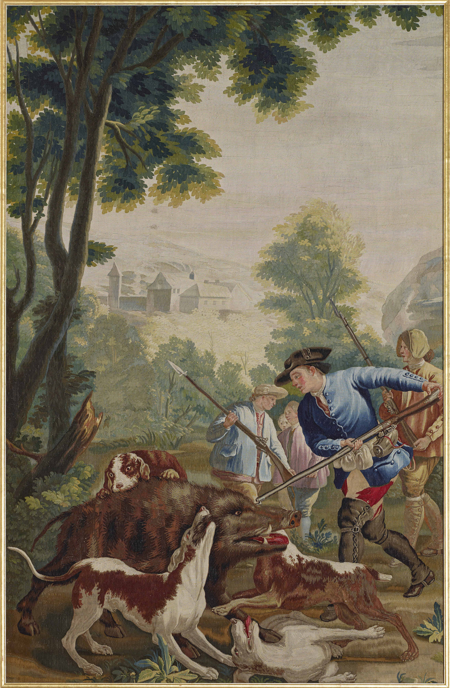
In 1775, a few years after the death of Franciscus van der Goten, a young man named Franciso de Goya arrived at the Royal Workshop with the recommendation of his brother-in-law Francisco Bayeu, who had recently come from Italy. Together with Francisco and Ramón Bayeu, Mariano Salvador Maella and José del Castillo, he was to bring about a new trend in tapestry weaving. Weavers would have found it difficult to produce tapestries based on Goya's energetic and often only vague sketches, which replaced classical themes with scenes from daily life, dotted with popular characters: majas, chisperos, jumping children or blind men praying. Although it was a highly fruitful period, it also had its moments of crisis, and in 1780, all royal commissions were temporarily suspended. Goya, now a popular painter, found himself increasingly uncomfortable at the Royal Workshop.
After the death of Franciscus van der Goten in 1744 and on the sovereign's advice, Cornelius had signed a contract to replace him as head of the Workshop with four of his former journeymen. In 1780, Cornelius van der Goten summoned Livinio Stuyck, his great-nephew, to Madrid, so he could train him in the art of tapestry and drawing. However, Livinio convinced him that the management of the workshop should remain in the hands of his own blood. This led to a succession crisis which was only resolved after the death of Cornelius on 26th March 1786. Like his brothers, he was buried in the Church of the Hospital de San Andrés de los Flamencos, of which he was also a member. The Van der Gotens had always lived together in the family home, under the authority of their energetic mother, except for Cornelius who married a Spanish woman named Antonia González, however the couple had no children.
Source: Royal Academy of History