Use of Cookies

The Royal Collections Gallery uses its own and third-party cookies, mainly for technical purposes, which are necessary to provide our services and provide you with relevant content. More information in our cookies policy. Cookies Policy.

ACCEPT to confirm that you have read the information and accepted their installation. You can change your browser settings.

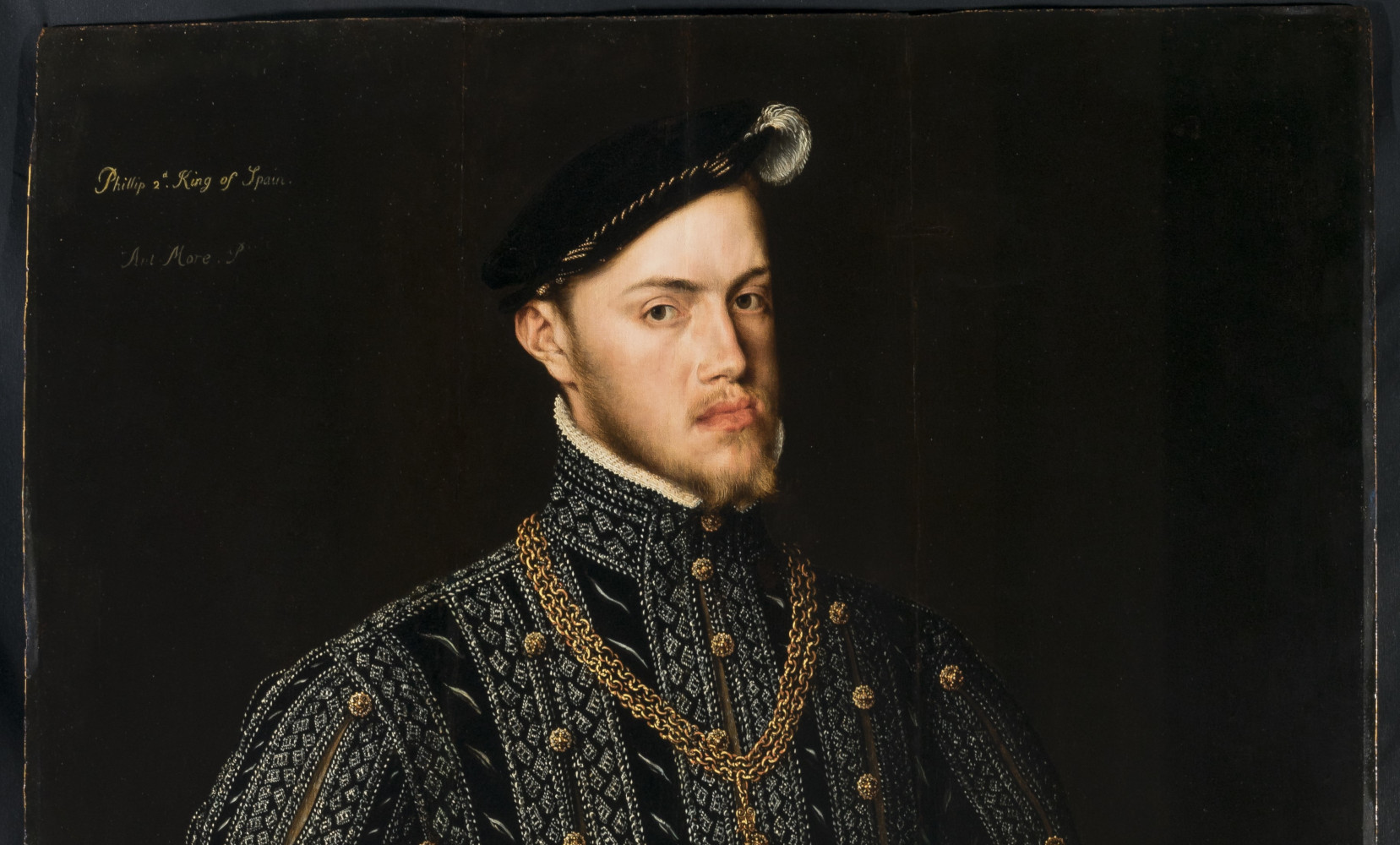
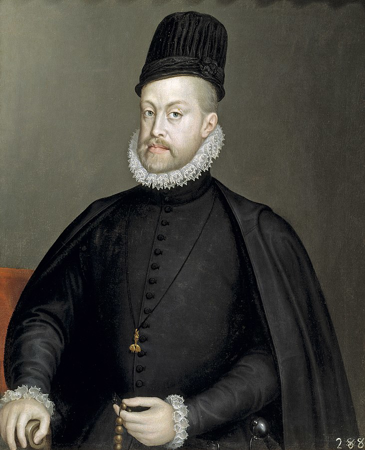
The portrait of Philip II by Anthonis Mor, which has been held by the Bilbao Fine Arts Museum since 1992, is one of the best portraits of young Philip as a prince of the Spanish monarchy. Mor painted it during the prince's stay in Brussels between April 1549 and May 1550, when he was on his "Happiest of Journeys" to Europe, as Juan Cristóbal Calvete de Estrella called it in his famous chronicle published in Antwerp in 1552. On this trip, his father Charles V presented him as the heir to the House of Habsburg to the States General of Flanders. Both father and son had the opportunity to make a triumphant entry into Brussels and Antwerp in the spring of 1549, ending the tour in Augsburg in 1551 where the Imperial Diet was to be held.

This journey was crucial to the artistic training of the future Philip II and thanks to his aunt Mary of Hungary, governor of the Low Countries, he was able to experience first-hand the works of important artists such as Leone Leoni, Anthonis Mor, Titian and Michiel Coxcie, which were displayed in the palaces in Coudenberg, Binche and Turnhout. This artistic exposure led him to become one of the greatest patrons of his time, a universal collector of all kinds of objects, with the Royal Monastery of San Lorenzo de El Escorial as the ideal place in which to exhibit them.

Mor, with his customary technical virtuosity, depicts a young Philip in a majestic pose that embodies royal majesty in itself. This attitude is boosted by the luxurious court dress: a rich black doublet, embroidered in silver and studded with gold buttons, slashed sleeves of yellow silk that match his breeches and codpiece, not to forget the rich hilt of his sword. The insignia of the Golden Fleece, the order par excellence of the Spanish monarchy, hangs on a gold collar on his chest. It is therefore the image that best embodies the perfect Renaissance prince, not unlike the contemporary full-length version by Titian in 1551, now in the Prado National Museum, but which failed to receive the same acclaim as Mor’s versions. The Dutchman's style of painting, with his precise draughtsmanship and marked attention to detail, set the rules for Spanish portraiture from the 1960s onwards. 

There is no mention of Mor’s portrait in any Spanish royal inventory, which may indicate that it was not directly commissioned by Philip or another member of the royal family. Its existence can only be documented from 1746 onwards, when the portrait is mentioned in the collection of the Counts of Spencer, where it remained until its acquisition by the Bilbao Fine Arts Museum in 1992. Hence the English inscription on the upper left background of the portrait - "Philip 2nd King of Spain // Ant. More Pt.".

Biography

Anthonis Mor (Anthonis Mor van Dashorst) (Utrecht c. 1516/1519-Antwerp 1576).  

A student of the Romanist painter Jan van Scorel, Mor imbibed the details of portrait painting from him. Although his stay in Italy is not documented, he was well acquainted with the portraits of the Italians Bronzino and Gian Battista Moroni.  In 1547 he became a master of the painters' guild of Saint Luke in Antwerp. Prior to March 1549, he became acquainted with the Spanish court in Brussels through Antoine Perrenot, later Cardinal Granvelle, who became his first patron.   It was in this environment that he came into contact with the portraits of Titian, commissioned by Mary of Hungary, the governor of the Low Countries and sister of Charles V, and by Granvelle, which were essential to his training.  In the summer of 1549 he painted the young Prince Philip (II) during his "Happiest of Journeys", as well as the future Cardinal and the Duke of Alba.

Granvelle helped him to enter the service of Mary of Hungary at the imperial court in Brussels, who then sent him to the Iberian Peninsula to paint numerous members of the Habsburg family between 1550 and 1553.  The first stage of this journey took place in Castile, where he painted portraits of Maximilian II and Maria of Austria, governors of Spain in the absence of Prince Philip, their daughter Anne of Austria at a very young age, Prince Charles and the jester Perejón.  Between 1552 and 1553, in Portugal, he painted portraits of Queen Catherine of Austria, her husband John III, Prince John, Princess Mary of Portugal whom Philip intended to wed, and other courtiers.  In 1554, he moved to England to paint the portrait of Queen Mary I, the second wife of Philip II, who appointed him royal painter at the end of that year with an annual salary of 300 ducats.

In 1557, he painted the portrait of Philip II after the battle of Saint Quentin and many other pro-Spanish nobles, such as Emmanuel Philibert, Duke of Savoy, or Vespasiano I Gonzaga.  In the summer of 1559, Mor came to Spain with Philip II's entourage. He resided in the Alcázar of Madrid, where he set up his studio and worked mainly on expanding the portrait gallery that was to be set up in the Alcázar and in the Palace of El Pardo.  In 1560, the artist returned permanently to Flanders owing to problems with the Inquisition, leaving behind him the foundations for the Spanish school of portraiture of the second half of the 16th and early 17th centuries, where painters such as Sánchez Coello, Pantoja de la Cruz and Bartolomé González, among others, flourished.  

Title

Philip II

Type of Object

Painting

Author

Anthonis Mor (1519-1576)

Date

c. 1549-1550

Characteristics

Oil on oak panel

Dimensions

107,5 x 83,3 cm

Origin

Bilbao Fine Arts Museum, Inv. 92/253

Location

Floor -1 Hall of the Habsburgs. Theme Philip II

Other related works

Philip II at the Battle of Saint Quentin
Anthonis Mor
1560
Royal Monastery of San Lorenzo de El Escorial
10014146

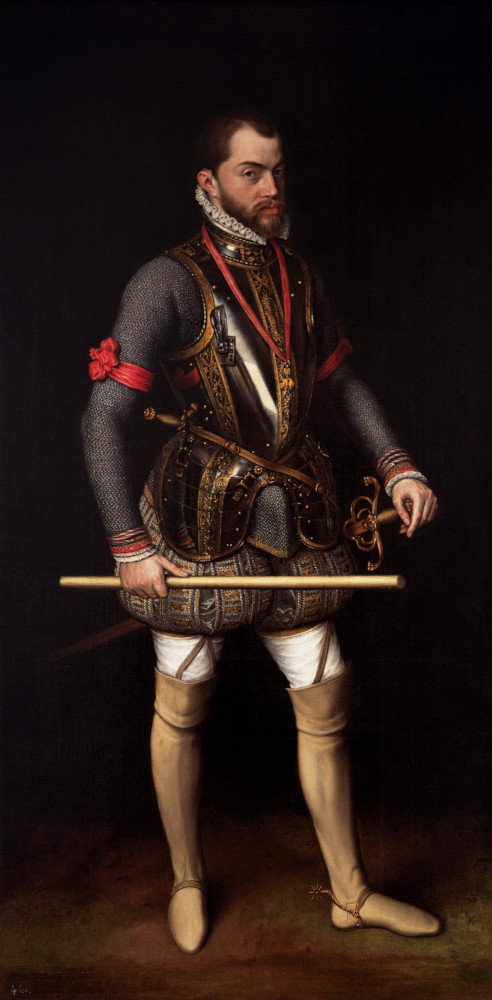
This is a full-length portrait of Philip II aged 30 and wearing his famed armour with burgundy crossesthat was forged for him by the armourer Wolfgang Grosschedel around 1551. The king took this armour with him on the Saint Quentin campaign in 1557, and it is kept today at the Royal Armoury of Madrid.

In late 1557, Mor made a first painting, now lost, in Brussels where the king headed after the victory.  This second painting was executed in 1560 during his second stay in Spain, commissioned by the king's sister, Joanna of Austria, for her gallery of family portraits at the Monastery of Las Descalzas Reales in Madrid, where it appears in the 1573 inventory of her possessions.  As heir to most of her works, Philip II decided to send it to the Royal Monastery of San Lorenzo de El Escorial in June 1575, in order to commemorate the victory that had played a decisive role in the construction of this building.  

The popularity of this portrait is revealed by its numerous copies, such as the one painted by Sánchez Coello in 1566 (Vienna), or the engravings based on it, such as the one by Francesco Terzi for the series Austriacae Gentis Imagines of 1569.

Maria of Portugal
Anthonis Mor
1552-1553
Monastery of Las Descalzas Reales in Madrid
00612063

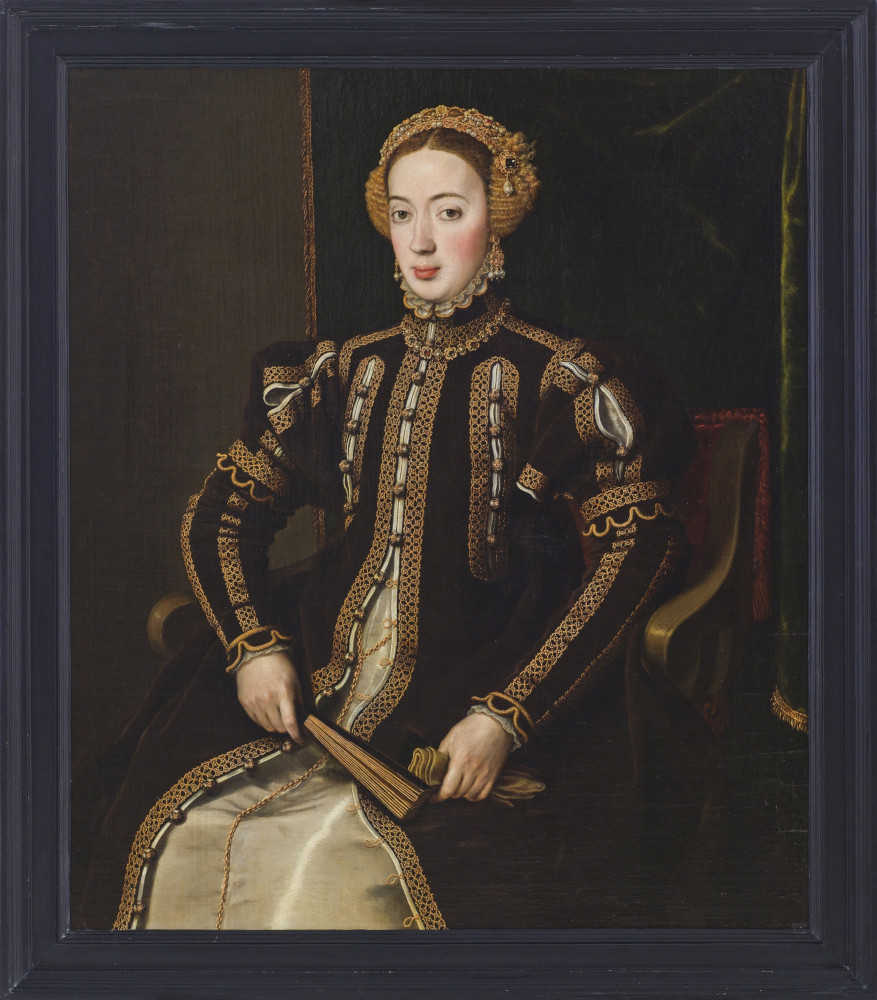
The Infanta Maria of Portugal was the daughter of Manuel I and his third wife Eleanor of Austria, who intended to marry her daughter to her godson and nephew, Prince Philip, the future Philip II, a widower since 1545 after the death of Maria Manuela of Portugal.  Eventually, in 1553, she was rejected as Philip’s bride, as his father Charles V had arranged his marriage to the Queen of England, Mary Tudor.   The Duchess of Viseu dedicated her life to the arts and books, thanks to a large fortune left to her by her mother.

This seated portrait of Maria, dressed in the Portuguese style, is linked to Mor’s commission by Mary of Hungary and her sister Eleanor of Austria, sending him to Lisbon to paint her portrait and to begin marriage negotiations with the imperial court.  If not the original portrait by Mor that was sent to the intended bridegroom, Philip, it is still a copy of great beauty and quality by the Dutch painter for Joanna of Austria, and it currently hangs next to the rest of the portraits of the Habsburg family in the Monarchs’ Hall at the Monastery of Las Descalzas Reales.

Catherine of Austria
Alonso Sánchez Coello
Copy of painting by Anthonis Mor
Between 1560 and 1570
Monastery of Las Descalzas Reales
00612061

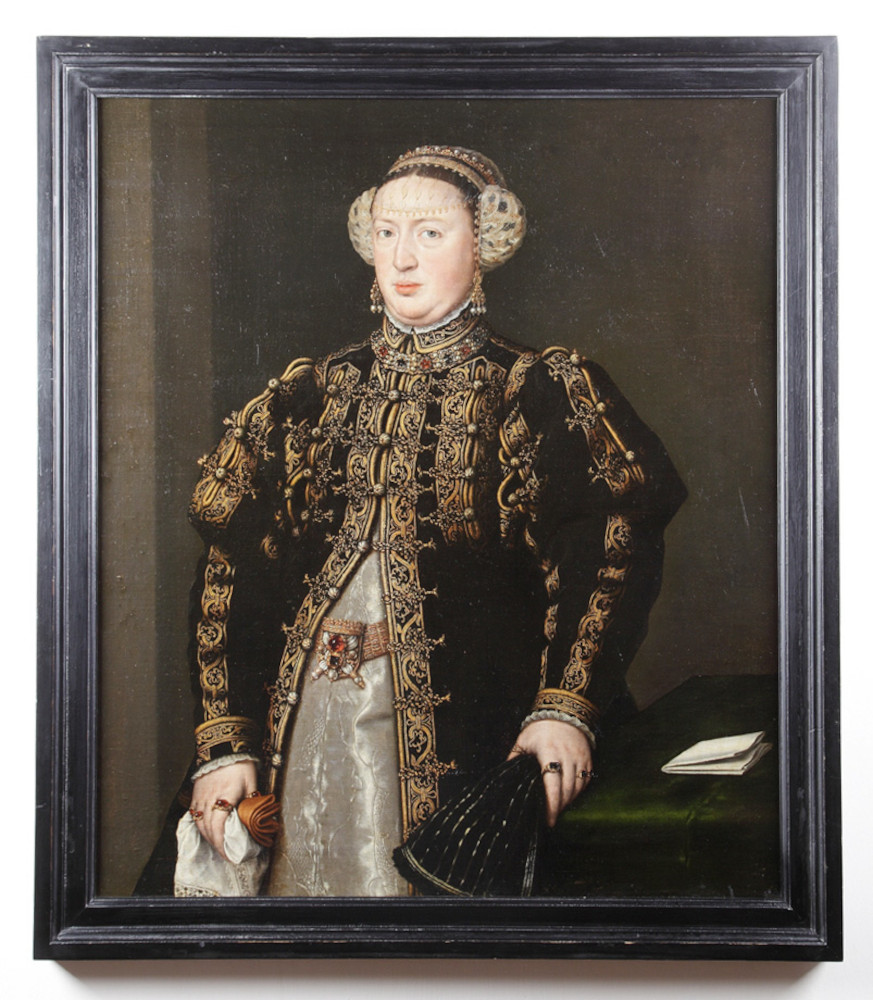
Catherine was the daughter of Philip of Austria (the Handsome) and Joanna of Castile, with whom she lived her early years in the Royal Palace of Tordesillas, receiving a humanist education.  In 1525, she married John III of Portugal, and after his death in 1557, acted as regent for her grandson Sebastian who was still underage.  As Queen of Portugal, she is dressed in the Portuguese style and wearing the rich choker of precious stones called "the necklace of roses", which belonged to her mother Joanna of Castile, and the belt with the double-headed eagle of the Habsburgs, a wedding gift from her husband John III of Portugal.  

Based on Mor’s original which was painted in Lisbon between 1552 and 1553, Sánchez Coello made this copy in the seventies for Catherine’s daughter-in-law, Joanna of Austria, who was also the founder of the Monastery of Las Descalzas Reales, where the painting hangs today.

Authors and Collectors

Philip II
Monarch

Philip II

(Valladolid, 1527 - El Escorial (Madrid), 1598)

The eldest son of Charles I of Spain and V, Holy Roman Emperor (1500-1558) and Isabella of Portugal (1503-1539), the future Philip II was educated by his tutor, Juan de Zúñiga, by Cardinal Silíceo, his teacher of elementary education and confessor, and by Juan Ginés de Sepúlveda, who provided his pupil with a humanist education. Prince Philip’s political apprenticeship commenced in 1543, when he first replaced his father, Charles I, as Governor of Spain. In 1548, the heir to the Crown set out on a long tour of northern Italy, Austria, Germany and the Netherlands, thus visiting some of the territories that he would rule over in the future.

Married four times, Philip II's wives were María Manuela de Portugal (1527-1545), whom he married on 14th November 1543, and who was the mother of Prince Carlos (1545-1568), heir to the Spanish Crown until his death; Mary Tudor (1516-1558), Queen of England whom he married on 25th July 1554; the French princess, Elisabeth of Valois (1546-1568), who was wedded to Philip II on 2nd February 1560, mother of Infanta Isabella Clara Eugenia (1566-1633), Archduchess of Austria y Sovereign of the Spanish Netherlands married to the Archduke Albert (1559-1621), and the Infanta Catherine Michaela (1567-1597), Duchess of Savoy, wife of Carlo Emanuele I of Savoy (1562-1630); and the Archduchess Anna of Austria (1549-1580), who married the King on 14th November 1570. With her, Philip II had five children: Prince Ferdinand (1571-1578), the Infante Carlos Lorenzo (1573-1575), Prince Diego (1575-1582), the future Philip III (1578-1621) who succeeded his father to the throne, and the Infanta Maria (1580-1583). After the death of Anna of Austria on 26th October 1580, the King remained a widower until his death.

Philip II became King of Spain on 16th January 1556, following the abdication of Charles I in Brussels (1555-1556). His reign coincided with the period of greatest hegemony of the Hispanic Monarchy in Europe after the French were defeated at the Battle of Saint Quentin on 10th August 1557 and the signing of the Peace of Câteau-Cambresis with France two years later. Spanish foreign policy during the reign of Philip II developed in two stages. During his first years in power, the King prioritised the defence of the Mediterranean and the conflicts with the Ottoman Empire, which was settled in favour of the Christian forces after the victory of Lepanto on 7th October 1571. From the mid-1570s, however, the international focus gradually shifted towards the Atlantic. The resurgence of the 1566 rebellion in the Habsburg Netherlands, and Philip II's difficulty in finding a political solution to it; the inclusion of Portugal and its overseas territories under the sovereignty of the Hispanic Monarchy in 1580-1581; worsening tensions with England under Elizabeth I (1533-1603), which culminated in the failed expedition known as the "Invincible Armada" in 1588, and Spanish intervention in the French Wars of Religion from 1590, were some of the events arising from the King's Atlantic policy. In May 1598, Philip II signed the Peace of Vervins with France. However, the confrontation with the British Kingdom and the rebellion of the Netherlands, whose northern regions became an independent state named the United Provinces in 1581, were still ongoing at the time of the King’s death.

With regard to Spain, Philip II's reign was characterised by institutional continuity, the defence of religious orthodoxy against heresy, political and social instability in areas such as Granada and Aragón, and increased taxation due to the monarchy's military commitments in Europe. In this regard, it is worth highlighting the King’s energetic response to the discovery of Lutheran centres in Valladolid and Seville; the implementation of the dictates of the Council of Trent (1545-1563); subduing the Moorish revolt of Granada, which lasted from 1568 until the end of 1570; and the King's response to the riots in Aragón in 1591. In terms of state administration, Philip II established Madrid as the capital of the Hispanic Monarchy (February 1561); he brought the Councils of Italy (1558), Portugal (1582), Flanders and the Chamber of Castile (1588) into the so-called polisynodial system; he promoted the creation of Collegiate Boards to rationalise and streamline the handling of government affairs; and encouraged the political projection of the Royal Secretaries (of whom the most famous was Antonio Pérez) as channels of communication between the Monarch and the different institutions. The King also ordered improvements to be made in both the Spanish Navy and in the organisation and armaments of the Tercio mixed infantry units.

Finally, Philip II's rule overseas was marked by the consolidation of Spanish rule in the Americas; expansion into the Atlantic and the Pacific; the conquest of the Philippines; and the creation of the "Fleet of the Indies" to protect commercial traffic and neutralise privateer attacks encouraged by enemies of the Hispanic Monarchy such as England, France and the United Provinces.

Certain events that took place during his reign (such as the rebellion in the Netherlands), his methods of ruling, aspects of his personality, and events in his private life (for example, the imprisonment and death of his son, Prince Carlos, or the death of his third wife, Elisabeth of Valois, in 1568) were seized upon by anti-Spanish propaganda in the so-called "Black Legend".

Philip II died in the Monastery of El Escorial on 13th September 1598, at the age of seventy-one. His remains are buried in the Monastery's Pantheon of Kings and Queens, erected at the behest of the Monarch to mark the victory of Saint Quentin.

Source: Royal Academy of History (https://www.rah.es)

Read more