Loading...

Otras casas dinásticas
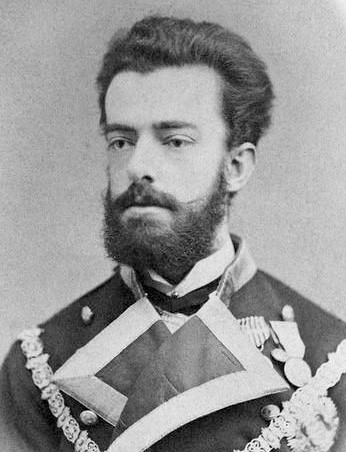
Amadeo I of Spain
Turín (Italia), 30 de May de 1845 - Turín (Italia), 18 de January de 1890
View in TimelineBiography
The son of Victor Emmanuel II (1820-1878), the first King of Italy, and Archduchess Adelaide of Austria (1822-1855), Amadeo of Savoy received a military education. After distinguishing himself in the battle of Custoza against Austria (24 June 1866), the then Duke of Aosta joined the Italian Navy as vice-admiral in 1868. In his youth, Amadeo of Savoy visited France, England, Sweden, Denmark, Turkey and Spain, where he was received by Isabella II in 1865. Two years later, on 30th May 1867, the Duke of Aosta married Maria Vittoria dal Pozzo (1847-1876), of the Piedmontese aristocracy. The couple had three children: Emanuele Filiberto (1869-1931), future Duke of Aosta; Vittorio Emmanuele (1870-1946), Count of Turin; and Luigi Amedeo (1873-1933), Duke of the Abruzzi, born in Madrid during his parents' reign in Spain.
Although at the time of his birth, Amadeo of Savoy was not in line to the throne of Italy since his older brother Prince Umberto was the heir to the Crown, in 1863 he was considered as a possible candidate to be the next King of the Greeks, which his father ultimately rejected. After the 1868 September Revolution that dethroned Isabella II, the new provisional Spanish government, headed by General Juan Prim, began searching for the Queen’s successor. Amadeo of Savoy was not the general's first choice. However, after the widowed King of Portugal and the Duke of Genoa turned down the Spanish Crown, and the candidacy of the German Leopold, Prince of Hohenzollern-Sigmaringen was vetoed by France, General Prim gave his support to the Duke of Aosta, who was elected King of Spain by the Cortes on 27th November 1870. Immediately after his election, Amadeo I commenced his journey to Spain. On arriving in Cartagena, the King learned of the assassination of General Prim in Madrid’s Calle del Turco on 30th December 1870.
The death of the man who had been Amadeo I's main supporter influenced the evolution of the new reign in more ways than one. From the very onset, the progressive party, led by General Prim until his death, split into two opposing factions: one headed by Manuel Ruiz Zorrilla and the other by Práxedes Mateo Sagasta. Engulfed in their political struggles, both leaders drew closer to movements contrary to the political system they were theoretically meant to support: republicanism and the Alfonsino party, which was in favour of a Bourbon Restoration. Secondly, the King did not have the full support of another important politician of the time, General Francisco Serrano, leader of the Liberal Union. In this context, the "party turn" that was to characterise the democratic monarchy represented by Amadeo became impracticable. Thirdly, the King had to deal with two simultaneous conflicts during his reign: the first Cuban War, also known as the "Ten Years' War" (1868-1878), and the outbreak of the third Carlist War (1872-1876). Finally, the new monarchs were not well received by Spanish society. Their status as foreigners proved to be a hindrance in this regard, as was the loyalty of the aristocrats and large sections of the Spanish economic oligarchy to the Bourbon dynasty in exile, who not only financed the future Restoration of Alfonso XII, but also played key roles in various manifestations of disdain towards the monarchs. As for the Spanish ultra-Catholics, they found it hard to accept the son of Victor Emmanuel II of Italy who had once been excommunicated by the Pope, as their Sovereign.
A King who scrupulously fulfilled the role assigned to him by the Constitution of 1869, a conflict with Manuel Ruiz Zorrilla, President of the Council of Ministers, over the dissolution of the Army Artillery Corps, led him to renounce the Crown on 11th February 1873. At the end of his reign, Amadeo of Savoy resumed his former title of Duke of Aosta and returned to Italy, where he became a lieutenant general in the army. His wife, Maria Vittoria dal Pozzo, died of tuberculosis in San Remo on 8th July 1876. Twelve years later, on 11th September 1888, Amadeo of Savoy married his niece, Princess Maria Letizia Bonaparte (1866-1926), with whom he had a fourth child: Prince Umberto (1889-1918), Count of Salemi. The former King of Spain died of complications arising from bronchopneumonia in Turin on 18th January 1890. The remains of Amadeo of Savoy are buried in the Basilica of Superga in Turin.
Source: Royal Academy of History (https://www.rah.es)