Loading...

Casa de los Austrias
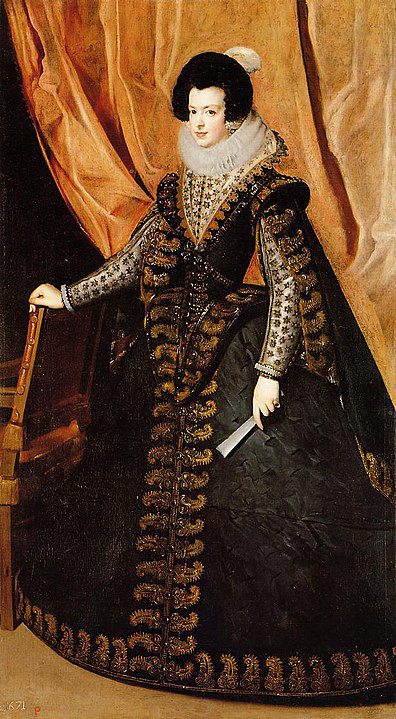
Elisabeth of France
Fontainebleau (Francia), 22 de November de 1602 - Madrid, 06 de October de 1644
View in TimelineBiography
The second of six children born to King Henry IV of France and III of Navarre (1553-1610) and Marie de' Medici (1575-1642), Elisabeth of France was reared at the refined court of her mother, who inculcated in her a deep artistic and cultural sensitivity. Her marriage to Prince Philip, the future Philip IV (1605-1665), was part of a new diplomatic rapprochement between France and the Hispanic Monarchy that also included the marriage between the Infanta Anne of Austria (1601-1666), daughter of Philip III (1578-1621), and the French King Louis XIII (1601-1643), Isabella's brother. The double wedding was celebrated on 18th October 1615, and the exchange of the two Princesses on the River Bidasoa, which took place on 9th November that same year, was immortalised in an anonymous painting now hanging in the Monastery of La Encarnación in Madrid. Philip IV and Elisabeth of France had eight children: Infanta María Margarita (born and died in 1621); the Infanta Margarita María (born and died in 1623); the Infanta María Eugenia (1625-1627); the Infanta Isabel (born and died in 1627); Prince Balthasar Charles (1627-1646), heir to the Spanish Crown until his death a few days before his seventeenth birthday; the Infanta María Antonia (1635-1636); and the Infanta Maria Theresa (1638-1683), Queen of France by her marriage to Louis XIV (1638-1715).
After becoming Queen of Spain in 1621, Elisabeth of France had limited political influence in her early reign due to the fact that, like her predecessor, she had to counter the presence of the Count-Duke of Olivares, her husband's favourite. From 1640 onwards, within the context of the war with France and the Catalan and Portuguese secessionist movements, Elisabeth of France took over government duties as Governor while Philip IV was at the front in Aragón. During this period, the Queen performed her duties responsibly and negotiated with various financiers to advance the funds needed for the military campaign. It is also claimed that Elisabeth of France had a hand in the downfall of the Count-Duke of Olivares. While the Queen was never on very good terms with the Royal Favourite, Olivares' exile was also influenced by the financial crisis, military difficulties, and an increasing number of major political figures opposed to the Count-Duke.
Fond of the arts and the theatre, the Queen died in Madrid on 6th October 1644, when she was once again ruling as Governor. Although Elisabeth of France was not the mother of a King, her remains are buried in the Pantheon of Kings and Queens in the Monastery of El Escorial.
Source: Royal Academy of History (https://www.rah.es)
