Loading...

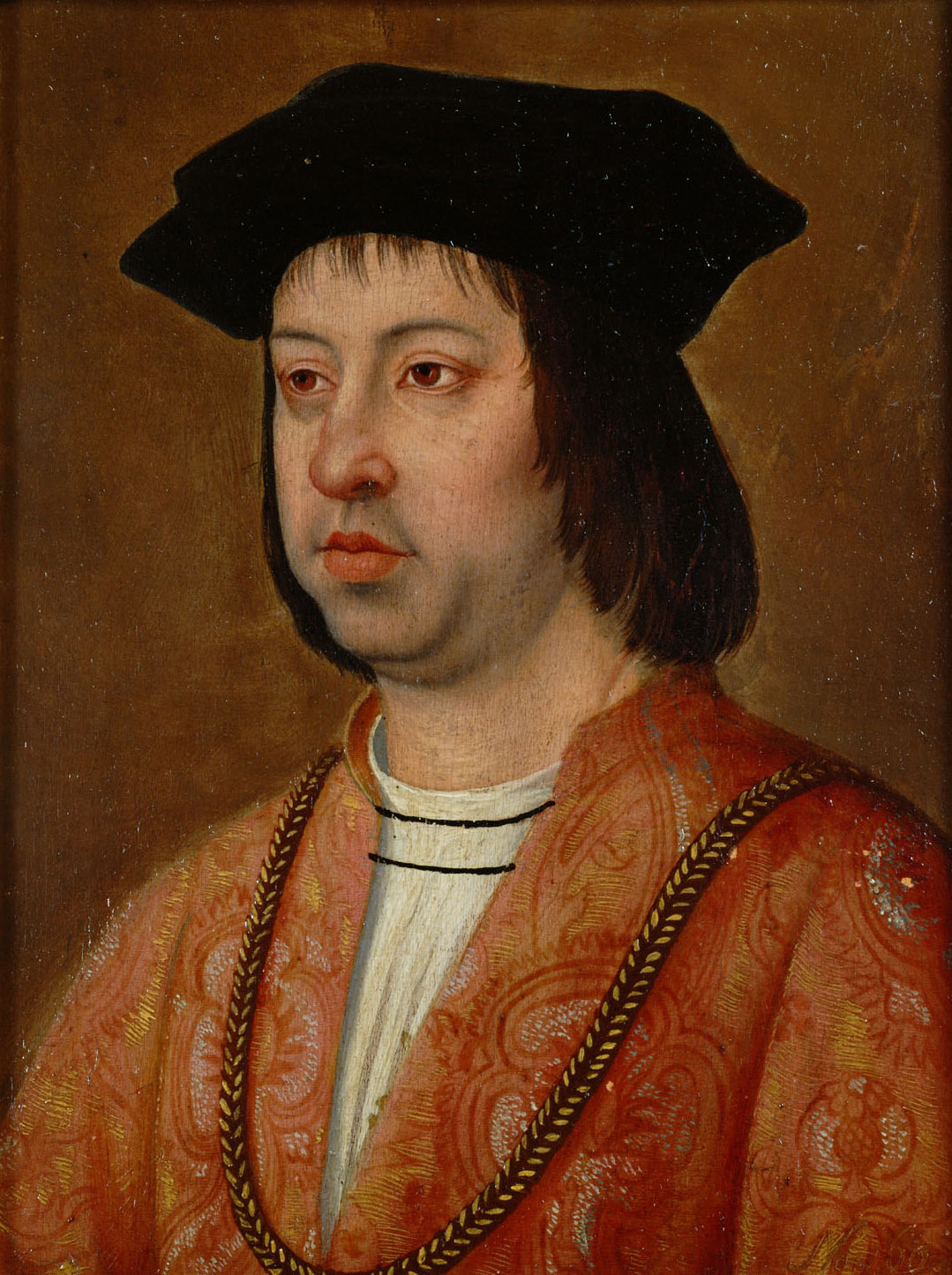
Reyes Católicos
Ferdinand II of Aragón and V of Castile
Sos, 10 de March de 1452 - Madrigalejo, 23 de January de 1516
View in TimelineBiography
Son of King John II of Aragón and Navarre (1398-1479) and his second wife, Juana Enríquez (1425-1468), the future Ferdinand the Catholic inherited the Kingdoms of the Crown of Aragón at the age of nine, after the death of his older brother, Charles of Viana, in September 1461. As a child, he received a humanist education under the supervision of Francisco Vidal de Noya, Bishop of Cefalú. In February 1465, the Prince was initiated into the art of war after taking part, albeit more as an observer than an active participant, in the battle of Calaf.
The marriage of Ferdinand of Aragón and Isabella of Castile (1451-1504), then heir to the Crown of Castile, was celebrated in Valladolid on 9th October 1469. The royal couple had five children: Infanta Isabella (1470-1498), Crown Princess and later Queen of Portugal by marriage to Manuel I (1469-1521); Prince John (1478-1497), who married Archduchess Margaret of Austria (1480-1530) and died before ascending the throne; the future Joanna I (1479-1555), also called Joanna the Mad, wife of Philip I the Handsome (1478-1506); the Infanta Maria (1482-1517), Queen of Portugal by marriage to Manuel I (1469-1521), the widower of her elder sister Isabella; and the Infanta Catherine (1485-1536), Princess of Wales by her marriage to Arthur Tudor (1486-1502) and then, after being widowed, Queen of England as the first wife of Henry VIII (1491-1547).
Isabella ascended the throne of Castile I on 13th December 1474, following the death of her half-brother Henry IV (1425-1474). Ferdinand's position in Castile during his wife's reign was clarified with the negotiation and signing of the Concord of Segovia (15th January 1475). Under the terms of the agreement, Isabella was recognised as Queen of Castile but Ferdinand was granted the title of King in addition to other privileges. Although some points in the Concord of Segovia limited the King’s authority in the Kingdom of Castile, in practice Ferdinand and Isabella ruled jointly until the latter's death in 1504.
At the start of their reign, the new kings were mainly concerned with consolidating their power against the claims to the throne made by Isabella’s niece, Joanna, also called La Beltraneja. She was the daughter of Henry IV and Joan of Portugal, and was therefore supported by Alfonso V of Portugal and certain Castilian cities and nobles led by the Marquess of Villena. The War of the Castilian Succession which started in 1475, was settled in favour of Isabella after Ferdinand won the Battle of Toro (Zamora) on 1st March 1476, and it ended with the signing of the Treaties of Alcaçovas-Toledo between Portugal and Castile in September 1479.
A short while before, in January that same year, Ferdinand became King of the Crown of Aragón. His accession to the throne brought about the dynastic union of the two major peninsular kingdoms, Castile and Aragón, although both continued to maintain their own laws, institutions and coinage. In 1496, Pope Alexander VI granted Ferdinand and Isabella the title of "Catholic Monarchs" in recognition of their efforts to defend and expand Catholicism.
In terms of domestic policy, the Catholic Monarchs aspired to create a strong and well-structured monarchy, with renewed structures in both the central and municipal administrations as well as the legal and military spheres. However, although Ferdinand was directly involved in the development of this process, war and international relations were the two areas of governance over which he had the strongest influence. The foreign policy developed by Ferdinand the Catholic with the approval of Queen Isabella, was dictated by the rivalry with the France of Charles VIII and Louis XII, and culminated in the formation of alliances with Austria, the Netherlands, England, Venice and the Holy See. The hostilities with France, which were mainly staged in Italy, ended with the inclusion of the Counties of Roussillon and Cerdagne in the Crown of Aragón, by virtue of the Treaty of Barcelona of January 1493; and of the Kingdom of Naples after the victory at Garellano (28-29 December 1503) of Gonzalo Fernández de Córdoba, also called The Great Captain. Ferdinand the Catholic was also instrumental in the defence of the Mediterranean against the Ottomans; the expansion in North Africa, which culminated in the capture of Melilla (1497), Oran (1509), Algiers and Bougie (1510); and the delimitation of the Castilian and Portuguese spheres of influence in the Atlantic following the voyage to America by Christopher Columbus (1492) and the conclusion of the conquest of the Canary Islands (1478-1496), which led to the signing of the Treaty of Tordesillas between the two kingdoms in June 1494. Finally, within the peninsula, he was responsible for bringing the Reconquest to its definitive end, after Granada surrendered to the Catholic Monarchs in January 1492 after ten years of war, and the merging of the Kingdom of Navarre into Castile in 1515, is also worth mentioning.
The death of Queen Isabella on 26th November 1504 influenced the position of Ferdinand the Catholic in the Castilian kingdom, and handed over power to the new kings, Joanna I and Philip the Handsome. At this point in history, Ferdinand the Catholic signed the Treaty of Blois with Louis XII of France (October 1505) and contracted a second marriage with the French princess Germaine of Foix (1488-1538) on 18th March 1506. He left the Kingdom of Castile after negotiating the Concord of Villafáfila (27-28 June 1506) with Philip the Handsome, which also declared Joanna unfit to rule.
In the summer of 1507, Ferdinand the Catholic returned to Castile from Naples following the death of King Philip on 25th September of the previous year. Queen Joanna, deemed incapable of ruling due to her alleged mental instability, was imprisoned in Tordesillas by order of Ferdinand the Catholic, who ruled Castile until his death in Madrigalejo (Cáceres) on 25th January 1516. The King’s remains are buried next to those of his first wife Isabella the Catholic in the Royal Chapel adjoining the Cathedral of Granada.
Source: Royal Academy of History (https://www.rah.es)