Loading...

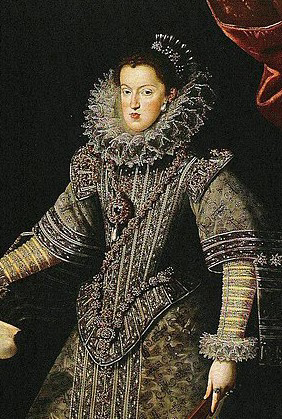
Casa de los Austrias
Margaret of Austria
Graz, Estiria (Austria), 25 de December de 1584 - El Escorial (Madrid), 03 de October de 1611
View in TimelineBiography
The eleventh of fifteen children born to Archduke Charles II of Austria-Styria (1540-1590) and Maria Anna of Bavaria (1551-1608). Margaret was chosen by Philip II to be the wife of his son and heir, Prince Philip (1578-1621), in order to strengthen bonds between the two branches of the House of Habsburg at a time of crisis and instability in European international relations.
Her marriage to Philip III, who had ascended the throne on 13th September 1598, was celebrated in Valencia on 18th April 1599. During their life together, the King and Queen had eight children: the Infanta Anne (1601-1666), Queen of France by marriage to Louis XIII (1601-1643); the Infanta María (born and died in 1603); the future Philip IV (1605-1665), who succeeded his father on the throne; the Infanta Maria Anna (1606-1646), Holy Roman Empress by marriage to Ferdinand III (1608-1657); the Infante Charles (1607-1632); the Infante Ferdinand (1609-1641), also known as the Cardinal-Infante; the Infanta Margarita (1610-1617) and the Infante Alfonso (1611-1612).
Margaret of Austria's early years in Madrid were complicated by her youth (she was barely fifteen years old at the time of her marriage), her unfamiliarity with the political situation at the Spanish court, and the attempts of the Duke of Lerma, the favourite of Philip III, to limit her possible influence over affairs of state. However, from 1602 onwards, the Queen took on a more active role in decision-making. Margaret of Austria's political influence increased from 1606 onwards, when the Duke of Lerma's influence over the King began to weaken. Thereafter, the Queen and her closest entourage made use of all means at their disposal to reveal to Philip III the corrupt practices of his favourite and those of his trusted men, including: Alonso Ramírez de Prado, Pedro Franqueza and Rodrigo Calderón. Gravely ill after giving birth to her last child, Margaret of Austria died at El Escorial on 3rd October 1611. Although the Queen died as a result of complications arising from childbirth, some people and courtiers blamed Rodrigo Calderón for her death, however these claims were never substantiated.
A deeply religious woman, she founded the Monastery of La Encarnación in Madrid. The remains of Margaret of Austria are buried in the Pantheon of Kings and Queens in the Monastery of El Escorial.
Source: Royal Academy of History (https://www.rah.es)