Loading...

The Royal Collections Gallery includes a visit to the oldest section of the Moorish wall of Madrid.
25/03/2023
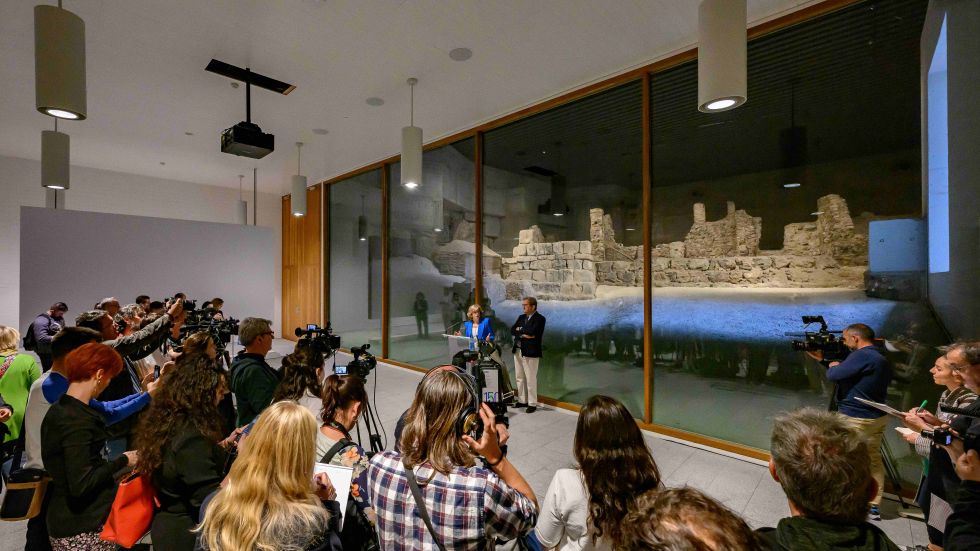
The President of Patrimonio Nacional, Ana de la Cueva, and the Director of the Royal Armoury, Álvaro Soler, have inaugurated the archaeological hall of the Royal Collections Gallery today. It is a conditioned space that exhibits the oldest section of the Moorish wall of Madrid, built in the 9th century: "It is a foundational gate that faced the River Manzanares and has been documented in 16th-century drawings”, explains Soler.
The archaeological remains, which were discovered during the construction of the Gallery, have been integrated into its museography, so visitors can understand the origins of Madrid. Ana de la Cueva stressed that including this discovery in the museum reflects the unique nature of Patrimonio Nacional: "It is in the DNA of Patrimonio Nacional to preserve this legacy and enhance its value for a better comprehension of its historical context. This space brings together the oldest and the most modern parts of Madrid, this marvellous 21st-century building".
To facilitate this mission, an audiovisual presentation of a 3D model of the successive walled enclosures of Madrid, from the foundation of the first castle until today, will be included in the archaeological room. Visitors will have the opportunity to compare this reconstruction with the remains found in the excavations carried out at the time of building the Royal Collections Gallery.
Foundational fortification
This archaeological finding is unique and of the highest importance. Research has made it possible to reconstruct the original appearance of the gate: a horseshoe arch with voussoirs, possibly painted in white and red, key in representations of the Umayyad dynasty.
Its construction technique which uses large masonry blocks, together with the short distance between the towers, and the inclusion of a stepped base, have made it possible to date the building’s origins to the 9th century, when the Emir of Córdoba built a set of fortifications to protect Toledo. "One of these defensive castles stands in Madrid, and the findings on display in the Gallery's archaeological room are a part of the fortifications that provided defensive support to Toledo," explains Álvaro Soler.
Visit included in the general admission ticket
According to the Director of the Royal Armoury, this enclosure was in use at least until the 13th century, when the growing city absorbed the fortification. Once the wall had lost its military use, it was used as a supporting section of houses built in the typical style of Toledo.
The archaeological room, open to the public and included in the general admission ticket, houses a three-metre wide section of this wall that shows off its great strength; the tower covering the foundational gate, built with large masonry blocks that are perfectly preserved, and the remains of two other others, as well as the remains of at least one late medieval dwelling.
Inauguration, 28th June
On 28th June, the Royal Collections Gallery will be inaugurated by Their Majesties, the King and Queen of Spain. The opening of this new museum of Patrimonio Nacional is poised to be the most important cultural and museum event of the last decade in Spain. The Gallery building, located in the heart of Madrid next to the Royal Palace, has a surface area of 40,000 square metres, and has so far received ten architectural awards.
.The inaugural exhibition includes over 650 pieces that represent the variety and richness of the Spanish Royal Collections: paintings, sculptures, armour, books, decorative arts, photographs and tapestries by artists of the calibre of Velázquez, Goya, Caravaggio, Titian and El Greco. The Gallery is also a means of advertising all Royal Sites and the work carried out by Patrimonio Nacional in supporting the Office of the Head of State, as well as the restoration, conservation, dissemination and custody of the impressive historical, cultural and natural legacy that it manages in six autonomous communities.