Use of Cookies

The Royal Collections Gallery uses its own and third-party cookies, mainly for technical purposes, which are necessary to provide our services and provide you with relevant content. More information in our cookies policy. Cookies Policy.

ACCEPT to confirm that you have read the information and accepted their installation. You can change your browser settings.

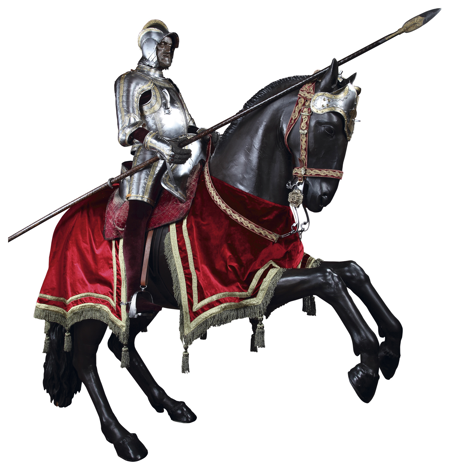
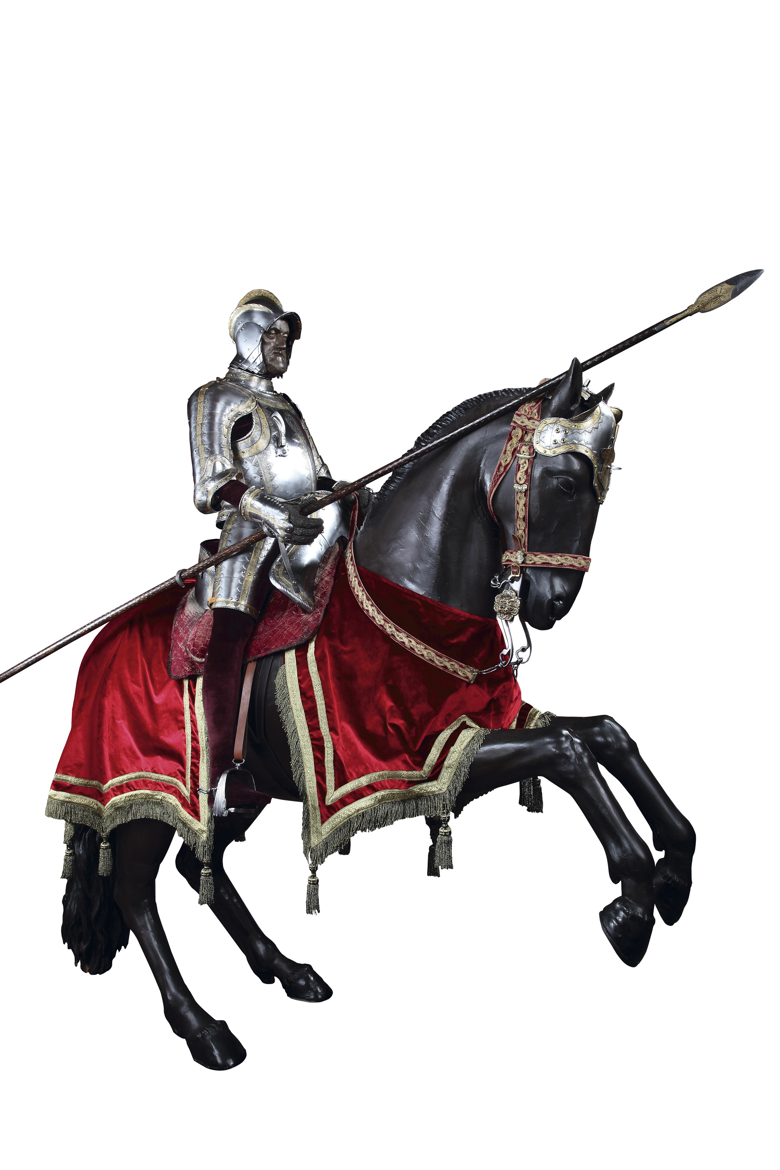
Armadura de Mühlberg para Caballería

Helmschmid, Desiderius
1544

Esta armadura forma parte de una extensa guarnición para la guerra fechada en 1544, probablemente la última que el armero imperial Desiderius Helmschmid, hijo de Kolman Helmschmid, forjó para el emperador. El rasgo distintivo de la decoración de todas sus piezas son los festones ojivales grabados y repujados que flanquean las bandas grabadas y doradas. Algunas piezas de la guarnición evidencian que fueron concebidas teniendo en cuenta el deterioro físico del emperador a los cuarenta y cuatro años de edad, sobre todo por la gota que sufría y el esfuerzo que suponía una campaña militar. La fecha de 1544 sugiere que originalmente fue forjada para la cuarta guerra contra Francia, pero que no fue sustituida por ningún otro encargo posterior porque debía sentirse cómodo con ella. En dicho año, Carlos V había avanzado sobre París, obligando a Francisco I de Francia a firmar la Paz de Crépy; sin embargo, el nombre de la armadura se debe a que fue utilizada en 1547 en la victoriosa batalla de Mühlberg contra los príncipes protestantes alemanes, unidos en rebeldía desde 1531 por la Liga de Smalkalda. Al año siguiente de la batalla, el emperador encargó a Tiziano un retrato ecuestre conmemorativo de la batalla, vistiendo piezas de la guarnición encargada tres años antes (Museo Nacional del Prado, Madrid, inv. PO04100).

Carlos V debió considerarla como su armadura favorita por su relación con estas campañas, ya que sus característicos festones representados de manera más o menos precisa se vincularon a su imagen personal. La armadura de Mülhberg, o su evocación, estuvo representada de manera más o menos precisa desde entonces en diversas esculturas, tapices, pinturas y medallas; como el cuadro de Pantoja de la Cruz conservado en el Real Monasterio de San Lorenzo de El Escorial o las esculturas de León y Pompeo Leoni del Museo Nacional del Prado.

General Classification

Armas y armaduras

Type of Object

Armadura

By

Helmschmid, Desiderius

Title

Armadura de Mühlberg para Caballería

Era / Cultural Context

Reinado de Carlos I; Emperador Carlos V

Place of Production

Augsburgo

Date

1544

Subject

Acero; Hierro; Oro; Cuero

Technical

Repujado; Dorado; Aguafuerte; Cincelado

Dimensions

Fondo completo: (Altura: 240 centímetros; Anchura: 270 centímetros; Longitud: 106 centímetros)

Inventory

19000286

Credits

Texto: Álvaro Soler del Campo

Discover it at the Planta -1

Authors and Collectors

Helmschmid, Desiderius
The Author

Helmschmid, Desiderius

(1513 - 1579)

The Helmschmids of Augsburg were one of the most prestigious families of blacksmiths and armourers of late medieval Europe. The name, occasionally spelled Helmschmied, literally means helmet smith. The most well-known members of the family were Lorenz Helmschmid (active from 1467, died in 1515), Kolman Helmschmid (1471 - 1532) and Desiderius Helmschmid (1513 - 1579).

The Helmschmids made armour for Philip II, King of the Spanish Empire, for the high nobility of the Holy Roman Empire including the Emperor, for the Archdukes of Austria and Tyrol, as well as other rich and powerful clients of the time.1 They competed for fame, prestige and noble patronage with the two other best known and most prestigious families of armourers of the time...

Read more
Charles I of Spain and V, Holy Roman Emperor
Monarch

Charles I of Spain and V, Holy Roman Emperor

(Gante (Bélgica), 1500 - Yuste (Cáceres), 1558)

The second of six children born to Joanna I (1479-1555) and Philip the Handsome (1478-1506), the future Charles I of Spain and V, Holy Roman Emperor spent his childhood in Mechelen (Belgium). Count of Flanders and Lord of the Netherlands since the death of his father in September 1506, his aunt, Archduchess Margaret of Austria (1480-1530) –the widow of Prince John (1478-1497), second son of the Catholic Monarchs, and younger sister of Philip the Handsome– ruled as Regent until he attained his majority in 1515. He was educated by Adriaan Florensz Boeyens, the future Pope Adrian VI. Although Prince Charles had a Spanish tutor, Luis Cabeza de Vaca, his childhood and early youth were spent in a predominantly French-speaking cultural environment.

Read more

The work in context

View in Timeline