Lamentación sobre Cristo muerto
Mengs, Anton Raphael
1768-1769
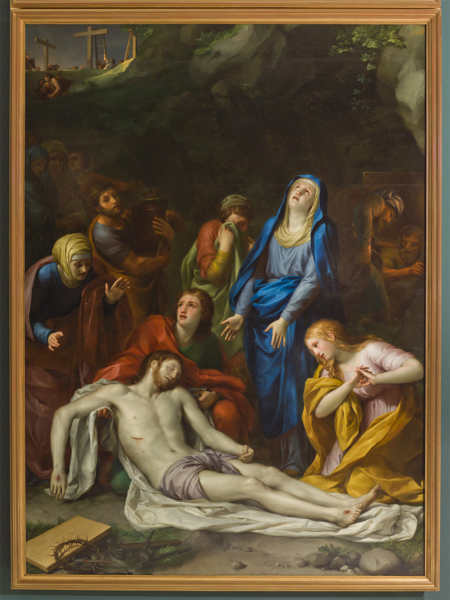
La tabla de la «Lamentación» –mal conocida como «Descendimiento»– está presidida por el cuerpo semidesnudo de Cristo yacente, sostenido por san Juan, con María Magdalena arrodillada a sus pies y, también llorosa, pero erguida e implorando a lo alto, la figura de la Virgen María. En la penumbra se distinguen otros santos varones –algunos disponiendo el sepulcro– y santas mujeres. En primer término, en el suelo, las reliquias de la Pasión: rótulo de la cruz, corona de espinas, clavos, martillo y tenazas, y, en el ángulo superior izquierdo, queda iluminado el Gólgota con las tres cruces.
Tiene esta tabla una inusual preparación verdeceledón que contribuye a resaltar el tono lúgubre que preside el cuadro, y «no es necesario decir por qué», anotaba Eugenio de Llaguno. El 1768, Jorge Balze hizo el marco, ahora perdido, para este «cuadro del Cristo muerto que pinté para S. M.», como escribía el propio Mengs al certificar la cuenta; del dorado a bruñido se ocupó Miguel García. La pintura fue colocada en el dormitorio de Carlos III en el Palacio Real de Madrid el 3 de enero de 1769 por tres oficiales durante medio día.
La tabla fue llamada «el quadro de la filosofía» por José Nicolás de Azara, y también la ponderó Gaspar Melchor de Jovellanos, al señalar que «espresó con la mayor delicadeza las llagas, las heridas y los livores del Salvador, de una manera que encanta, al mismo tiempo que conmueve».
Carlo Giuseppe Ratti, discípulo y biógrafo de Mengs, indica que su maestro pintó esta obra «per compagno» de la «Caída en el camino del Calvario» –«El Pasmo de Sicilia»–, de Rafael (Museo Nacional del Prado, cat. P000298), entonces también tabla, aunque difícilmente hubiera podido adaptarse esta última a la decoración del dormitorio por el necesario orden de la historia representada, incluidas las sobrepuertas. Sin embargo, ambas pinturas tienen medidas semejantes –310 × 226,5 cm, la de Mengs, y 318 × 229 cm, la de Rafael– y parece que el primero quiso emular en esta obra al segundo en la composición y expresión de los afectos.
Se conservan diversos dibujos preparatorios de la «Lamentación», unos simples «rasguños» a pluma que plantean la disposición de las figuras (Uffizi de Florencia, inv. 9954 S. y Musée des Beaux-Arts de Orleans, inv. 190) y otros más concluidos a lápiz, de la cabeza de Cristo en el Palazzo Rosso de Génova (inv. 2489), de la cabeza de la Virgen en la Albertina de Viena (inv. 4627) y la figura yacente de Cristo en el Museo Nacional del Prado (cat. D007826). También se conoce un cartón de la Magdalena y consta que, en 1886, la Real Academia de San Carlos de Valencia conservaba «un contorno del Descendimiento».