Loading...

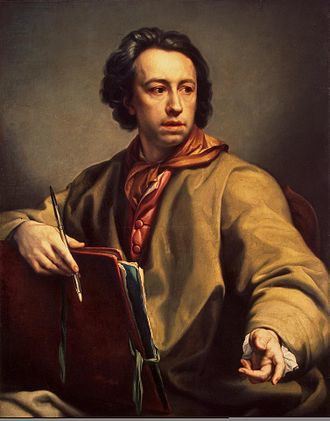
Mengs, Anton Raphael
(Aussig, Bohemia, 1728 - Rome, 1779)
Mengs, Anton Raphael. Aussig, Bohemia, now Ústi nad Labem (Czechia), 12.03.1728 – Rome (Italy), 29.06.1779. Painter and art theorist.
He was the son of Ismael Mengs (1688-1764), court painter to Frederick Augustus II, Elector of Saxony, and of Charlotte Bormann; and the brother of Therese Concordia, (1725-1806/8), also a painter and miniaturist. Rigidly educated by his father in painting, enamel work and miniatures, he also learnt pastel drawing techniques, which was highly fashionable at the Court. After his mother's death (1731), he spent his childhood in Dresden until 1740. In 1741 the family moved to Rome, where he continued his studies by making copies of Michelangelo and Raphael at the Vatican; studied anatomy at the Arcispedale di Santo Spirito in Rome and attended the workshops of the Late Baroque painters Marco Benefial (1684-1764) and Sebastiano Conca (1680-1764), both of whom were settled in Rome.
At the end of 1744, the family returned to Dresden, where Anton Raphael began painting pastel portraits, a technique that had become fashionable at the Court thanks to the Venetian painter Rosalba Carriera (1675-1757), who had decorated a room with her portraits. At the same time he began his career as a portrait painter, thanks to the French influence of Louis Sylvestre (1669-1740), who had been the first painter of Augustus II and who painted at the Court of Dresden until 1748. Mengs' first self-portraits are from this period and reveal a Raphaelesque influence in the poses.
In 1745, he was appointed painter to the Saxon court, and in the same year the Mengs family made their second journey to Rome.
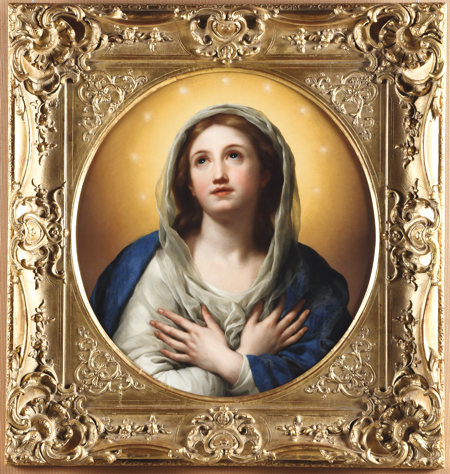
During this journey and before taking up residence in Rome, he visited Parma, where he examined the frescoes by Correggio; Bologna, where he studied the work of the Carracci brothers; and Venice, where he was attracted to the work of Titian. After settling in Rome he continued to study classical statuary and the Renaissance masters, and in 1748, began work on a painting of the Holy Family, with his model for the Virgin an Italian girl of humble origins, Margarita Guazzi, whom he married in 1749, having previously converted to Catholicism. That same year in December, he returned to Dresden.
In 1751, he was appointed first painter to the Saxon court and received a commission to paint three works for the Hofkirche in Dresden; the one on the high altar was dedicated to the Ascension and it was with this painting in mind that he asked permission to return to Rome to study Raphael's work. The painting itself was completed many years later, in 1766, when Mengs was already working for the Spanish court. Before his third trip to Italy, he met Sir Charles Hanbury Williams, an English diplomat who provided him with a letter of introduction to the British ambassador in Florence. This was his first contact with English clients, who would commission numerous works from him throughout his career. In September 1751, he left for Italy with his wife, two children and two sisters.
They spent the winter in Venice, where he met the British landscape painter Richard Wilson and the art dealer Thomas Jenkins. In the spring of 1752 he passed through Florence and visited the British ambassador, Horace Mann, who gave him a letter of introduction to Cardinal Albani in Rome. In May of that year he settled in Rome, on the Via Sistina, where he continued to work with his English clients, painting portraits of British gentlemen on their Grand Tour. His fame grew and in June he was appointed an honorary member of the Accademia Clementina in Bologna. In August, he was elected a member of the Accademia di San Luca in Rome. In the meantime, his studio in Rome had become well-known and many artists from different nations passed through it, including: Nicolas Guibal (1725-1784), Laurent Pecheux (1729-1821), Anton von Maron (1735-1808) who married his sister Therese Concordia, and Giovanni Casanova (c. 1730-1795). Two years later he became a professor at the Accademia del Nudo founded by Pope Benedict XIV. In 1755, he met Joachim Winckelmann and the two developed a friendship which was to be highly fruitful for both, as Mengs made use of Winckelmann's theories on ancient art in his writings and the philosopher was enlightened by Mengs’ practical and technical knowledge of Greco-Roman statuary. The same year, he completed the copies of Raphael's School of Athens commissioned by the Duke of Northumberland many years ago for his house in Charing Cross, London. Their fame outlasted the painter, as they were engraved in 1785 by Giovanni Volpato, one of the best Italian engravers of the day, using the drawings handed down by his heirs.
1755 witnessed the start of his problems with the Saxon court, and Mengs stopped receiving his salary in Rome. However, at the same time, his fame spread and he continued to receive honours: he was made a Knight of the Golden Spur and, together with Winckelmann, elected a member of the Auguste Academy. His studio became a meeting place for numerous English travellers due to his knowledge of antiquities and his fame as a portraitist; he was also visited by important figures such as the Margravine Wilhelmine of Prussia, and it was probably in connection with this visit, that he drew up plans for an Academy in Bayreuth, although it did not come to fruition.
In 1757, he was tasked with painting the frescoes of the ceiling of the church of Saint Eusebius in Rome, which he completed in 1759. He was assisted by Maron and Byres in this project, and almost at the same time, the Court of Naples commissioned him to paint portraits of Charles VII —the future Charles III of Spain— and his wife Maria Amalia of Saxony.
In 1758, he took up residence in a house on the Via Vittoria, next to the Spanish Steps, where he held gatherings that were attended by numerous British artists such as the Scottish architect James Byres, the architect Robert Adam, the painter Allan Ramsay, and Winckelmann. His links to the colony of British artists brought him fame and made him one of the most important art agents of Rome, together with Thomas Jenkins and Gavin Hamilton. His fame as a portrait painter earned him the commission to paint Pope Clement XIII, and in September 1759 he moved to Naples to paint the portrait of the Royal Family; the portrait of the crown prince and future monarch Ferdinand IV (Prado Museum) also dates back to this period. This trip allowed him to broaden his knowledge of Roman art, as it gave him the chance to visit Herculaneum and study the archaeological remains that had been recently discovered.
Before his return to Rome, he had the opportunity to present the painting commissioned for the altar of the Palatine Chapel in Caserta to the Royal Family of Naples. Now in Rome, he completed the painting of Octavian and Cleopatra for Henry Hoare; and this time the family settled in the Villa Albani, as he had been commissioned to paint the ceiling of its ballroom on the theme of Parnassus or Apollo and the Muses. Meanwhile, he continued to meet British artists such as Benjamin West and the aristocrat Giacomo Casanova (1725- 1798); he also received further honours, being invited to join the Roman Arcadia under the name of Dinia Sipilio.
Meanwhile, in Spain, Charles III had ascended the throne following the death of Ferdinand VI, and in July 1761 he summoned Mengs to Spain, granting him the title of chamber painter. That year in August, the painter and part of his family left Rome for Naples, where they embarked on a voyage to Alicante, arriving at Madrid on 22nd September 1761. The Neapolitan painter Corrado Giaquinto (1703-1765) was at the Spanish court at that time, tasked with decorating the staircase of the Royal Palace with frescoes. He left for Rome in 1762, at the same time that Giambattista Tiepolo and his two sons arrived in Madrid to paint frescoes for the Palace Throne Room.
From this moment onwards, the Spanish court was the meeting point for the three predominant artistic movements in Europe: Late Baroque, Rococo and Neo-Classicism.
As the three painters were put in charge of large-scale decorative projects, they had to call upon Spanish assistants, thus creating an important pool of young artists who would shape the various trends in Spanish painting until the end of the reign of Ferdinand VII. In the case of Mengs, his most outstanding assistant was Francisco Bayeu (1734-1795).
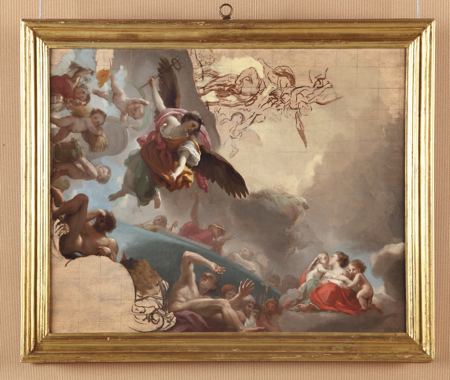
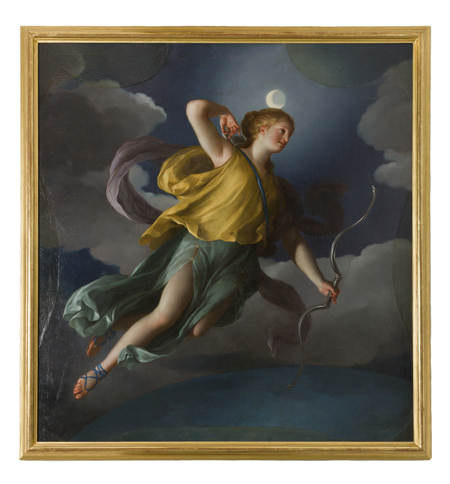
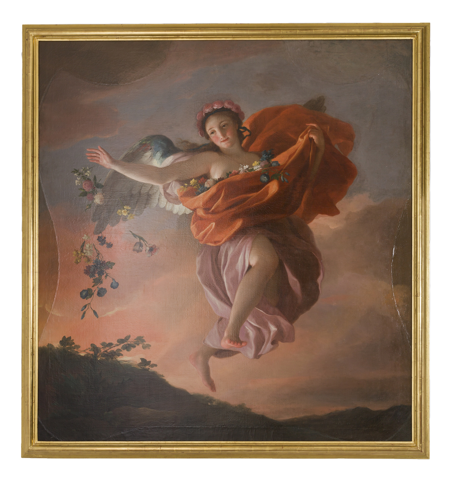
In 1762, Mengs started painting The Dawn on the ceiling of the chamber of the Queen Mother, Elisabeth Farnese, and The Apotheosis of Hercules in the Gasparini Antechamber.
The same year, he published his first written work, Die Gedanken über die Schönheit and über den Geschmak in der Malerey, in Zurich, and in July, Winckelmann wrote to him that there were many art lovers who wanted his book to be translated into other languages. In England, his fame continued to grow and eventually he received a proposal to settle there.
Mengs, who had always considered his living conditions and the climate in Madrid to be unfavourable, was tempted but decided to stay on the promise that he would soon be granted royal permission to return to Rome.
In 1763, he came into contact with the Royal Academy of Fine Arts of San Fernando, which appointed him honorary director of Painting, but his opinions were not always well received by the Spanish academicians. In 1764, the Bohemian painter decided to resign his appointment and was only prevented from doing so by the King's direct intervention. In spite of these differences, Mengs continued to collaborate with the Academy, especially on the new curriculum proposed in 1766, and although these differences of opinion would continue until the end of his stay in Spain, before he returned to Rome, he gifted his important collection of casts to the Academy so they might be used as models by the students. He wrote two treatises based on his disagreements regarding the teaching methods used at the Academy of Fine Arts of Madrid: Discorso sopra i mezzi per far florire le belle arti in Spagna and Ragionamento su l’Accademia delle Belle arti di Madrid.
In these works, he explains his teaching methods in order to achieve a better learning experience for his students. Two years later the painter finally left the Academy, giving up his post and resigning his appointment as honorary director of Painting.
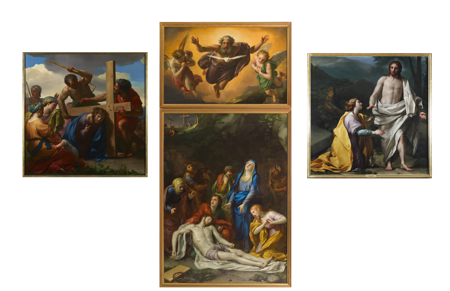
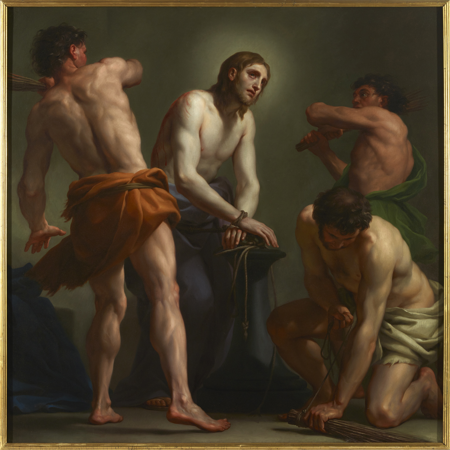
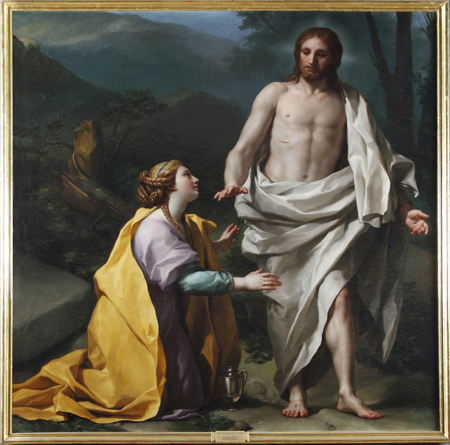
Between 1765 and 1769, he painted the decoration of Charles III's bedroom and other chambers in the Royal Palace in Madrid, a series of five oil paintings on the topic of the Passion and Death of Christ. In 1766, he completed the painting of the Ascension of Christ for the high altar of the palace chapel in Dresden, which had been commissioned in the previous decade. It was painted and sent from Spain and its composition made a great impression on similar works by his Spanish pupils. At the same time, he was commissioned to paint a Noli me tangere for the chapel of All Souls College in Oxford. That same year Corrado Giaquinto died in Naples and the now-vacant position of first chamber painter was filled by Mengs, who was working on portraits of King Charles III and his sons at the time.
During his stay in Spain, Mengs maintained his international connections; Giacomo Casanova travelled to Madrid in 1767 and stayed with Mengs, but the following year, he was expelled from his home due to his ecclesiastical failings. Casanova recounts this anecdote in his Memoirs.
1768 also witnessed the murder of Winckelmann in Triestre, with whom Mengs had corresponded from Madrid. Mengs's fame as an art theorist grew in Europe through his writings and the director of the Academy of Fine Arts in Saxony considered inviting Mengs to Dresden, but the post of first painter was still occupied by the Venetian Giovanni Casanova, and the appointment was not made.
In November 1769, after repeated requests to return to Rome due to his constant physical ailments caused by the climate in Madrid, Mengs was granted a three-year leave of absence and left for Italy via Monte Carlo, Genoa, Parma and Florence. In Parma he began to write a biography of Correggio, which was to have been included in a new edition of Vasari's Lives of the Most Excellent Painters, Sculptors, and Architects, but remained incomplete and was later included in the works of Mengs edited by Azara. Before his arrival in Rome, he stopped in Florence in the early spring and spent the entire year there, painting.
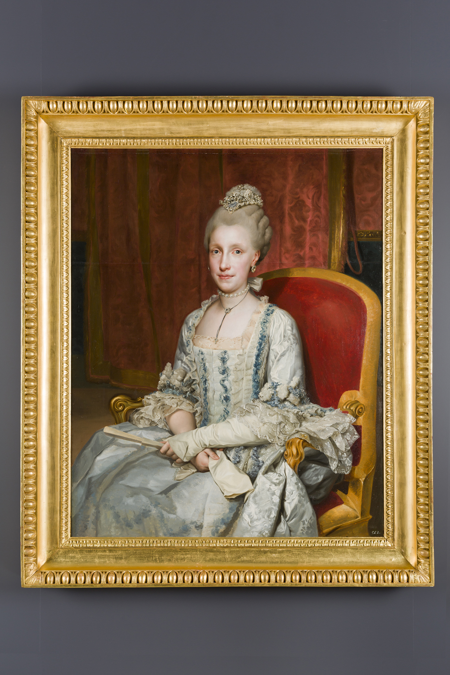
He painted portraits of the Grand Duke Leopold and his wife Maria Luisa, daughter of Charles III (Prado Museum). His enthusiasm for the Greek and Roman sculptures in their possession led him to apply for permission to make plaster copies of the most important ones, which increased his collection of copies. In June 1770, he was appointed academician of the Accademia del Disegno in Florence, the following month he was appointed a member of the Accademia Liguistica in Genoa, and in December, he was elected prince of the Accademia di San Luca in Rome.
In February 1771, he left Florence for Rome, where he settled and was appointed director of the Accademia di San Luca; and possibly thanks to the intervention of Cardinal Albani, he was commissioned to paint frescoes in the Papyri Chamber in the Vatican library, the principal subject being an Allegory of History. He continued to work as a portrait painter, although he gave up his British clientele to depict individuals connected to the Spanish world such as Azara, and Roman scholars. Between October and November of the same year, Mengs completed the enormous panel commissioned in 1769 for All Souls College, Oxford. The theme Noli me tangere (London, National Gallery) is clearly reminiscent of Correggio and of his painting of the same name for the bedchamber of Charles III in the Royal Palace of Madrid.
While in Rome and still fulfilling his duties as first painter to the King of Spain, he painted an Adoration of the Shepherds (Washington, Corcoran Gallery) for Charles III's private chapel in the palace of Madrid. The painting was sent to Spain in 1772 and it soon became apparent that its installation was erroneous due to the amount of reflections it caused, and Mengs offered to paint a fresco on the same subject.
That same year he rented the Pamphili palace in Rome as a residence, where he set up his studio and his collection of plaster casts, establishing a small academy where many of his pupils worked alongside him. It was at that time that he was commissioned to paint an altarpiece on the theme of The Delivery of the Keys to St Peter for St Peter's Basilica in the Vatican, however it was never executed and only a preparatory grisaille survives.
Towards the end of 1772 and in the spring of 1773, he travelled to Naples at the request of King Charles III to paint several portraits of the Neapolitan royal family: Ferdinand IV of Naples, his son (Madrid, Patrimonio Nacional), two portraits of his wife, Queen Caroline (Madrid, Prado Museum and Patrimonio Nacional) and one of his daughters, María Theresa (Madrid, Patrimonio Nacional), all of which were transported to Spain. After his stay in Rome and in response to requests from the Spanish court to return and finish the frescoes begun during his first stay, Mengs set out for Spain by land, stopping in Florence in the summer of 1773 and spring of 1774, where he painted his Self-Portrait for the Gallery of Self-Portraits (Florence, Galleri degli Uffizi). At the end of April he headed for Spain, passing through Bologna, Parma, Turin and Milan, arriving in Madrid on 9th July.
During his final stay in Spain (July 1774 - January 1777), Mengs painted frescoes of The Apotheosis of Trajan in the Gasparini Chamber of the Royal Palace of Madrid, and Time Snatching Pleasure in the theatre of the palace at Aranjuez, which he left unfinished.
In 1776, he published his Letter to Antonio Ponz with a Description of the Most Capital Pictures in the King of Spain's Palace at Madrid; and in July, requested permission to return to Rome, citing health reasons. This being granted, he left at the beginning of 1777.
Several months before, he had given his important collection of plaster casts to be deposited at the Academy of Fine Arts of San Fernando for the students’ use. It was also a means to avoid addressing the institution directly, which he considered had been unfair to him. Among other activities at the palace, Mengs was in charge of supervising the cartoons for tapestries to decorate the walls of the royal palaces and, according to a 1779 letter by Goya to Charles III applying for a position as chamber painter, it was Mengs who had summoned him to work in Madrid. There is a report of the short time during which the two men interacted at court, in which Mengs (July 1776) speaks favourably of the work of Goya (1746-1828), José del Castillo (1787-1793) and Ramón Bayeu (1746-1793).
After a short stay in Florence, Mengs arrived in Rome in March 1777 where, in addition to the unfinished commission for Saint Peter's Basilica in the Vatican, he made a copy of the Roman paintings at the Villa Negroni, excavated at the expense of José Nicolás de Azara. In February 1778, he presented his oil painting of Perseus and Andromeda to the public, which received great approbation from Roman art enthusiasts. In April, his wife Margherita Guazzi died and Mengs entered a profound depression that led to his death on 27th June 1779. He was buried in the Roman church of San Michele in Sassia. Before his death, he had arranged the marriages of two of his daughters, one of them, Anna María, to the Spanish engraver Manuel Salvador Carmona (1734-1820), and continued to send more casts of antique statues to the Academy of Fine Arts of San Fernando. On his death, Charles III awarded pensions to Meng’s children, and his will was administered by the Spanish diplomat José Nicolás de Azara. Meng’s influence on Spanish art is not only limited to his direct students, but also spread to other painters of his time on whom he left his mark, such as Mariano Salvador Maella, and can be seen in painters of the second half of the 19th century, such as Vicente López (1772-1850).
Source: Royal Academy of History (https://www.rah.es)