
Use of Cookies

The Royal Collections Gallery uses its own and third-party cookies, mainly for technical purposes, which are necessary to provide our services and provide you with relevant content. More information in our cookies policy. Cookies Policy.

ACCEPT to confirm that you have read the information and accepted their installation. You can change your browser settings.

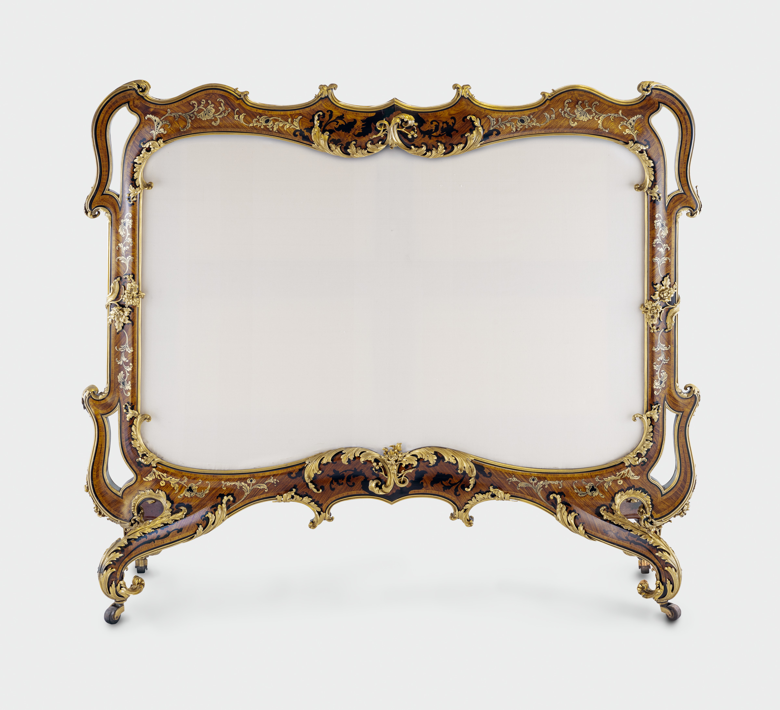
Pantalla de chimenea

Mueble: Atribuido a Balze, Jorge; Mueble: Canops, José; Bronces: Giardoni, José; Diseño: Gasparini, Mattia
1769-1770

En 1764 Carlos III habitó, por primera vez, el Palacio Real Nuevo de Madrid, estableciendo su cuarto en el ala suroeste del edificio. Aún por concluir las decoraciones interiores, el monarca encargó el ornamento de los espacios más representativos e íntimos de su cuarto al veneciano Mattia Gasparini, llegado desde Nápoles en 1759 acompañando a la corte del nuevo rey. La cámara —hoy Salón Gasparini— y los anexos gabinetes de maderas finas o «de Indias» fueron los principales espacios en los que el adornista italiano desarrolló su labor, creándose para ello los denominados talleres de ebanistería, bronces y bordados, donde trabajaron grandes broncistas —como Giovanni Battista Ferroni, Antonio Vendetti y Joseph Giardoni—, ebanistas ―destacando al alemán Knopps, españolizado como José Canops―, y bordadores ―sobresaliendo la esposa de Gasparini, Maria Luigia Bergonzini―.

De entre todos los gabinetes de maderas finas destaca el despacho privado del rey, estudiado por Juan José Junquera Mato, Ángel López Castán, Pilar Benito García o José Luis Sancho Gaspar, entre otros. Para este espacio diseñó Gasparini un completísimo conjunto que, además del mobiliario, incluía el suelo, el techo y la «boiserie». Líneas curvas y elementos rococós dan forma a los distintos muebles, cuya estructura queda oculta por una intrincada labor de marquetería a base de maderas exóticas y latón grabado, obra de Canops, cuyo trabajo se complementa con las aplicaciones de bronce cincelado y dorado de Ferroni, Vendetti y Giardoni ―dependiendo de cada caso―. Los motivos ornamentales, principalmente a base de elementos vegetales, aves y peces de clara influencia oriental, cuajan la base con motivo de rombos.

La pantalla de chimenea es una de las piezas que decoraban este gabinete. De sinuoso perfil, está dotada de ruedas y de dos asas en la parte superior para facilitar su movimiento. No se ha conservado el textil original, que haría juego con la colgadura de la sala y que incluiría, al igual que los bronces de la pieza, motivos decorativos vegetales de carácter oriental.

General Classification

Mobiliario de protección

Type of Object

Pantalla de chimenea

By

Mueble: Atribuido a Balze, Jorge; Mueble: Canops, José; Bronces: Giardoni, José; Diseño: Gasparini, Mattia

Era / Cultural Context

Reinado de Carlos III

Place of Production

Madrid

Date

1769-1770

Subject

Palo de rosa; Ébano; Palosanto; Limoncillo; Nogal; Latón; Bronce; Seda

Technical

Ensamblado; Chapeado; Marquetería; Cincelado; Dorado; Tejido

Dimensions

Fondo completo: (Altura: 112,2 centímetros; Anchura: 135 centímetros; Profundidad: 37 centímetros)

Inventory

10003016

Credits

Texto: Mario Mateos Martín; Foto: Mario Sedeño

Discover it at the Planta -2

Authors and Collectors

Canops, José
The Author

Canops, José

(Brussels, 1814 - Brussels, 1814)

Canops, José. Brussels (Belgium), 2nd half of 18th century – 16.04.1814. Cabinetmaker of the royal workshops.

In 1759, during the reign of Charles III, he was called to work in the "King's Chambers" in the New Palace of Madrid. Thanks to this monarch, a royal workshop was founded to manufacture bronzes and marquetry for furniture. The workshop was headed by the Italian Giovanni Battista Ferroni.

In 1777, José Canops obtained the King’s permission to reside in the city of Sprá (Liège) for six months. Upon his return to Madrid, he continued to lead the Royal Cabinetmaking Workshop until 1781. The designs for the suite of rooms were provided by Matteo Gasparini, but were executed by a number of cabinetmakers...

Read more
Gasparini, Matteo
The Author

Gasparini, Matteo

(1774 - 1774)

Gasparini, Matteo. ?, 1st half of 18th century – 1774. Painter, designer and plasterer.

His date and place of birth are unknown. He arrived in Spain from Naples on 13th January 1760, at the summons of King Charles III to decorate the King’s Chamber in the Royal Palace of Madrid, to carry out renovations on the Royal Sites, as well as to work on the new palace of La Granja. He was accompanied by his wife and children, as well as a number of Italian artists who would collaborate in the execution of these new works. During this king’s reign, there was a significant amount of furniture making, to the extent that a royal workshop was founded...
Read more
Charles III
Monarch

Charles III

(Madrid, 1716 - Madrid, 1788)

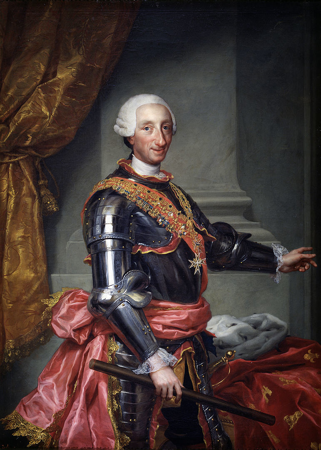
The first-born son of Philip V (1683-1746) and his second wife, Elisabeth Farnese (1692-1766), the future Charles III was educated by Joseph Arnaud, the Jesuit priest Ignace de Laubrussel, and Father Saverio de la Conca. Together with learning to read and write, his training included knowledge of geography, history, religion, military tactics, Latin and modern languages, as well as other disciplines of a more social nature such as horse riding, hunting, dancing and music. 

Charles III was not originally destined to reign, as his older brothers, the future Louis I and Ferdinand VI, preceded him in the line of succession to the Spanish throne. However, in early 1731, he was recognised as Duke of Parma and Piacenza, following the death...

Read more

The work in context

View in Timeline