Loading...


Brambila, Fernando
(Fara Gera d'Adda, 1763 - Madrid, 1834)
Brambilla e Ferrari, Ferdinando. Fara di Gedda d’Adda (Italy), 1763 - Madrid, 23.01.1834. Painter.
The son of Francisco Brambilla and Antonia Ferrari, he began painting at a very early age, and was working as a painter in Milan when it was suggested he join Alessandro Malaspina's expedition at the end of March 1791. His inclusion was a matter of some luck, as two other individuals had been invited: Juan Ravenet, a painter from Parma who hastened to accept, and Blas Martini, who, by rejecting it, enabled the young Brambilla, who was already a professor at the Accademia di Belle Arti di Brera, to join.
After an eventful journey by horse-drawn carriage from Barcelona to the kingdom’s capital, he headed to Galicia. After a few weeks, they arrived in Veracruz, having briefly stopped in Havana. In the Mexican capital they were told to make for Acapulco, where the two corvettes, Atrevida and Descubierta, belonging to the expedition headed by Malaspina, would embark on a scientific and political voyage lasting from 1789 until 1794.
Once he had joined the expedition, the Italian painter was commissioned to paint the most important ports visited by the corvettes (Humatac, Palapa, Sorsogon, Manila, Macao, Zamboangan, Sydney, Parramata, Vavao, Lima, Buenos Aires and Montevideo). Brambila painted several panoramic pictures of these places which provide precise and extensive information on their locations, defences and monuments, etc., information that was essential to understanding the life and situation of those cities at the end of the Age of Enlightenment. Brambilla’s paintings in Lima must have pleased the local authorities, as they suggested that he work at a public drawing school in the Peruvian capital as soon as he had finished his mission, although this did not last long. Brambila's series of landscapes of the city of Manila, painted during his six-month stay there, are of great historical interest. According to Professor Carmen Sotos, in some cases, these drawings constitute the last image of a city that was destroyed in the Second World War.
It was precisely on the island of Luzon that Antonio Pineda, the expedition's naturalist, died, and Brambila was commissioned to design the tomb erected in his memory.
On his visit to Australia, Brambilla's perfect drawings were gifted by Malaspina to his English hosts. Some of the Italian painter's plates were sent to England so that the British authorities could see the fast growing settlement around Port Jackson and what would later become Sydney.
When the corvettes returned to the Iberian Peninsula in 1794, the painters, similar to other members of the expedition, settled at Court. The imprisonment of the brigadier of the Armada after his failed plot against Manuel Godoy did not prevent Brambilla from updating his drawings made during the expedition.
In 1799, in view of his merits and his constant appeals, he was awarded the title of "painter-architect and adorner of the Royal Chamber” by Charles IV of Spain. In 1800 he married Josefa Tami. The marriage brought forth a single daughter, Antonia, as Brambilla was soon widowed.
On the occasion of the elevation of Cardinal Luis María de Borbón to the office of Archbishop of Toledo, Brambilla, together with Gregorio Borghini, was commissioned to design a large triumphal arch to be placed on the Puerta del Perdón (Door of Forgiveness) of the cathedral. When he completed his work in February 1801, he set its value at 90,000 reales. As this was a significantly high price, other artists were asked to comment on Brambilla's work. The last word was left to Francisco de Goya, who valued his colleague's work at half the price set by the Italian painter. The latter accepted the verdict, but not before ostentatiously expressing his disagreement with the lower valuation of his work.
In 1806, Brambilla faced problems collecting his salary when handing over the final drawings of the expedition to the director of the Hydrographical Institute. In response to his angry protests, he was invited to appear before the intendant of the Casa de Porcelana or House of Porcelain, "so that his skills could be examined to find out if he could be of use to the establishment". On 30th May 1806, the three directors of the Casa de Porcelana, very politely but firmly, rejected the Lombard painter.
However, he was soon commissioned in 1808 to make etchings of the disasters caused by Napoleon's troops in Saragossa, accompanied by the painter Juan Gálvez. Some of these plates were published in Cadiz in 1812, where Brambila had sought refuge from the unstoppable advance of Napoleon's troops.
These works contributed greatly to popularising the artists. In 1814, Brambilla was appointed the director of Perspectives at the Royal Academy of Fine Arts of San Fernando, and a year later he was appointed Academician of Merit. During this period, his artistic output was considerable, as he worked on the repairs to the palace of Moncloa in 1816, according to Ezquerra del Bayo, and a year later on, on repairs to the Casa de la Florida.
The Lombard painter's work also had a theoretical component, as he was the author of a Treatise on the Elementary Principles of Perspective. In 1821 he was commissioned to paint a series of views of the Royal Sites, a task which occupied him until his death.
To carry out this task, he travelled to and lived in each of the places that were to be painted. Initially he worked at the Royal Site of San Ildefonso with the help of the painter Rafael Tegeo.
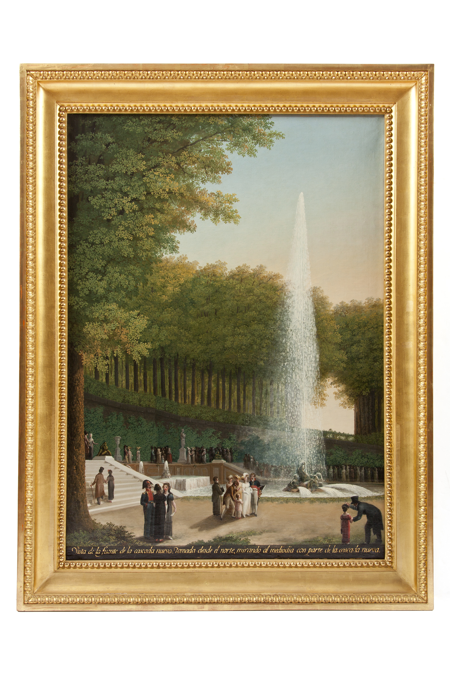
The Casa del Labrador palace in Aranjuez houses twenty-eight oil paintings executed by Brambilla at San Ildefonso, depicting general vistas, palaces, fountains, rivers, waterfalls, ponds and gardens, including two snowy landscapes of great artistic value. His stay at San Lorenzo de El Escorial in 1822 led to the creation of some twenty paintings, ranging from panoramic views of the monastery to its numerous halls: church, library, main staircase, sacristy, pantheon, courtyards and so on.
In 1826, he resigned from his post as director of Perspectives at the Royal Academy of Fine Arts of San Fernando, citing his inability to carry out his duties satisfactorily owing to his responsibilities as court painter and the commission to paint vistas of the Royal Sites which meant that he had to leave the capital on several occasions. However, he continued to hold the position of Academician of Merit. Between 1822 and 1829, Brambilla's health deteriorated considerably and there are several requests and permits in his file “to go and take the waters and mineral baths of Trillo so he may recover his health".
Between 1828 and 1829, during his stay in Aranjuez, he produced several paintings that are now considered outstanding examples of traditional scenes.
Another twenty-eight oil paintings have been inventoried from this period, which are in line with and match the quality of his earlier work. Regarding his works on Madrid, a city he painted on numerous occasions as well as his paintings of the Royal Sites, there is sufficient documentary evidence of most of them in the Palace archives. According to Professor Sotos Serrano, there is evidence that he painted sixteen oil paintings, twelve of which belonged to the Buen Retiro palace, views that were lithographed, and four paintings that belonged to the palace of Moncloa.
1832 witnessed the publication of his Collection of Views of the Royal Sites, a compendium of the work of these last years. It consisted of eighty-eight views, all signed by Brambilla, except for one; with a selling price of fifty reales per booklet of four prints. Two prints were published of this collection, one in black and white and the other in colour.
In August of the same year, in Madrid, the artist bequeathed his entire estate to his daughter, Antonia. A certificate from the church of San Martín states that Fernando Brambilla, aged seventy-one, chamber painter to His Majesty, "died on the twenty-third day of January 1834", at his home in Madrid's Calle de Amaniel.
Source: Royal Academy of History (https://www.rah.es)