Use of Cookies

The Royal Collections Gallery uses its own and third-party cookies, mainly for technical purposes, which are necessary to provide our services and provide you with relevant content. More information in our cookies policy. Cookies Policy.

ACCEPT to confirm that you have read the information and accepted their installation. You can change your browser settings.

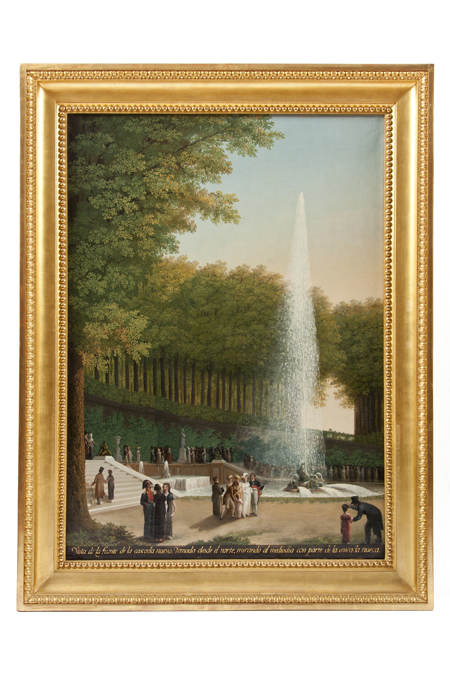
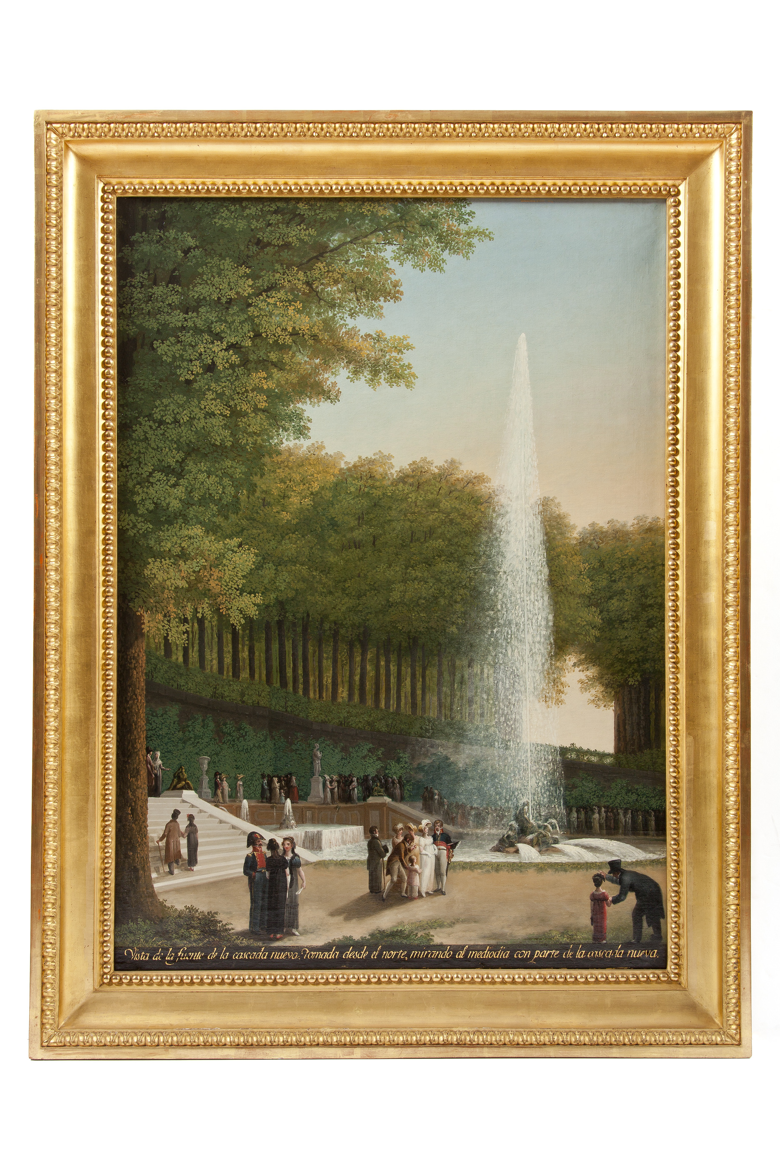
Vista de la fuente de la Cascada Nueva

Diseño general y perspectiva: Brambila, Fernando; Figuras: Tegeo, Rafael
1821-1822

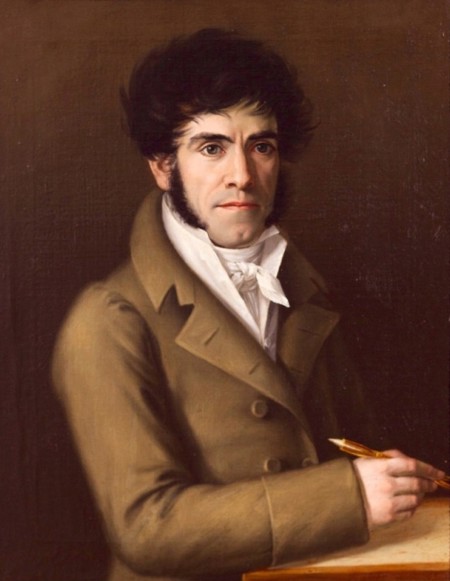
Fernando Brambila (Fara di Gedda d’Adda, 1763-Madrid, 1834) fue un pintor especializado en la realización de perspectivas y vistas urbanas. Formado con probabilidad en la Academia milanesa, ejercía la enseñanza en esta institución cuando fue contratado en 1791 para participar como dibujante en la expedición de Alejandro Malaspina. A partir de entonces, permaneció vinculado a la corte española como pintor, arquitecto y adornista. Tuvo un interés especial por la representación de vistas topográficas, realizando a lo largo de su carrera dibujos y pinturas que después pasarían a la estampa, como la «Vista del Acueducto de Segovia» (1798), la «Vista del Castillo antiguo de Cervantes en Toledo» (hacia 1801) y la serie «Ruinas de Zaragoza», que hizo junto con Juan Gálvez entre 1808 y 1813. Su obra más importante es el conjunto de vistas de los Sitios Reales, pintadas al óleo sobre lienzo entre 1821 y 1833 por encargo del rey Fernando VII. Fue un proyecto artístico de gran envergadura, con un total de noventa y cinco cuadros, concebidos para ser colgados en gabinetes de los distintos palacios reales, con el fin de tener presente la imagen del resto de los Reales Sitios. Se trata de vistas arquitectónicas, pero también de paisajes, donde los habitantes y paseantes tienen un papel importante. Para la realización de las figuras, Brambila contó con la colaboración de otros artistas, principalmente de Manuel Miranda. Se representan ampliamente los jardines de La Granja de San Ildefonso y de Aranjuez, con especial atención a las fuentes, estanques y a las actividades de ocio. Pero también está representado El Escorial, con numerosas ceremonias y actos públicos, así como la ciudad de Madrid, con vistas del Palacio Real, los jardines del Buen Retiro y el paseo del Prado.

Este cuadro forma parte del conjunto de treinta vistas que realizó Brambila del Real Sitio de San Ildefonso entre 1821 y 1822. Se trasladó allí junto con su ayudante, Rafael Tegeo, quien se encargaría, probablemente, de la ejecución de los personajes. De las fuentes, seña de identidad del Real Sitio, realizó hasta catorce pinturas. Esta obra representa la zona baja de la fuente de la Cascada Nueva, impresionante conjunto que se desarrolla frente a la fachada del palacio, con la fuente de Anfítrite, diosa del mar, a la que rodean un grupo de nereidas.

General Classification

Pintura paisajística; Pintura de caballete

Type of Object

Cuadro

By

Diseño general y perspectiva: Brambila, Fernando; Figuras: Tegeo, Rafael

Title

Vista de la fuente de la Cascada Nueva

Era / Cultural Context

Reinado de Fernando VII

Place of Production

La Granja

Date

1821-1822

Display

Lienzo

Technical

Pintura al óleo

Dimensions

Fondo enmarcado (Altura: 106 cm; Anchura: 80,5 cm; Profundidad: 6,8 cm)

Inventory

10028563

Credits

Texto: Isabel Rodríguez Marco; Foto: Mario Sedeño

Discover it at the Planta -2

Authors and Collectors

Brambila, Fernando
The Author

Brambila, Fernando

(Fara Gera d'Adda, 1763 - Madrid, 1834)

Brambilla e Ferrari, Ferdinando. Fara di Gedda d’Adda (Italy), 1763 - Madrid, 23.01.1834. Painter.

The son of Francisco Brambilla and Antonia Ferrari, he began painting at a very early age, and was working as a painter in Milan when it was suggested he join Alessandro Malaspina's expedition at the end of March 1791. His inclusion was a matter of some luck, as two other individuals had been invited: Juan Ravenet, a painter from Parma who hastened to accept, and Blas Martini, who, by rejecting it, enabled the young Brambilla, who was already a professor at the Accademia di Belle Arti di Brera, to join.

After an eventful journey by horse-drawn carriage from Barcelona to the kingdom’s capital, he headed...

Read more
Tegeo, Rafael
The Author

Tegeo, Rafael

(Caravaca de la Cruz, 1798 - Madrid, 1856)

Texedor Díaz, Rafael Facundo, Rafael Tegeo or Rafael Tejeo. Caravaca de la Cruz (Murcia), 27.11.1798 – Madrid, 03.10.1856. Painter.

Called “Tegeo” or sometimes also “Tejeo”, he was a complex artist who depicted with great clarity, the academic eclecticism of the painters of an entire generation, halfway between Neoclassicism and Romanticism.

His refined and precise artistic language with a characteristic fluid, clear and emphatic drawing, ranged from the declamatory style of his early compositions -with a highly visible influence of the classical tradition- to the delicate simplicity of his portraits of the bourgeoisie that attest to the maturity of his art, always characterised by an exquisite artistic sensibility.

His early training was with the Genoese sculptor Santiago Baglietto at...

Read more
Ferdinand VII
Monarch

Ferdinand VII

(El Escorial (Madrid), 1784 - La Granja (Segovia), 1833)

The ninth of fourteen children born to Charles IV (1748-1819) and Maria Luisa of Parma (1751-1819), the future Ferdinand VII was sworn in as Prince of Asturias before the Cortes on 23rd September 1789, following the successive deaths of his older brothers. The Prince’s early years were spent under the tutelage of his caretaker, the Marquess of Santa Cruz, and his successive tutors, of whom the best known were Canon Escóiquiz and his teacher, Father Cristóbal Bencomo. As part of his education, Prince Ferdinand studied philosophy, grammar and Latin, as well as being introduced to music and drawing, the latter being taught by the painter Antonio Carnicero. 

Married four times, Ferdinand VII's wives were Princess María Antonia of Naples and...

Read more

The work in context

View in Timeline