Loading...

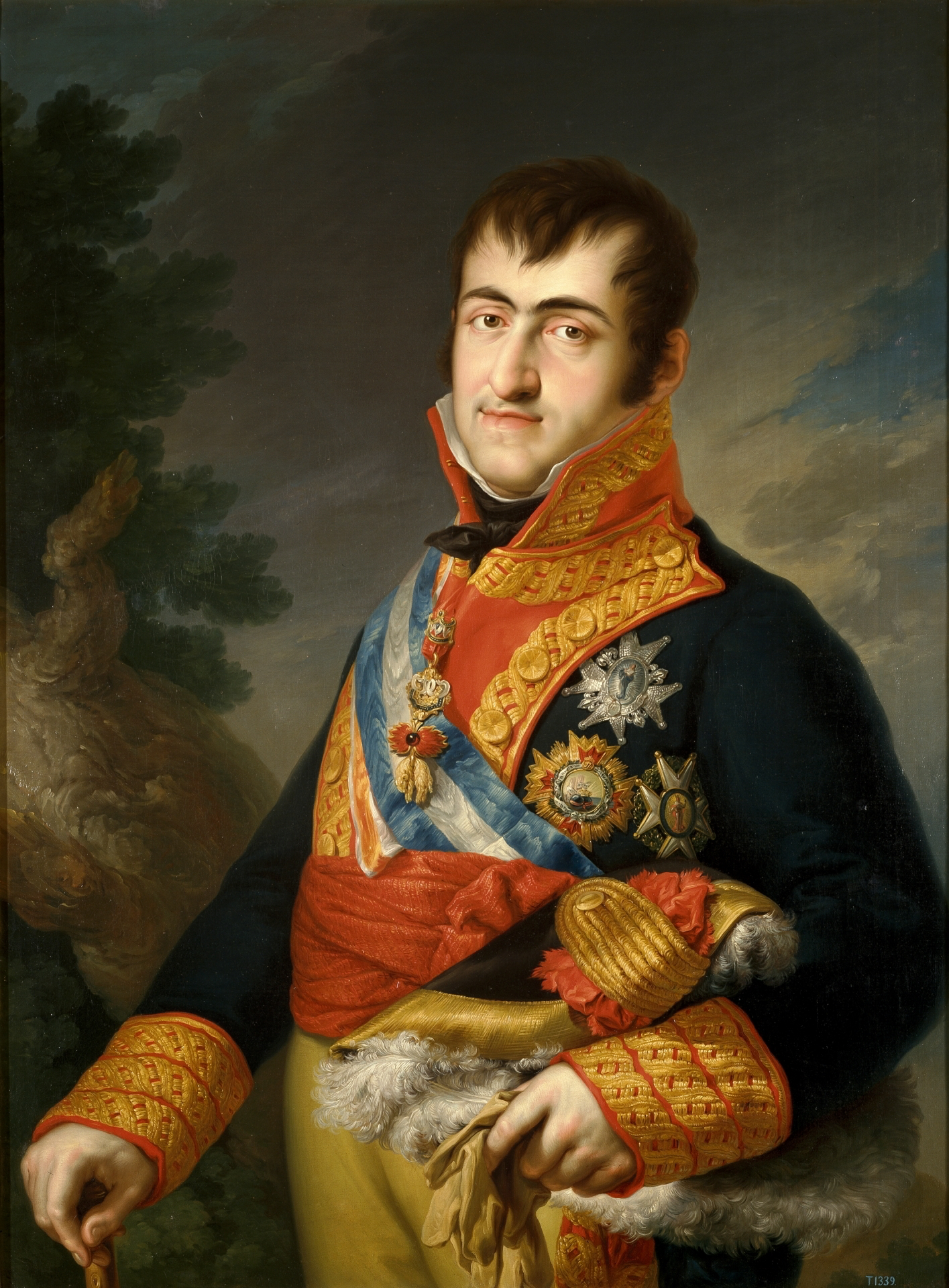
Casa de los Borbones
Ferdinand VII
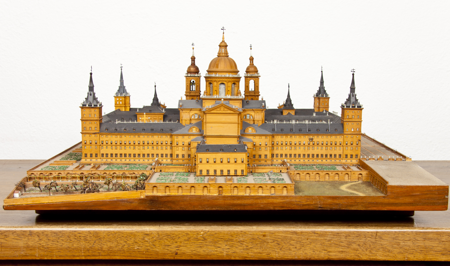
El Escorial (Madrid), 14 de October de 1784 - La Granja (Segovia), 29 de September de 1833
View in TimelineBiography
The ninth of fourteen children born to Charles IV (1748-1819) and Maria Luisa of Parma (1751-1819), the future Ferdinand VII was sworn in as Prince of Asturias before the Cortes on 23rd September 1789, following the successive deaths of his older brothers. The Prince’s early years were spent under the tutelage of his caretaker, the Marquess of Santa Cruz, and his successive tutors, of whom the best known were Canon Escóiquiz and his teacher, Father Cristóbal Bencomo. As part of his education, Prince Ferdinand studied philosophy, grammar and Latin, as well as being introduced to music and drawing, the latter being taught by the painter Antonio Carnicero.
Married four times, Ferdinand VII's wives were Princess María Antonia of Naples and Sicily (1784-1806), with whom he had no children; the Portuguese Infanta Maria Isabel of Braganza (1797-1818), mother of the Infanta María Luisa Isabel, who died shortly after her birth in 1817; the Princess María Josepha Amalia of Saxony (1784-1806), also without children; and Princess Maria Christina of the Two Sicilies (1806-1878), whom Ferdinand VII married on 12th December 1829 and with whom he had two daughters: the future Isabella II (1830-1904) and the Infanta Maria Luisa Fernanda (1832-1897), Duchess of Montpensier by her marriage to Antoine of Orléans (1824-1890).
As heir to the Crown, Prince Ferdinand participated in various plots to bring about the downfall of the minister Manuel Godoy, a particular favourite of King Charles IV and Queen Maria Luisa of Parma. The most important of these was the "Conspiracy of El Escorial", which ended in failure in November 1807. The events at El Escorial were the prelude to the Tumult of Aranjuez. This conflict which took place between 17th and 18th March 1808, led to Godoy being deposed and briefly imprisoned, while Charles IV abdicated in favour of his son on 19th March 1808. Shortly afterwards, Napoleon summoned the royal family to a meeting in Bayonne. During the meeting, the French Emperor forced Ferdinand VII to return the Spanish Crown to his father, Charles IV, who in turn was forced to cede it to Napoleon. Napoleon then handed it over to his brother Joseph Bonaparte. The abdications of Bayonne were never accepted by the Spanish people, who fought against the French occupation and the imposition of Joseph Bonaparte as monarch during the Peninsular War (1808-1814). Throughout the conflict, Ferdinand VII remained in exile in the Château de Valençay (France), where he led a dreary life. Unable to defeat the Spanish resistance, which was supported by England, the French troops left Spain in mid-1813. Under the Treaty of Valençay of 11th December that year, Napoleon agreed to return the Spanish Crown to Ferdinand VII. The monarch returned to Spain in the spring of 1814. Rather than accepting the constitutional system established by the Cortes of Cadiz in 1810, Ferdinand VII took advantage of the differences that had arisen within Spanish Liberalism to repeal the Constitution of 1812 and re-establish an absolute monarchy.
The early years of Ferdinand VII's reign were marked by frequent liberal conspiracies and failed military uprisings led by officers who had distinguished themselves in the Peninsular War, such as the generals Francisco Espoz y Mina, Luis Lacy and Juan Díaz Porlier, among others, as well as the economic difficulties of a post-war Spain that was in the process of rebuilding itself. On 7th March 1820, the uprising of Lieutenant Colonel Rafael del Riego in Las Cabezas de San Juan (Seville) spread the insurrection to different parts of Spain, forcing Ferdinand VII to swear to rule under the Constitution of 1812. Educated from childhood to be an absolute monarch, the monarch found it difficult to adapt to his role as constitutional King. After three years of liberal rule, fears that changes in the Spanish regime could affect the political stability of a post-Napoleonic Europe, led absolutist European powers to plan a new invasion of Spain. At the end of 1823, owing to the intervention of the French army called the Hundred Thousand Sons of Saint Louis, Ferdinand VII was restored to the status of an absolute monarch.
The last decade of his reign (1823-1833) was marked by the financial crisis, aggravated by the definitive emancipation of Spanish America in 1824, and by the struggle between liberals and ultra-Royalists, in favour of continuing the previous regime. Both groups encouraged various absolutist uprisings and insurrections such as the absolutist "War of the Aggrieved" (1827) and the landing of the liberal general José María Torrijos on the coast of Malaga (1831). From 1830 onwards, the question of succession passed to the forefront of the political scene. The Salic Law that excluded women from inheriting the throne was repealed, recognising the Isabella II as heir to the Crown. This was however rejected by the ultra-Royalists, leading Ferdinand VII to surround himself with a group of moderate absolutist ministers, most notably Francisco Cea Bermúdez, with whom he governed until his death in Madrid on 29th September 1833. The remains of Ferdinand VII are buried in the Pantheon of Kings and Queens in the Monastery of El Escorial.
Source: Royal Academy of History (https://www.rah.es)