Loading...

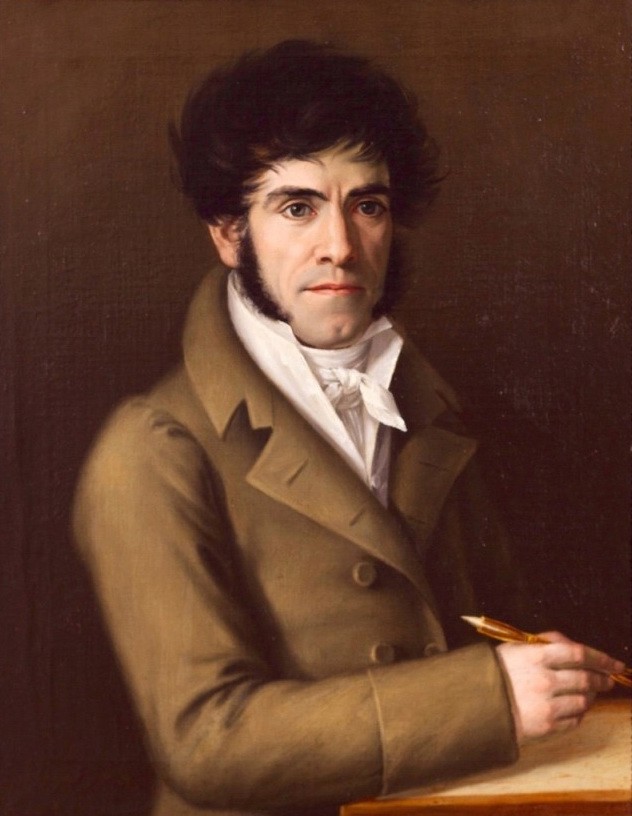
Tegeo, Rafael
(Caravaca de la Cruz, 1798 - Madrid, 1856)
Texedor Díaz, Rafael Facundo, Rafael Tegeo or Rafael Tejeo. Caravaca de la Cruz (Murcia), 27.11.1798 – Madrid, 03.10.1856. Painter.
Called “Tegeo” or sometimes also “Tejeo”, he was a complex artist who depicted with great clarity, the academic eclecticism of the painters of an entire generation, halfway between Neoclassicism and Romanticism.
His refined and precise artistic language with a characteristic fluid, clear and emphatic drawing, ranged from the declamatory style of his early compositions -with a highly visible influence of the classical tradition- to the delicate simplicity of his portraits of the bourgeoisie that attest to the maturity of his art, always characterised by an exquisite artistic sensibility.
His early training was with the Genoese sculptor Santiago Baglietto at the Economic Society of Friends of the Nation in Murcia, under the patronage of the Marquess of San Mamés. From 1818 onwards, he continued his studies at the Academy of San Fernando in Madrid, where he became the most outstanding pupil of the painter José Aparicio (1773-1838) from Alicante, although he also established a close relationship with the Italian landscapist Ferdinando Brambilla (1763-1834), with whom he collaborated as an assistant on the landscapes of the Royal Sites commissioned by Ferdinand VII, between 1821 and 1822 at the palace of La Granja de San Ildefonso.
Following his teachers’ advice, he travelled to Rome to complete his training in late 1822 or early 1823, remaining there for more than five years. During this time, Tegeo’s work was influenced by the Italian master Vincenzo Camuccini (1773-1844), one of the leading artists of the most conservative neoclassical movement in Rome, and who exerted an extraordinary influence on the Accademia di San Luca. He must have also travelled to Florence, where he was a pupil of Pietro Bienvenuti (1769-1844), an artist whose style was similar to Camuccini’s.
During his stay in Rome, he successfully completed a number of religious paintings, including his Healing of Tobias (Caravaca de la Cruz, Brotherhood of the Holy Cross), with echoes of Michaelangelo’s David. His famous Penitent Magdalene (Prado Museum, destroyed) was exhibited for decades in the central gallery of the Prado Museum as one of the reference works of the contemporary Spanish school.
His prodigious, high-quality output in Italy gained him a solid artistic reputation both there and in Spain. Upon his return to Madrid in 1827, his Italian works made him one of the most promising painters of his generation. As a matter of fact, his extended stay in Italy gave him exceptional access to the Academy as an Honorary Member in 1828. But first he was required to prove his loyalty to Ferdinand VII, for which he had to submit statements declaring that for the duration of his stay at the Royal Site of San Ildefonso -and given that many remembered him there as a member of the National Militia- he had remained loyal to the Monarch. He held important positions at the Academy, such as deputy director in 1839 and honorary director from 1842 onwards.
After he joined the Corporation, he produced one of his first major works, Hercules and Antaeus (Madrid, the Academy), clearly influenced by the Florentine Mannerist sculpture he had studied on his trip. The Prado also houses a small sketch of this work, and a beautiful preparatory drawing has also survived. It was undoubtedly a key painting in his career, as it was widely distributed by means of engravings.
When he joined the Academy, the Navy Secretariat commissioned him to make several copies of portraits of illustrious seamen, now held at the Naval Museum. At the same time that he returned and settled at Court, Tegeo probably married María de la Cruz Benítez. Although the date of their marriage is not known, prior to travelling to Rome, he had already painted most of her family and her.
Most of his compositional works, especially his religious paintings —some of which were works of true devotion—, are rooted in Roman Baroque Classicism. This is the case of The Last Communion of Saint Jerome (Prado Museum, now in the Church of San Jerónimo el Real, Madrid), is clearly based on a well-known painting by Domenichino. It was commissioned in 1829 for the high altar of the Church of San Jerónimo el Real in Madrid, although it was never actually hung in its intended site.
Most of the paintings which he presented at Academy exhibitions were inspired by classical antiquity and are painted according to the Neoclassical style in which Tegeo had been trained since the start of his career, but which was by then out of fashion, leading to him being harshly criticised for it. The most notable paintings were those displayed at the Artistic and Literary Lycee in Madrid and painted for the Infante Sebastián Gabriel (1811-1875), depicting subjects such as Antilochus bringing Achilles news of the hard-fought battle between the Greeks and the Trojans to obtain Patroclus' body (private collection), Diomedes led by Minerva, wounding Mars (private collection) and the Battle of the Lapiths and the Centaurs (private collection), among others. During this time, he continued to paint important religious paintings, some of which were owned by the Infante himself or by Isabella II, whose bedchamber also housed an Immaculate Conception painted by the artist
However, Rafael Tegeo's success was largely due to his extraordinary skill as a portrait painter, which he excelled in and which brought him the most social renown, more than any other genre. His refined artistic sensibilities for portraiture, both in terms of the format and the intimate and simple style in which he captured the personalities of his sitters, resulted in a much bolder and freer expression than in other genres.
He created a genre of bourgeoisie portraiture where the sitters are portrayed against a landscape - as in Young Girl Seated in a Landscape, Madrid, Prado Museum) - linking him to the Andalusian portrait painters of the Romantic generation such as Antonio María Esquivel (1806-1857), but with an artistic language that is quite different from theirs.
It was precisely his leading role as a portrait painter at the court of Isabella II that made him an honorary court painter in the late 1840s; after being appointed to his new position, he resumed painting historical compositions, now for propaganda purposes, for example, Ibrahim-el Djerbi or the Holy Moor when he attempted to assassinate the Catholic Monarchs in the tent of the Marquess of Moya (Madrid, Royal Palace), which brought him great success in both Madrid and Paris. His new position also meant he had to accept certain commissions to decorate ceilings, such as The Fall of Phaeton at the Royal Palace of Madrid, or the ones painted in the Casino de la Reina and in the Palace of Vista Alegre.
In 1841, when his father died, he travelled to his homeland to settle his inheritance.
In that year, he also travelled to Caravaca de la Cruz and to Ceheguín, where he painted various portraits, including those of the Santos family and that of Magdalena de Cuenca. Shortly afterwards, in 1845, Tegeo resigned as director of the Academy of Fine Arts of San Fernando, and from all other positions in the institution, without any apparent reason, although it appears to have been prompted by the new curriculum that José de Madrazo sought to impose.
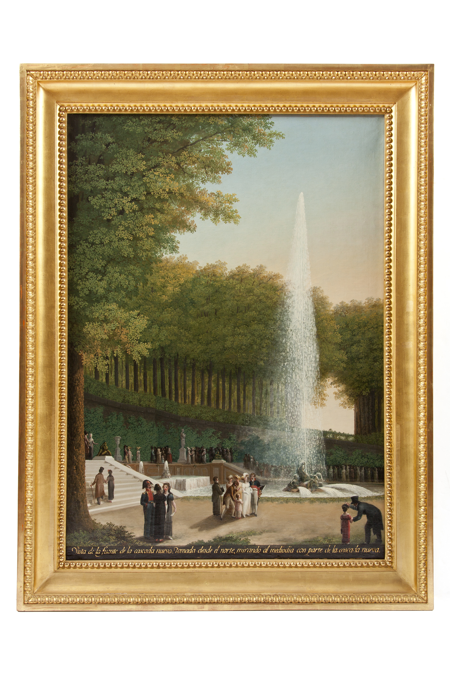
Tegeo also painted other genres deemed of lesser interest in academic circles. Few know of his extraordinary drawing skills, of which there are certain examples in the National Library and the Prado Museum. He was held in especial regard for his extensive activity as a landscape painter, a skill he had acquired as Brambilla's assistant, as well as his forays into genre scenes, which attest to his commitment to the most modern Romantic ideals.
Source: Royal Academy of History (https://www.rah.es)