Loading...


Coxcie, Michiel
(Mechelen (Belgium), 1499 - Mechelen (Belgium), 1592)
Michel (or Michiel) Coxcie (Mechelen, Belgium, 1499 - 1592) was a Flemish painter, nicknamed "the Raphael of the Low Countries" for his great success in the Romanist style.
After an apprenticeship with Bernard van Orley in Brussels, he travelled to Haarlem and Rome, where he resided around 1530-39. He learned the technique of fresco mural painting and was the first Nordic master to practise it. In 1532, he decorated the chapel of Cardinal Enckenvoirt in the Roman church of Santa Maria dell'Anima.
The Original Sin, the wing of a triptych whose central panel has since been lost (Vienna, Kunsthistorisches Museum).
He attained a certain reputation in Italy, and Giorgio Vasari acknowledged that Coxcie had successfully adopted the Italian style. Coxcie's main work in Rome, however, was to design engravings such as The Fable of Psyche (32 plates) engraved by Agostino Veneziano and Bernardo Daddi. These images in the Classist style were mistakenly attributed to Raphael.
Upon his return to the Low Countries, Coxcie joined the Guild of Saint Luke in Mechelen in 1539. Shortly afterwards he moved to Brussels, and joined its guild (1542). He is mentioned in 1546 as being the painter to Mary of Hungary, Philip II's aunt, filling the vacancy left by the late Van Orley. He painted works for the castle of Binche, and made a large copy of Jan van Eyck's Ghent Altarpiece for Philip II, when the king understood that he could not acquire the original. Coxcie also copied Rogier van der Weyden's The Descent from the Cross; when the original was included in the Prado Museum’s collection, Coxcie's copy replaced it in the monastery of El Escorial.
Around 1563, Coxcie returned to Mechelen, at the time, the religious and judicial centre of the Low Countries, and in 1585 he moved to Antwerp. He died in his native city after falling from a scaffolding, almost a hundred years old and still active.
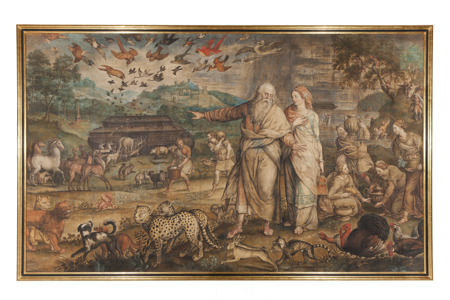
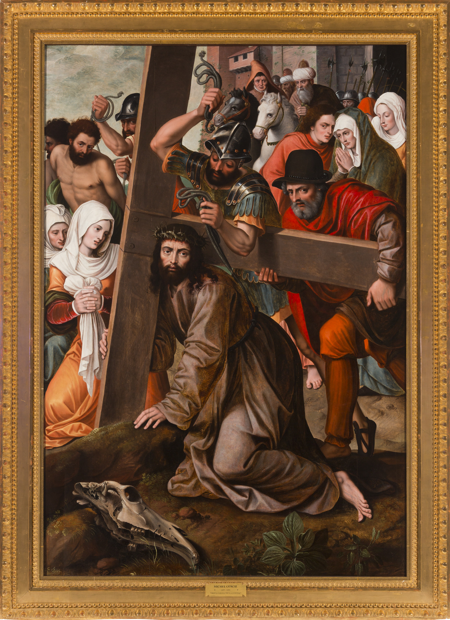
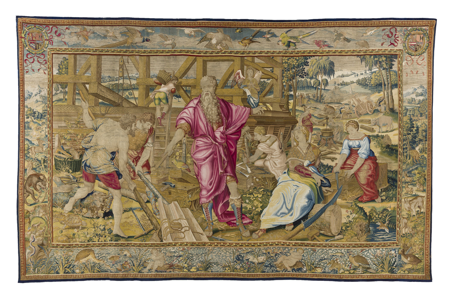
He was a prolific artist: in addition to paintings, altarpieces, frescoes and portraits, he also created designs for engravings, stained glass and tapestries. Greatly admired during his lifetime, he was nicknamed "the Raphael of the Low Countries” and his influence reached as far as the young Rubens, but he was relegated to obscurity in modern times. In 2013, the M-Leuven Museum held an exhibition celebrating works by this artist, the first to date.
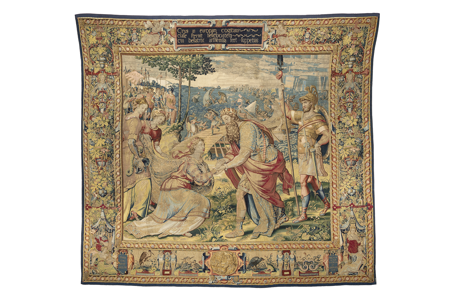
Many of Coxcie's tapestries were acquired by Sigismund II for his castle at Wawel, and the tapestries of The History of Cyrus II, now in the Royal Palace of Madrid, are also attributed to Coxcie. They are based on a text by Herodotus.
In his old age, Coxcie taught a promising boy: Gaspar de Crayer.
Source: Wikipedia
View on Wikipedia
View in timeline