
Use of Cookies

The Royal Collections Gallery uses its own and third-party cookies, mainly for technical purposes, which are necessary to provide our services and provide you with relevant content. More information in our cookies policy. Cookies Policy.

ACCEPT to confirm that you have read the information and accepted their installation. You can change your browser settings.

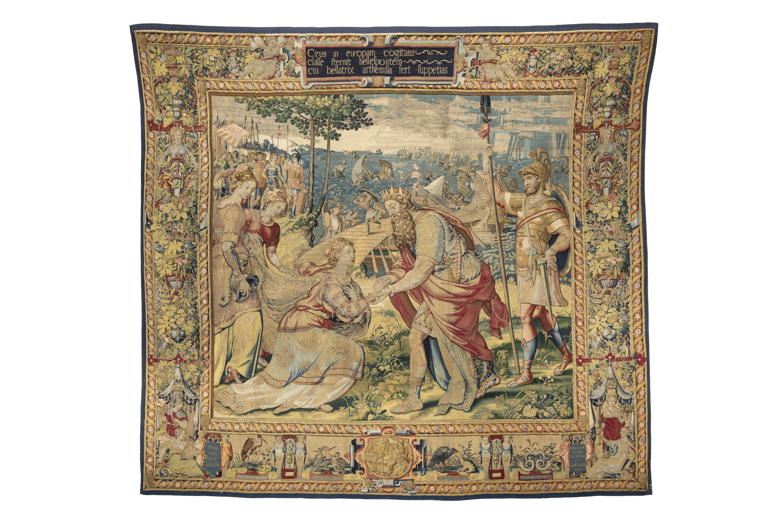
Entrevista de Ciro a Artemisa

Tapiz: Van Tieghem, Jan; Diseño: Atribuido a Coxcie, Michiel; Diseño: Atribuido a Van Heemskerck, Maarten
1555-1558

Este tapiz forma parte de una de las más grandes y ambiciosas series narrativas del siglo XVI: la historia de Ciro el Grande, inspirada en los relatos clásicos sobre este legendario fundador del Imperio persa. Esta impresionante obra, parte de un ciclo de varios paños, fue realizada en Bruselas entre 1555 y 1558, centro neurálgico de la tapicería europea durante el Renacimiento.

Atribuido al maestro tejedor Jan van Tieghem y basado en diseños de los célebres artistas Michiel Coxcie y Maarten van Heemskerck, el tapiz representa un episodio crucial en la expansión persa: la rendición de la reina Artemisa, hija del tirano de Caria, ante el poderoso Ciro. La escena está cargada de simbolismo visual: Artemisa se presenta humillada y escoltada por dos damas, mientras al fondo se aprecian tropas carias y una batalla naval que contextualiza el conflicto.

Esta pieza sobresale por su riqueza material y simbólica. Los hilos metálicos, dorados y de plata, iluminan vestiduras, estandartes y bordes, mostrando el alto nivel técnico y la intención propagandística de la obra. Detalles como la inscripción «ARTEMISIA REGINA CARIE» en la túnica de la reina, o las sentencias en latín que recorren la cenefa («FAMA CONSTAT BELLUM», «REGNUM AUTEM IVSTICIA ET LIBERALITATE») refuerzan su carácter político y moralizante.

En lo alto, una cartela en latín resume el mensaje del tapiz: Ciro se prepara para cruzar hacia Europa, apoyado por la reina guerrera. Esta mezcla de historia, leyenda y alegoría era típica de la tapicería renacentista, un arte que combinaba el lujo visual con el poder del discurso. Así, este tapiz es mucho más que un objeto decorativo: es un testimonio de cómo el arte textil servía como instrumento de memoria, poder y prestigio. Su calidad artística, su riqueza de materiales y su impecable ejecución lo convierten en uno de los paños más notables de toda la serie de Ciro el Grande.

General Classification

Textiles

Type of Object

Tapiz

By

Tapiz: Van Tieghem, Jan; Diseño: Atribuido a Coxcie, Michiel; Diseño: Atribuido a Van Heemskerck, Maarten

Title

Entrevista de Ciro a Artemisa

Collection or Series Title

Historia de Ciro el Grande

Era / Cultural Context

Reinado de Felipe II; Renacimiento flamenco

Place of Production

Bruselas

Date

1555-1558

Subject

Lana; Seda; Hilo de oro; Hilo de plata

Technical

Tapiz de alto lizo

Dimensions

Fondo completo (Altura: 420 centímetros; Anchura: 450 centímetros)

Inventory

10026211

Credits

Texto: Roberto Muñoz Martín; Foto: Mario Sedeño

Discover it at the Planta -1

Authors and Collectors

Coxcie, Michiel
The Author

Coxcie, Michiel

(Mechelen (Belgium), 1499 - Mechelen (Belgium), 1592)

Michel (or Michiel) Coxcie (Mechelen, Belgium, 1499 - 1592) was a Flemish painter, nicknamed "the Raphael of the Low Countries" for his great success in the Romanist style.

After an apprenticeship with Bernard van Orley in Brussels, he travelled to Haarlem and Rome, where he resided around 1530-39. He learned the technique of fresco mural painting and was the first Nordic master to practise it. In 1532, he decorated the chapel of Cardinal Enckenvoirt in the Roman church of Santa Maria dell'Anima.

The Original Sin, the wing of a triptych whose central panel has since been lost (Vienna, Kunsthistorisches Museum).

He attained a certain reputation in Italy, and Giorgio Vasari acknowledged that Coxcie had successfully adopted the Italian style....
Read more
Van Heemskerck, Maarten
The Author

Van Heemskerck, Maarten

Read more
Philip II
Monarch

Philip II

(Valladolid, 1527 - El Escorial (Madrid), 1598)

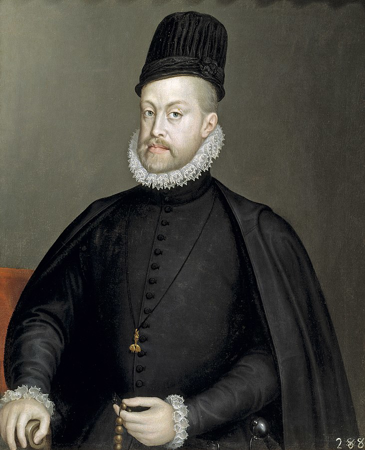
The eldest son of Charles I of Spain and V, Holy Roman Emperor (1500-1558) and Isabella of Portugal (1503-1539), the future Philip II was educated by his tutor, Juan de Zúñiga, by Cardinal Silíceo, his teacher of elementary education and confessor, and by Juan Ginés de Sepúlveda, who provided his pupil with a humanist education. Prince Philip’s political apprenticeship commenced in 1543, when he first replaced his father, Charles I, as Governor of Spain. In 1548, the heir to the Crown set out on a long tour of northern Italy, Austria, Germany and the Netherlands, thus visiting some of the territories that he would rule over in the future.

Married four times, Philip II's wives were María Manuela de Portugal...

Read more

The work in context

View in Timeline