Loading...


Goya y Lucientes, Francisco de
(Fuendetodos, 1746 - Bourdeaux, 1828)
Goya y Lucientes, Francisco de. Fuendetodos (Zaragoza), 30.III.1746 - Bordeaux (France), 16.IV.1828. Painter.
Goya was accidentally born in Fuendetodos, the village of his maternal family. Braulio José Goya, a gilder of Biscayan descent, and Gracia Lucientes, from a well-off peasant family, lived in Saragossa, where they married in 1736. Francisco was the fourth of six siblings: Rita (1737); Tomás (1739), also a gilder and sometimes mentioned as a painter; Jacinta (1743); Mariano (1750), who died in infancy; and Camilo (1753), an ecclesiastic and chaplain in the collegiate church of Chinchón from 1784.
After the school, which tradition accepts with reservations as that of the Piarist fathers of Saragossa, he entered the workshop of José Luzán (1710-1785), also the son of a gilder who was a neighbour of the Goya family, of Neapolitan training and linked to the Academy of Drawing.
Javier Goya, in his biographical notes on his father for the San Fernando Academy (1832), stated that "he studied drawing from the age of thirteen at the Zaragoza Academy under the direction of José Luzán", and Goya, in his autobiography in the Museo del Prado catalogue (1828), said that he had "taught him to copy the most beautiful prints he had", although there are hardly any traces of his late-baroque style in his earliest known works. He later continued his training with Francisco Bayeu Subías (1734-1795), who was related to the Goya family by distant kinship and who, years later, would become his brother-in-law through this traditional link between families of artists. In 1771 the Parma Academy cited Goya as "scolaro del Signor Francesco Vajeu" and he himself confirmed this in 1783 on the occasion of the marriage of his sister-in-law María Bayeu, whom he had known for twenty years as he had studied "at Bayeu's house".
After modest beginnings in Aragon, where the destroyed reliquary in the parish church of Fuendetodos with the Apparition of the Virgin of the Pilar to Saint James is attributed to him around 1765, as well as several paintings for private devotion confirmed as by his hand in the latter years, a court career seemed the only possible one for a young man with ambitions. He moved to Madrid in 1763, following Bayeu, who was working on the decoration of the Royal Palace. In December 1763 Goya applied for a pension from the San Fernando Academy of Fine Arts and in 1766 he applied for the first-class prize for painting, although he failed in both.
In a burst of independence Goya travelled to Italy on his own, as he later stated in a memorial to Charles III (24 July 1779), and he is documented in Rome in the spring of 1771, although he travelled to Italy in June 1769, as the latest documentation of his wedding vows has revealed. Tradition has it that he was in Rome at no. 48 Strada Felice (Via Sistina), the artists' quarter, in the house of the Polish painter Taddeus Kuntz, a friend of Mengs, as Mengs's family claimed years later, although there is no documentary evidence of this. The Italian Notebook (Madrid, Museo del Prado), a sketchbook bought in Italy, contained notes on the cities he visited, all in the north, including Bologna, Venice, Parma and Milan, travelling back via Genoa and Marseilles.
In April 1771 he sent the painting The Victorious Hannibal seeing Italy from the Alps for the first Time (Museo del Prado) to the competition of the Parma Academy, for which he received a mention, reported in the Mercure de France gazzette in 1772. Several drawings in the Italian Notebook copy classical sculptures from Rome, a fresco by Giaquinto, as well as his own compositions and the first documented ideas for early paintings, some of which were already painted in Spain, where he returned between May and July 1771. His first commission was the fresco of the coretto of the Basilica del Pilar in Zaragoza in 1771-1772, the Adoration of the Name of God, a work of exceptional modern grandeur. In this occasion, he gave himself the title of "Professor of Drawing in this City [Saragossa]" (22 November 1772).
He married, however, in Madrid, in the church of San Martín (25 July 1773) to Josefa Bayeu (born on 19 March 1747), sister of Francisco, who was best man at the wedding with his wife, Sebastiana Merklein, although Goya's first son, documented in the Italian Notebook, Antonio Juan Ramón Carlos, was born in Saragossa (29 August 1774), where the artist was working on the frescoes in the Carthusian monastery of Aula Dei.
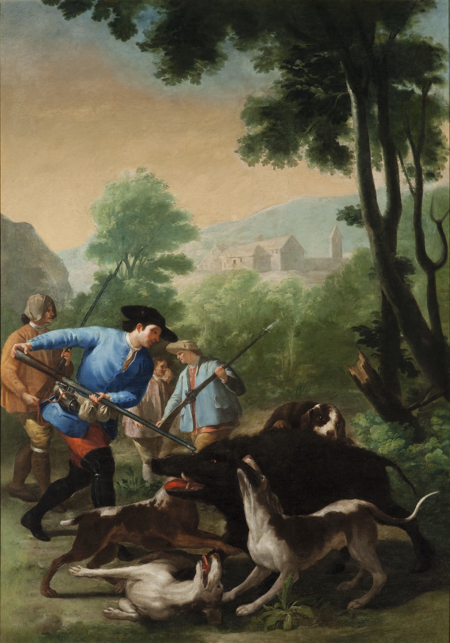
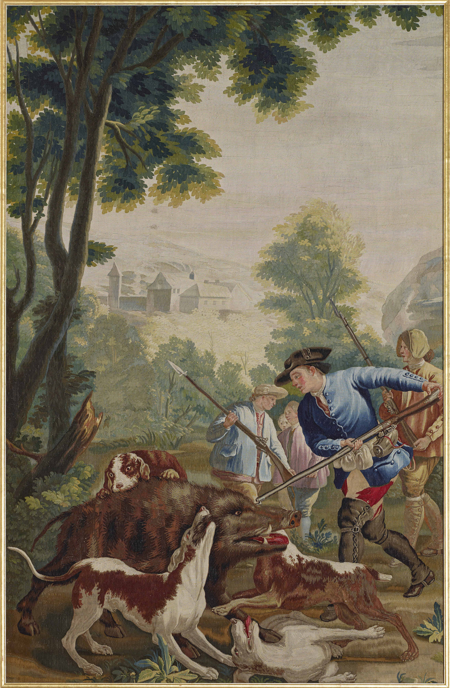
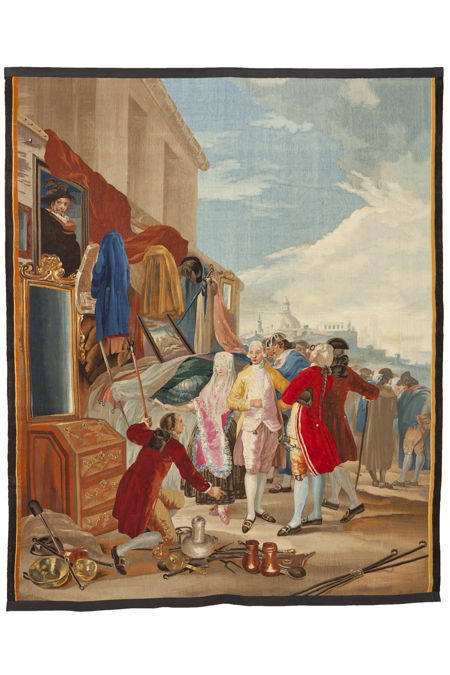
Goya left Saragossa again on 3 January 1775, arriving in Madrid on the 10th (entry in his Italian Notebook) to begin work as a painter of tapestry cartoons for the Real Fábrica de Santa Bárbara at a salary of 8,000 reales de vellón a year. Recommended by Bayeu, Goya later proudly claimed that it was Mengs who brought him back from Rome for the Royal Service, although his first cartoons, dated in the spring of 1775 for the series already begun for the dining room of the princes of Asturias at El Escorial, were painted according to Bayeu's ideas. The subjects depicted, chosen by the king, were hunting, which was the artist's most important hobby throughout his life. Dogs, shotguns and favourite hunting spots, sometimes in the company of his illustrious patrons, appear in the important correspondence with his childhood friend, the Zaragozan merchant Martín Zapater (Madrid, Museo del Prado), such as the outskirts of Madrid, the Guadarrama mountains and El Escorial, Arenas de San Pedro, Chinchón, the Albufera in Valencia and the Coto de Doñana in the lands of Sanlúcar de Barrameda (Cadiz). The artist’s second son, Eusebio Ramón, was born in Madrid (15 December 1775). Goya lived at that time in Calle del Reloj, perhaps in Bayeu's house. Between 1776 and 1778 he painted the cartoons for the dining room of the princes of Asturias in the palace of El Pardo with scenes of popular life in Madrid, such as The Dance on the Banks of the Manzanares and The Parasol, already of his own invention, with popular types characterised with masterly perfection, and amusing stories full of satirical and moralising content, linking up with the popular trend favoured by the Enlightenment. In the naturalism and sense of humour of his scenes, the artist was closer than his peers to the types and situations described in the sainetes (short comic theatre pieces) by a friend of his from those years, the playwright Ramón de la Cruz. Likewise, the characterisation of figures displayed the same knowledge of types and fashions as the illustrations of the engraver Juan de la Cruz, brother of Ramón, in his Colección de Trages de España ("Collection of Spanish Costumes"). The Italian Notebook reveals that Goya attempted to return to Italy with Mengs in 1777, but became seriously ill at the end of that year, as he assured to Zapater to whom he wrote that he had "escaped from hell" and that he had been commissioned to paint two more series for the Tapestry Factory. Two more children were born in Madrid, Vicente Anastasio (21 January 1777) and María del Pilar Dionisia (9 October 1779), when Goya was living in Carrera de San Jerónimo, in the house of the Marchioness of Campollano, although shortly afterwards he moved into his own house, at no. 1 Calle del Desengaño, where he lived until June 1800. Between 1778 and 1780 he painted the series of tapestry cartoons for the bedroom of the Princess of Asturias in El Pardo, with scenes such as The Pottery Vendor and The Blind Guitarrist.The prints on works by Velázquez in the royal collection, which were appreciated by the scholar Antonio Ponz, and The Garrotted Man, of his own invention, are dated at that time. In January of this same year, according to what he told Zapater, he had been presented to the King and the Princess of Asturias, "... and I kissed their hands, as I had never had so much happiness before".
On 7 July 1780, with the classicist Christ on the Cross (Madrid, Museo del Prado), he was unanimously admitted as a member of merit to the San Fernando Royal Academy of Fine Arts. His fifth son, Francisco de Paula Hipólito Antonio Benito, was born (22 August 1780), and in the autumn Goya moved with his family to Saragossa to paint the fresco for the dome of the Regina Martyrum in the Basilica del Pilar. The work was rejected in 1781 by the Basilica's board because of the inappropriateness of the figure of Charity and the general darkness of the colouring, and Bayeu's supervision was imposed on him, which Goya refused. The rift between the two brothers-in-law lasted several years and affected Goya's activity, as he lost commissions from his brother-in-law. His honour as an artist, which he felt so deeply throughout his life, was restored when he was commissioned by the Minister of State, the Count of Floridablanca, to paint one of the paintings for the Basilica of Saint Francis the Great, The Preaching of Saint Bernardine of Siena, which was completed in January 1783. A new child, Hermenegilda Francisca de Paula (13 April 1782), had been born, while his Carthusian brother-in-law, Fray Manuel Bayeu, in his letters to Zapater, admired the artist's fecundity, although all his children except the last, Javier (2 October 1784), died in infancy. In the 1780s Goya's activity as a portraitist began in earnest, of which only a Self-Portrait of around 1772-1775 (Saragossa, Museo de Bellas Artes) is known. Other outstanding works include the Portrait of the Count of Floridablanca as Protector of the Canal of Aragon (1783, Madrid, Banco de España), and those he painted for his new patron, the Infante Don Luis de Borbón, in exile in his palace at Arenas de San Pedro (Ávila). By then, Goya was already recognised by important cultural figures of his time, such as the aforementioned Antonio Ponz, Gaspar Melchor de Jovellanos, whom he portrayed around 1783 (Oviedo, Museo de Bellas Artes), and the scholar and collector Juan Agustín Ceán Bermúdez, although his friendship with other figures such as Leandro Fernández de Moratín and Juan Meléndez Valdés must have begun somewhat later, according to Ceán Bermúdez.
Goya was appointed lieutenant director of painting at the San Fernando Academy (1 May 1785) with a salary of 25 doubloons a year (2,000 reales), and the following year, in July 1786, having settled his differences with Bayeu and at Maella's suggestion, he was appointed painter to the King with a salary of 15,000 reales.
Manuel Bayeu told Zapater of his brother-in-law's appointment: "This action by Francho [Bayeu], as they had not dealt with each other for some time, has been for me the most satisfying I have ever had. God grant that they may live in peace and as God commands". His work for the Tapestry Factory was resumed after six years of inactivity, and in 1786-1787 he produced the series of the Four Seasons for the Prince's dining room in El Pardo, and in 1788 the sketches for the tapestry cartoons for the Infantas' bedroom, including The Meadow of San Isidro and Blind Man’s Buff , the only one of which he executed the cartoon since work was suspended due to the death of Charles III. It was also during this period that he began his long relationship with the Ducal house of Osuna, which lasted until after the War of Independence.
Goya had attained an excellent position at Court, which flattered him deeply. As he told Zapater, he worked only for the highest aristocracy, and of course for the King, whose portrait he painted as a hunter around 1787 (Madrid, Museo del Prado). He concluded that decade with his appointment as Chamber Painter (30 April 1789) and with the portraits of the new kings, Charles IV and Maria Luisa of Parma (Madrid, Academia de la Historia). His correspondence with Zapater, numerous in the 1780s, reveals Goya's friendship with illustrious Zaragozans, including Juan Martín de Goicoechea; Manuel Fumanal, director of the Seminary of San Carlos; Tomás Pallás, a military man and member of the Real Sociedad Económica Aragonesa (Royal Aragonese Economic Society); Alejandro Ortiz y Márquez, doctor and university professor; José Yoldi, general administrator of the Aragon Canal, and Ramón Pignatelli, founder of the Royal Aragonese Economic Society, rector of the University and promoter of the Aragon Canal. These relations culminated with the artist's election as a member of merit of the Real Sociedad Económica Aragonesa de Amigos del País (Royal Aragonese Economic Society of Friends of the Country) (22 October 1790). In Valencia he had painted the works for the chapel of the Duchess of Osuna in the cathedral and related to the Academy of Fine Arts of San Carlos through its secretary, Mariano Ferrer y Aulet, who was appointed a member of merit of the institution(20 October 1790). According to what he told Zapater in November 1787, he was learning French, already spoke Italian and had become "old with many wrinkles that you wouldn't know me except by my bluntness and melted eyes [...] what is certain is that I'm noticing the 41s a lot". The correspondence with his close friend reveals Goya's hobbies, as well as demonstrating what a good son, brother and father he was and how warm his relationship with his friends was. He was fond of bullfighting - even Moratín said, during the Bordeaux years, that Goya boasted of having fought bulls in his youth - but he also attended the theatre, the opera and music concerts at the Court. His cheerful character is revealed in his taste for "tiranas", parties with his friends and family, his trips to Valencia,to "take in the maritime airs", or to Saragossa to attend the Pilar festivities. From 1783 he signed himself as "Francisco de Goya", thus indicating his noble origins due to his Biscayan ancestry, but all his efforts to obtain an “infanzonia¨were unsuccessful, as he found nothing in the archives of Zaragoza to prove his supposed nobility.
Towards the end of 1790 the first symptoms of the serious illness that befell him at the beginning of 1793 appeared, the tremors and dizziness to which he refers in letters from that period to Zapater. In 1791 Goya found it difficult to continue painting tapestry cartoons under Maella's orders and was accused of this before the King by Livinio Stuyck, director of the Royal Factory. However, Bayeu's intervention and the threat that his salary would be reduced made him reconsider his position. Afterwards, the artist then began to prepare his last series, thirteen cartoons for the office of King Charles IV at El Escorial, with "country and funny" scenes, of which he only painted six, including The Wedding and The Straw Manikin. On 14 October 1792 Goya signed the report requested by the San Fernando Academy on the teaching of the fine arts, in which he expressed the need for freedom in the study of painting, which he defined as a "sacred science". He attended the Extraordinary Meeting of 28 October but did not attend that of 18 November owing to a colic he suffered from, and received his academic roll at the beginning of January 1793. He then travelled to Seville, where he fell ill at the end of that month according to correspondence between his friends Zapater and the Cadiz merchant Sebastián Martínez, to whose house in Cadiz Goya was taken, already ill, by his friend Ceán Bermúdez. Martínez stated in January that "the nature of the illness is one of the most fearsome" and at the end of March that "the noise in his head and his deafness have not subsided at all, but his eyesight is much better and he no longer has the confusion that made him lose his balance". Zapater said that "Goya, as I told you, has been precipitated by his lack of reflection". This ambiguous phrase has given rise to numerous interpretations of the nature of the illness, from which Goya was definitively deafened: syphilis, saturnism, "Madrid colic" - metal poisoning in the utensils used to prepare food - and "perlesia" - hemiplegia.
He returned to Madrid at the beginning of May 1793 and in January the following year he presented to the San Fernando Academy the decisive series of cabinet paintings on tin plate, with scenes of bullfighting and other "national amusements", such as The Strolling Players (Madrid, Museo del Prado), together with dramatic subjects, such as The Shipwreck, Fire at Night (private collections), Yard with Madmen (Dallas, Meadows Museum) and A Prison Scene (Bowes Museum), painted independently and without being subject to the impositions of the clientele. It is possible that it was in the months that followed that Goya completed the last cartoons for the tapestries for the King's dining room, begun before his illness. He resumed full activity in 1795, with portraits and commissioned paintings, such as those for the Santa Cueva Chapel in Cadiz. At that time he became close to Godoy and became a patron of the Duke and Duchess of Alba, which even gave rise to the modern legend, based on faint evidence, of the artist's love affair with the Duchess. On Bayeu's death in August 1795, Goya was appointed Director of Painting at the Fine Arts Academy and during this brilliant period he began his albums of drawings, the so-called Sanlúcar Album and Madrid Album, now dated around 1794-1795, with no trace of the tremors of his illness to be seen in his confident, delicate technique. In them he put forward the first ideas for those masterpieces of satire against the vices and customs of society that were Los Caprichos, published in January 1799 and, according to his first biographer, L. Matheron, conceived in the circle of the Duchesses of Alba and Osuna.
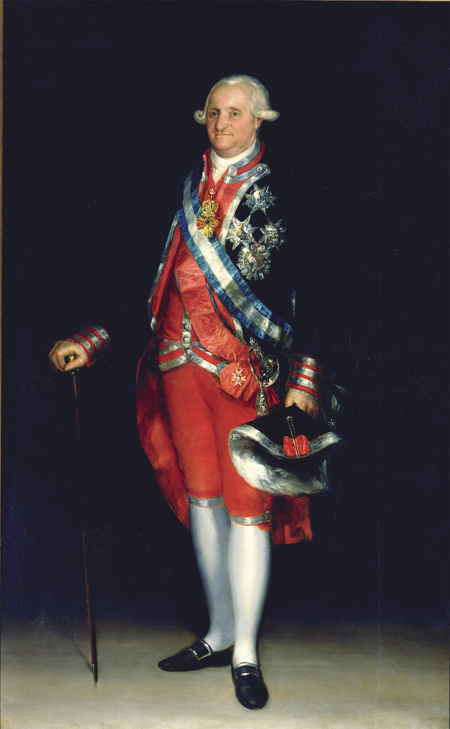
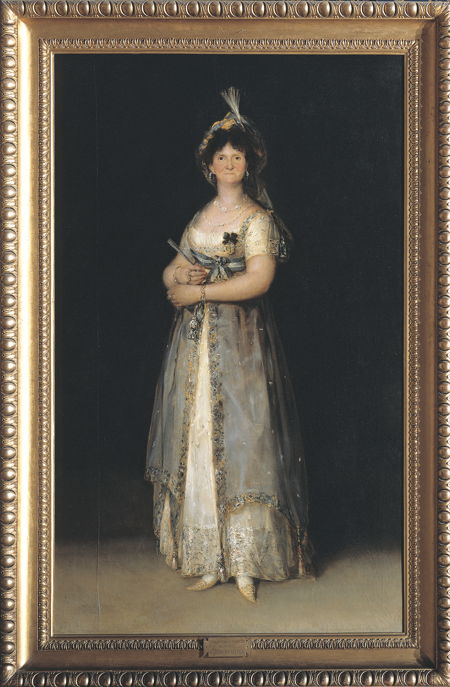
According to Moratin’s notes, he spent part of 1796 in Andalusia, in Cadiz, where he had his own house, and in Seville, while the news about his health was not very favourable. He visited the Duchess of Alba in Sanlúcar and painted the famous portrait of the lady dressed in black (New York, Hispanic Society, 1797). At the beginning of 1797 he returned to Madrid to resign his post as Director of Painting at the Academy because "he sees in the day that instead of having relented his ills have been more exacerbated". The release from his responsibilities at the Academy marked the most prolific years of Goya's life, with exceptional portraits including Jovellanos (1798) (Madrid, Museo del Prado) and La Tirana (1799) (Madrid, Real Academia de Bellas Artes de San Fernando), and works such as The Naked Maja, documented in Godoy's palace in 1800, and the later The Clothed Maja, documented in January 1808. At the end of this decade he finished paintings such as Witches' Affairs for the Duke and Duchess of Osuna, the frescoes in the chapel of San Antonio de la Florida and in December 1798 the Prendimiento for Toledo cathedral, as well as the new royal portraits, Queen María Luisa in a Mantilla, Carlos IV in his Hunting Clothes and the Portrait of María Luisa on Horseback in the autumn of 1799.
The 1790s culminated with Goya's appointment as First Chamber Painter, the highest step in his court career, signed on 31 October 1799 by the Prime Minister, Mariano de Urquijo, and with a salary of 50,000 reales de vellón. On that day Goya wrote his last letter to Zapater (who died in 1803): "The King and Queen are mad about your friend". This royal patronage, and that of Godoy, continued throughout the early years of the 19th century, beginning in June 1800 with the spectacular Family of Charles IV. That same month Goya had moved to his new house at 35 Calle de Valverde and sold his previous home to Godoy, whose service is evident in Portrait of the Countess of Chinchón (April 1800) (Madrid, Museo del Prado), in Portrait of the Minister on the Occasion of the War of the Oranges (1801) (Madrid, Real Academia de Bellas Artes de San Fernando) and in the large allegorical canvases for the decoration of his palace (c. 1802-1804), such as The Allegory of Time and History (Stockholm, Nationalgalleriet). His activity on private portraits was exceptionally rich in these years; In them Goya defined the aristocratic portrait model, of unusual variety, such as those of the Count and Countess of Fernán Núñez (1803) (Madrid, Fernán Núñez collection), of the Marchioness of Villafranca painting her husband (1804) (Madrid, Museo del Prado), of the Marchioness of Santa Cruz (1804) (Madrid, Museo del Prado) and of the Marquis of San Adrián (1804) (Pamplona, Museo de Bellas Artes). At the same time, the rise of bourgeois society led to portraits of this new social class, which Goya painted from the outset in more intimate, sober and realistic works of acute psychology, such as those of the painter Bartolomé Sureda and his wife Teresa Sureda, 1804-1805 (Washington, National Gallery), of Antonio Porcel (1806) (Buenos Aires, Jockey Club, destroyed), of the actors Isidoro Máiquez (Chicago, Art Institute) and of the retired actress Antonia Zárate (c. 1808) (Dublin, National Gallery of Fine Arts), and of the actors Isidoro Máiquez (Chicago, Art Institute) and Antonia Zárate (c. 1808) (Dublin, National Gallery of Fine Arts). 1808) (Dublin, National Gallery).
In June 1803 Goya bought a new house at 7 Calle de los Reyes, which he never lived in, and on 7 July, in a letter to Miguel Cayetano Soler, he gave the King the copper plates of the Caprichos and two hundred copies in exchange for a pension of 12,000 reales for his son Javier, who wanted to study painting. Goya was preparing the future of his son, of whom there is no reliable information about his activity as a painter. On 8 July 1805 he married Gumersinda Goicoechea, daughter of the Madrid merchant Martín Miguel de Goicoechea, whom the artist also portrayed in two splendid new full-length portraits (Noailles collection). In 1806 the artist's only grandson, Mariano, was born, portrayed by his grandfather in 1810, elegantly dressed and pulling a toy cart (Madrid, Larios collection). At the beginning of the 19th century, the artist began to be praised for the height of his art, among which Manuel José Quintana's poem of 1805 stands out, valuing his figure above that of Raphael of Urbino and predicting universal fame for him for centuries to come. He must have continued with his sketchbooks, which are difficult to date extensively, as the compositions relate to themes ranging from the early 19th century to 1820, such as those in albums C, D, E and F.
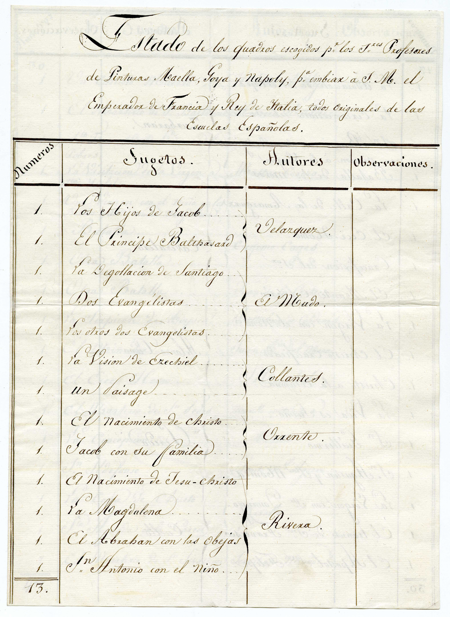
Goya stayed in Madrid during the War against Napoleon (1808-1814) and swore allegiance to Joseph Bonaparte as Palace Officer. He also received the Order of Spain, which he did not take up, and portrayed some of the ministers and authorities of the new French government. In addition, as chamber painter to the new king, he provided lists of paintings from the royal collection for the museum created by Napoleon in Paris, although there is little documentary evidence of his activity at that time, with long periods of silence. The inventory of his assets and those of Josefa Bayeu, who died at the end of the war (12 July 1808), records numerous works that reveal his unceasing activity. He also worked on the etchings of the Disasters of War, denouncing violence against the defenceless people, and on Tauromaquia, published in 1815. In February and March 1814 the Regency commissioned the two large canvases of The Second and Third of May in Madrid (Madrid, Museo del Prado), with the brutal attack by the patriots who were victims of the invasion and the merciless response of the French.
In May Goya passed favourably the purge of palace officials in the service of the French government, recovered his salary and rights and painted again for the Crown and its high dignitaries (Ferdinand VII in Court Dress, Madrid Museo del Prado, and Portrait of the Duke of San Carlos, Saragossa, Museo de Bellas Artes). From 1815 onwards the artist gradually distanced himself from the Court, replaced in the monarch's taste by Vicente López, and then focused on his private activity: portraits (Portrait of the 10th Duke of Osuna, Bayonne, Musée Bonnat), paintings for the Church, which had been his loyal patron since his youth (Saints Justa and Rufina, Seville Cathedral, Sacristy of the Chalices, and The Last Communion of Saint Joseph of Calasanz, Madrid, Piarist Fathers), in the drawings of the albums of that period, C, D and E, in the last plates of the Disasters of War, the so-called Caprichos enfáticos, and in the Disparates series.
Goya was still living in Calle de Valverde when in 1818 he bought a country house on the outskirts of Madrid, known as the "Quinta del Sordo", which was to house his "Black Paintings". From 1815 Leocadia Zorrilla and her two children lived in the house; the young woman, who acted as governess, was a cousin of his son's wife and has been considered by evidence and some references by Moratín, who was already in Bordeaux, as the companion of his last years, although there is no reliable information on this subject.
On 2 May 1824 Goya asked the King for permission to go to France to take the mineral waters of Plombières (Vosges). When the Hundred Thousand Sons of Saint Louis arrived in Spain in September 1823 to restore the King's absolute power, Goya was able to decide to go into exile, as many of his friends and family had been forced to do. However, there is no reliable information about the reasons of his departure, since the trips he made between 1824 and 1828 to Madrid from Bordeaux, as well as his letters to the King requesting his leave of absence and retirement, do not indicate that he was persecuted. In February 1824 Goya granted a general power of attorney to Gabriel Ramiro to administer his salary as a Palace Officer, in May of that year he donated the Quinta del Sordo to his grandson Mariano, and in June, after obtaining the king's permission, he left for Bordeaux. Moratín told Abbé Melón (27 July 1824), a mutual friend, of the arrival of the artist, "deaf, old, clumsy and weak, and not knowing a word of French [...] and so happy and eager to see the world". He immediately travelled on to Paris, where Police, which spied on Spanish political exiles, reveals in its documents that he lived alone, strolled around public places and visited monuments. It is possible that the artist's intention was to visit the Salon, which had been delayed until August that year.
In Paris Goya painted two sober portraits of surprising modernity, those of the exiled politician Joaquín María Ferrer and his wife, and returned to Bordeaux in September, where he met Leocadia Zorrilla and her children. He suffered from a number of ailments and illnesses in those years, which did not, however, prevent him from making four trips to Madrid to settle his affairs and, no doubt, to visit his son and grandson. Moratín gave regular accounts of Goya's life and health to his Madrid acquaintances: "Goya, with his seventy-nine flowery easters and his ailments, neither knows what he expects nor what he wants [...] he likes the city, the countryside, the climate, the food, the independence and the tranquillity he enjoys". He painted portraits of only a few of his friends, such as that of Moratín himself (Bilbao, Museo de Bellas Artes), that of Jacques Galos (Philadelphia, Barnes Foundation) and the last, a few months before his death, the one of his grandson Mariano (Dallas, Texas Meadows Museum) and the one of the merchant Juan Bautista de Muguiro (Madrid, Museo del Prado). His activity focused on intimate, small-format works, such as a series of miniatures on ivory, of which a few examples are known, with singular, expressive and mordant figures, which Goya described as closer to "the brushstrokes of Velázquez than those of Mengs" due to the freedom and expressive power of the brushstrokes. The Bordeaux period is undoubtedly defined by his works on paper, such as the black pencil drawings of the albums G and H, with scenes inspired by reality and others in which he drew on memories and themes that had always interested him, such as satires against the clergy or on deceit and madness, and distorted figures with an aesthetic that precedes 20th-century Expressionism. He then developed a passion for a new technique, lithography, and used the Cyprien Gaulon's atelier to print the series of the Bordeaux Bull. These are impressive visions of the "Spanish fiesta" which are shocking for their large size and their brutal denunciation of the violence of human beings, an idea which had preoccupied him all his life. When he died, he was appreciated only by a small group of friends and family who had faithfully accompanied him to the end, for his profoundly individual art was far removed from the fashions of the moment. He died on the night of 15-16 March 1824, described with shocking realism by Leocadia Zorrilla, and was buried in the Chartreuse cemetery in the same grave as his father-in-law, Martín Miguel de Goicoechea. Years later, what were believed to be his mortal remains were moved to Madrid, where they rest in the chapel of San Antonio de la Florida, beneath the frescoes he had painted in 1798.
Source: Real Academia de la Historia (https://www.rah.es)