Loading...

Juvarra, Filippo
(Messina (Italy), 1678 - Madrid, 1736)
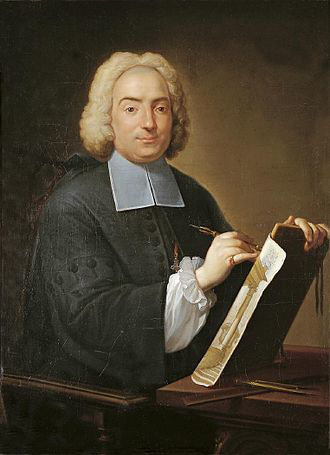
Juvarra, Filippo. Messina (Italy), 1678 – Madrid, 31.01.1736. Architect.
The most renowned architect of his time in Italy and arguably in Europe, his extensive and well-studied European career drew to a close in Madrid, where he had been called by Philip V to build the New Royal Palace in 1735.
Apparently descended from Spaniards —surnamed Ibarra— who settled in Sicily when it was part of the Habsburg Monarchy, Juvarra’s initial artistic education was with his father, a silversmith, in Messina. Although he followed his father's wish that he join the Church, and was ordained at the age of twenty-five, from this moment onwards, the young priest developed a passion for architecture and moved to Rome, where he would begin his real training. There he began studying in 1704 as pupil to, and one of the most talented collaborators of, Carlo Fontana, the heir to the great sculptor and architect, Bernini. His assimilation of this school of architecture is demonstrated by his academic designs for the concorsi clementini. In 1714 he left Rome at what may be considered the completion of his training period.
Between 1714 and 1734, he matured as an architect and developed his personality to the full, all the while in the service of the Savoy family in Turin. His activity and fame, however, were not limited to Italy until his arrival in Spain; firstly, certain unrealised projects, such as a large palace with eight courtyards for the Margrave of Hesse-Cassel (1706-1708) are noteworthy; secondly, he was commissioned to build the new patriarchal church of Lisbon by John V of Portugal in 1718 Juvarra arrived in Portugal in January 1719, and worked on a grandiose plan that included both the temple and a new royal palace. In 1720, he visited London and Paris on his way back to Turin.
The ducal dynasty of Piedmont had been established as a royal house following the readjustment of the Italian political map brought about by the War of the Spanish Succession. Consequently, His Most Serene Highness Victor Amadeus II became His Majesty, first as King of Sicily in 1713 and later in 1720, as King of Sardinia. Economic prosperity and the political promotion of the state meant that the Savoy family undertook the construction of new palaces and the refurbishment of existing ones both in Turin and in the surrounding royal country residences, according to the principles of courtly architecture codified by Louis XIV’s reign, and in whose political and cultural orbit Piedmont had revolved.
Juvarra responded to this vast need with works such as the interior decoration of the Royal Palace in Turin (including the Chinese Room and the scala delle forbici, of 1714), the immediate Palazzo Madama for the Queen Mother, unfinished by Juvarra except for the central section with the monumental staircase (1718-1721), the Palazzo Reale in Rivoli, an ambitious building that also remained unfinished, but whose brilliant plan was captured in scale models and in a painting by Panini (1721), and the additions to the hunting lodge at Venaria Reale, where the royal chapel of Saint Hubertus, the great Gallery, and the stables compete to do outdo each other in terms of their brilliance. But Stupinigi (1729) is undoubtedly the most brilliant and famous of the country palaces conceived by Juvarra for the Savoy family, and the only one to be completed in its entirety: its extensive wings form an X with the vast reception hall at the intersection. The interior, as well as the general planning of this not really small palazzina, is one of the most important creations of late European Baroque architecture.
No less important is another of Juvarra's works for the Savoy family, the basilica of Superga (1717-1731), the most effective solution to a theme typical of the Roman school of architecture where he was trained, that of the central church with a large dome, preceded by a classicist portico and accompanied by two bell towers. His extraordinary palatial designs should not obscure other aspects of his activity in Piedmont, such as his contribution to the urban planning of Turin, where he built buildings such as the Quartieri militari (1716-1728), churches such as the Carmine (1732-1736) and other works for private individuals.
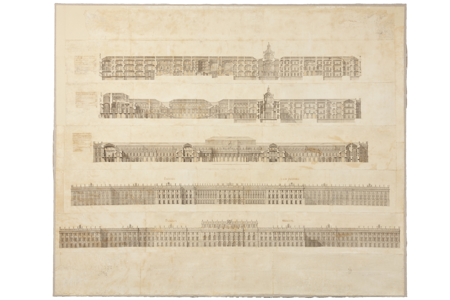
His grand project for the Portuguese Court appears to have been a decisive factor in his arrival in Spain: when the Alcázar of Madrid burnt down in a fire on Christmas Eve 1734, Philip V and Elisabeth Farnese decided to build a new palace and commission its construction to "the Sicilian architect who built the cathedral of Lisbon, whose name is unknown and who serves the king of Sardinia". It took them less than a fortnight to reach this decision, as the king of Sardinia responded to the Spanish monarchs on 18th January 1735, agreeing to allow the artist to leave, and he arrived in Madrid on 12th April.
Given Juvarra's tendency to megalomania, and his own later statement that he did not come to Spain so much to earn money as to gain honour and fame, it was undoubtedly the idea of designing an entire new Royal Palace by himself for the Spanish monarchs that captured his imagination and appealed to him.
The Spanish monarchy was still among the leading powers in Europe, and other ranking monarchies were unlikely to undertake a comparable project -France already had Versailles, in England the royal representation excluded a building of this size- or they had already chosen their own architects, as in the case of Schönbrunn.
The Spanish reality proved to be unsatisfactory; the palace was never built, although his death precluded his knowledge of it, an event that was certainly exacerbated by other disappointments: the architect found himself badly housed, paid with delays, and deprived of some of promised perquisites, mainly that of a carriage. However, the King and Queen appear to have been quite cordial to him, and the communication between artist and sovereign seems to have been good.
It was to this relationship with Philip and Elisabeth, and to the architect's prestige, that we owe a basic feature of Juvarra’s concept of the palace: its location, which was not to be that of the ruined Alcázar of Madrid, a steep site "as he never wanted to design the Palace on this very place, stating that its shortness and irregularity would cause the best architect to lose his credit", in Juvarra's opinion as stated by his disciple Sacchetti. The architect designed a building with a vast horizontal layout requiring another building on much flatter and wider ground; where this was to be was a secondary question, subject to approval by the King and Queen. Apparently, Juvarra suggested more than one location, of which one was Buen Retiro, another along the "heights of San Bernardino", that is, towards the current intersection of the streets of Calle Princesa and Calle Alberto Aguilera. The King and Queen let themselves be swept along with Juvarra's enthusiasm, approved the project in principle, and commissioned a splendid model. While its execution was underway, Juvarra died in Madrid on 31st January 1736. When his disciple Sacchetti arrived to take over the direction of the works, he found that his mission was no longer to build what his master had planned in detail, but to "adapt" his design to the site of the Alcázar, an impossible task in itself.
In the nine and a half months that he lived in Madrid, Juvarra only left his main task to fulfil other royal commissions, above all the Royal Palace of La Granja de San Ildefonso, for which he conceived the building façade towards the gardens. This is one of the most brilliant examples of late European Classicist Baroque architecture, thanks to its powerful giant composite order, covering the two ground and main floors, the delicacy of the design and the magnificence of its execution in pink limestone, grey granite and pink marble. Juvarra apparently received the commission during the summer "sojourn" at said royal site; the marble had already been ordered from Genoa in September and when the architect died, work had begun on digging the foundation trenches. These ruined the modest pre-existing building to which the King and Queen had ordered such a monumental façade to be attached, and it was then that they thought of altering the line of the ground plan, eliminating the central recess. Sacchetti was confronted with this problem upon his arrival in 1736, when all the pieces of Genoese marble were already on site according to Juvarra’s measurements and specifications, but to his credit, he solved this "puzzle" with such skill and discretion that his master's composition lost not an iota of its brilliance nor strength.
In 1735, Juvarra also designed two interiors for La Granja: the great gallery and the Kings' bedroom; both were united by an architectural structure, and their panels were decorated with paintings commissioned by Juvarra from leading contemporary Italian painters.
The bedroom is preserved, with its gilt and Chinese lacquer pilasters, and the series of paintings by Panini; but the gallery with its eight large paintings (now in Patrimonio Nacional) depicting the deeds of Alexander the Great as Philip V's alter ego , was never completed.
.Other commissions by Philip V to Juvarra were minor, if not minimal, such as the cornice of the wall enclosing the palace's new parterre in Aranjuez. As far as is known, he did not undertake any private commissions in Spain, not even for the highest nobility, although this in itself is not surprising, given the brevity of his stay here and the intensity of his dedication to the grand projects which he believed would make him famous. He was buried in the parish church of San Martín in Madrid, where Tiepolo was also buried years later; and after its demolition by the French, there remains no tombstone to commemorate either the architect or the painter, as if they had not been the most renowned Italians of the 18th century. The scale model of Juvarra's grand design for the Royal Palace in Madrid was lost in the second half of the 19th century.
Both his finished buildings and those that did not make it past the design stage had a decisive influence on late European Baroque architecture and the transition to the Neoclassical period, given the creativity with which he handled the Classicist language. His designs were a decisive factor in Spanish architecture, and above all in the creative focus of the Court, as although his grandiose idea was abandoned, it dictated the forms of the New Royal Palace, which was eventually built by his disciple Sacchetti. This monumental work served to train an entire generation of Spanish architects, including Ventura Rodríguez, and led to the creation of the Royal Academy of Fine Arts of San Fernando, in whose teachings the Juvarrian imprint may be traced back to the end of the 18th century.
Source: Royal Academy of History (https://www.rah.es)