Loading...

Pantoja de la Cruz, Juan
(Valladolid, 1553 - Madrid, 1608)
Pantoja de la Cruz, Juan. Valladolid, ca. 1553 – Madrid, 26.10.1608. Chamber painter of Philip III.
He started his first apprenticeship at a very early age, in the workshop of Alonso Sánchez Coello. In one of his wills —which provide a great deal of information on his life and work— he refers to him as “my master”. He did not however stay in Madrid, but left shortly for France after the death of Elisabeth of Valois in 1568, in the company of Jooris van der Straeten, a colleague of Sánchez Coello at Court. From 1572 onwards, Van der Straeten worked as “Peintre de la Reine” for Elisabeth of Austria, the sister of Anna of Austria. After the death of Elisabeth's husband, Charles IX of France, she returned to Vienna. Pantoja parted company with Van der Straeten to accompany the widow, while the latter remained in the service of Catherine de Medici in France. Pantoja painted Elisabeth of Austria, around 1574 in Vienna as a widow and accompanied by a female dwarf (Madrid, prev. Hofmeyer Collection, lost portrait of which a photograph survives), in a style reminiscent of Van der Straeten. In Vienna, he also painted Margarita de Cardona with a girl child who may have been her daughter or granddaughter (Czechia, Nelahozeves Castle). Her husband, Adam von Dietrichstein who had accompanied the Archdukes Rudolf and Ernest as to Spain as their tutor in 1563, had returned with them in 1571 to Austria, where he held important posts at Rudolf's side. Margarita’s portrait was probably painted around 1575 and is therefore related to that of Elisabeth of France. En 1585, Pantoja painted Adam von Dietrichstein wearing black after the Spanish fashion, with an emblem and baton in hand. The portrait bears the inscription "adamus a dietrichstein, rudolphi ii imperatoris supra aula prefectus 1585” (Buenos Aires, Enrique Larreta Museum of Spanish Art.
Pantoja must have returned to Spain around 1585, probably in the hopes that there would be greater demand for portrait painters on the occasion of the wedding of the Infanta Catherine. In 1587, he married Francisca de Huertos, whose mother had died, and who lived in the house of the scholar Barrionuevo de Peralta in Valladolid. Their daughter Mariana was born in 1588, and six years later, their son, Juan Jacome. In 1588, Pantoja’s master, Sánchez Coello died, and he soon began to work at court, although he would not be appointed chamber painter until 1596. At the same time, he maintained his Vienna clientele.
He painted Margarita de Cardona as a Widow(Buenos Aires, Enrique Larreta Museum of Spanish Art) after 1590, as a companion piece to her husband's portrait. After the death of Adam von Dietrichstein in 1590, Margaret had returned to Spain and joined her married daughters. The portrait bears the inscription: “Margarita De Cardona Adami a Dietrichstein Uxor” and underneath, the addition “+ MDCIX”. The portrait of a Young Knight in Armour (Collection of the Duke of El Infantado) and the portrait of A Lady, probably from the house of Aragon or Manrique de Lara (Czechia, Nelahozeves Castle), are also likely to belong to this period, as they were the property of the Pernsteins, a powerful Austro-Hispanic family related to these two Spanish houses. With this last painting, Pantoja was competing with the painter of the house of Aragón, Roland de Mois. Subsequently, in 1591, a year before the death of Mois, Pantoja painted the portrait of María Luisa de Aragón (Czechia, Nelahozeves Castle) and in 1595, that of her sisters, the daughters of the Dukes of Villahermosa and granddaughters of Maria Manrique de Lara, married to Vratislav von Pernstein (in the same location, in very poor condition).
In 1590, Pantoja obtained his first official commission in Simancas, possibly with the help of his family connections in Valladolid. He was to paint thirteen portraits of former Spanish kings for the doors of thirteen "caxones" or document cabinets. A sketch depicting the distribution of the cabinets inside a rectangular room and a preliminary drawing of one of the kings of the "caxons" in Roman costume may still be seen in Simancas.
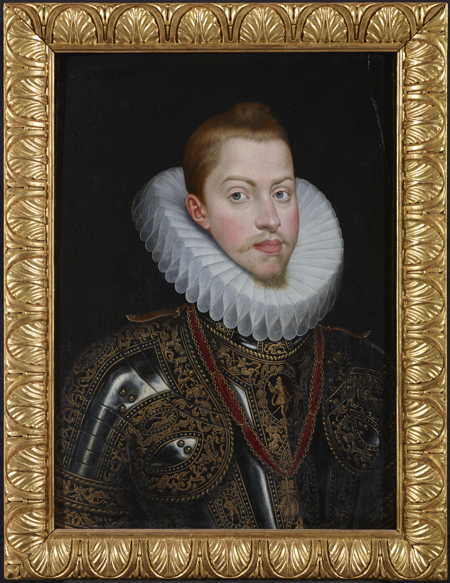
Soon after the death of Sánchez Coello in 1588, Pantoja was called to paint the heir to the throne, the Infante Philip (III). An early full-length portrait of the Infante between the ages of ten and eleven approximately is preserved in photographs. It was followed, in 1591, by another portrait that has been trimmed (Barcelona, Palacio de la Vierreina), yet another in 1592 (Viena, Kunsthistorisches Museum), and a third portrait in 1594 (at the same museum in Vienna). In addition to painting the prince, he also painted the Infanta Isabella Clara Eugenia (Pethworth Sussex, Pethworth House) in this early court period, around 1597, and in the same year he carried out "the works of his trade" for "the funeral of the Infanta Catherine Michaela". In the previous year, 1596, he had been promoted from "painter at court" to the official position of chamber painter.
Around this time, as Philip II feared that he would die without seeing the cenotaphs or tombs of his father and himself by Pompeo Leoni, completed, "plaster casts of the burials" were made.. These plaster copies were placed high up on the right and left of the high altar of the Basílica of El Escorial where the bronze originals would later be placed and were coloured by Pantoja, in collaboration with Niccolò Granello and Fabrizio Castello. Together with Castello, Pantoja also painted the “coats of arms, or genealogies” (Monastery of El Escorial) for these tombs. In the end, Pantoja "copied the plaster casts on two boards" (Monastery of El Escorial, chambers of Philip II) which were placed in the Old Church so that the "tombs" would also be present there. In 1599, he finished a "Portrait of Charles V in Armour, according to Titian" (El Escorial, Audience Hall), also intended for the Old Church as a companion piece to a portrait of Philip II as a young man also in armour, by another painter. After the death of Philip II in 1598, an inventory of the Old King's art collection began and it continued until 1610. In 1600, Pantoja swore an oath to “faithfully appraise the paintings". This was his last task for the Old King.
In 1599, Pantoja commenced his short but intense professional career as chamber painter for Philip II, which ended with the painter’s death in 1608. He painted an early Portrait of Philip III as King in 1599 (Vienna, Kunsthistorisches Museum). That year, he also painted the Portraits of Isabella Clara Eugenia and the Archduke Albert (Munich, Alte Pinakothek), on the occasion of the weddings of Philip II’s two children —Philip III and the Infanta Isabella Clara Eugenia—. Pantoja painted many more portraits of the new royal couple, Philip III and Margaret of Austria, and their children, than Sánchez Coello had painted for Philip II and his family.
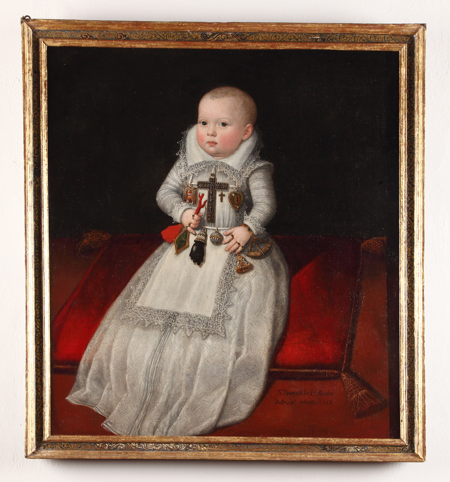
An almost complete list of these portraits was included in the two accounts presented by his heirs after his death. Six portraits of King Philip III, seven of Queen Margaret and eight portraits of the Infantes and Infantas are still available today. These include the portraits of the royal couple in the Prado Museum and of the Queen in Houston (S. H. Kress Foundation); the portraits of the Infanta Anne Maurice at the Descalzas Reales Monastery,in the Villagonzalo Collection and the Vienna portrait (Kunsthistorisches Museum); as well as the Double Portrait of Anne and her brother Philip (IV) in the same place. The accounts also mention three portraits "to be sent to England": those of the King and Queen and the Infanta Anne, no doubt to secure the 1604 peace treaty at Somerset House. He also painted portraits of the King and Queen’s dwarves, such as the lost group of the dwarves Bonamie and Don Antonio, accompanied by several hounds, including Baylan, the Kings' favourite. Pantoja was famous for his depictions of animals, including the Queen's macaque.
Source: Royal Academy of History (https://www.rah.es)