Loading...

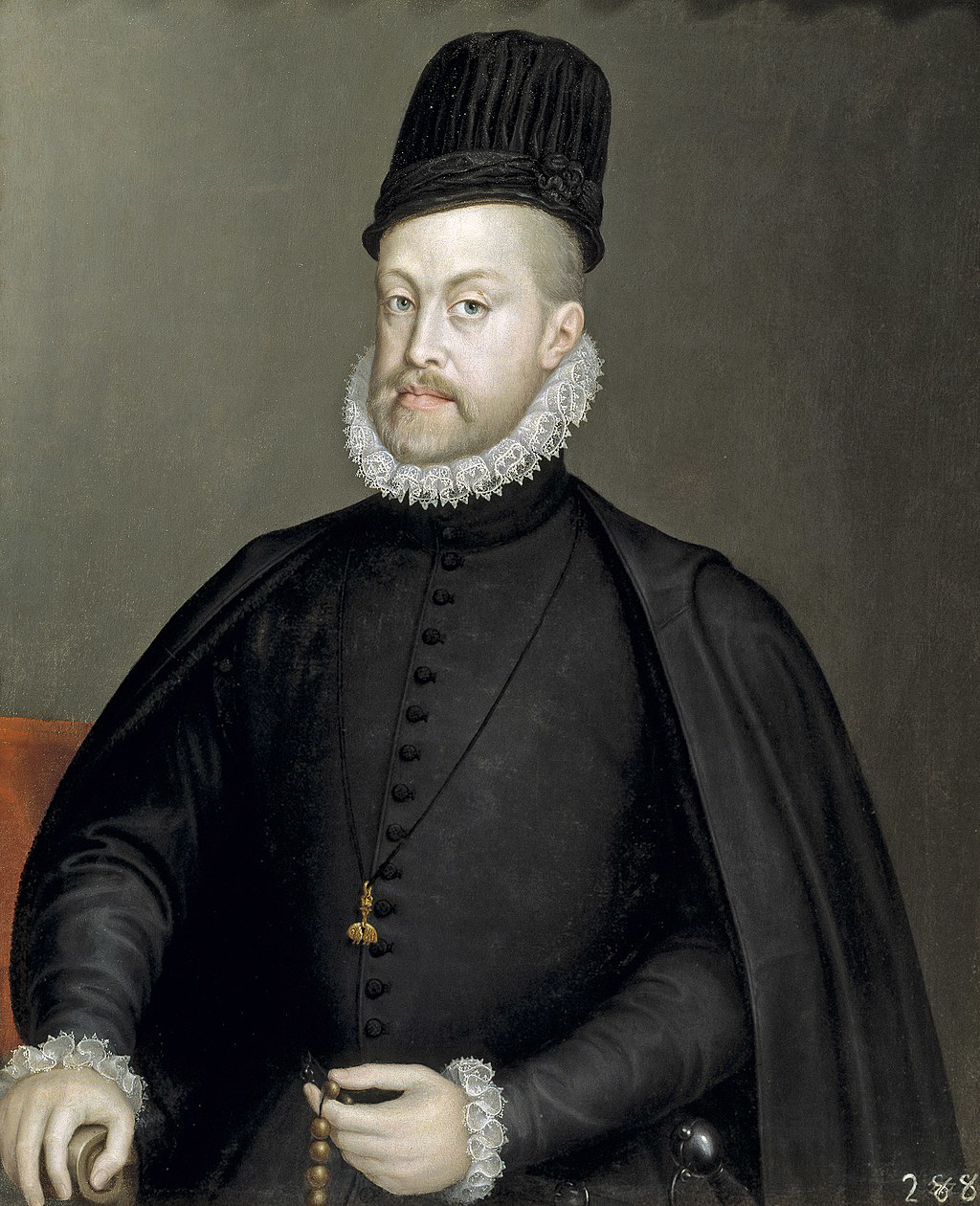
Philip II, King of Spain
(Valladolid, 1527 - San Lorenzo del Escorial, 1598)
Philip II of Spain, also called "the Prudent" (Valladolid, 21st May 1527 - San Lorenzo de El Escorial, 13th September 1598), was King of Spain from 15th January 1556 until his death; King of Naples and Sicily from 1554; and King of Portugal and the Algarves- as Philip I - from 1580, achieving a dynastic union that lasted sixty years. He was also jure uxoris King of England and Ireland by his marriage to Queen Mary I in 1554 until her death in 1558.
He was the son and heir of Charles I of Spain and Isabella of Portugal, brother of Mary of Austria and Joanna of Austria, grandson of Joanna I of Castile and Philip I of Castile by his father, and of Manuel I of Portugal and Maria of Aragon by his mother. He died on 13th September 1598 at the age of seventy-one in the monastery of San Lorenzo de El Escorial at his insistence that he should spend his last days there, for which he was brought from Madrid in a sedan chair made especially for the occasion.
After his death, he was painted by his defenders as an archetypal gentleman and virtuous king, and by his enemies as an extremely fanatical and despotic individual. This black and white dichotomy was also boosted by the king’s own actions, as he refused to have biographies of himself published during his lifetime and ordered the destruction of his correspondence.
His reign was characterised by global exploration and territorial expansion across the Atlantic and Pacific oceans. Under Philip II, the Spanish monarchy became the leading power in Europe and the Spanish Empire reached the peak of its power. It was the first time in history that an empire had included territories from all inhabited continents.
Source: Wikipedia
View on Wikipedia
View in timeline