Loading...

Procaccini, Andrea
(Rome, 1671 - Royal Glass Workshop of La Granja, 1734)
Procaccini, Andrea. Rome (Italy), 1671 - La Granja de San Ildefonso (Segovia), 1734. Italian painter, architect and decorator.
He was born in a wealthy Italian family and began his training in the studio of Carlo Maratta, the most prestigious Roman artist of the times. Together with his master, he restored the frescoes painted by Raphael in the halls of the Vatican and also participated in the decoration of the Baptismal Chapel of Saint Peter’s, as did his master and Andrea Passeri. In 1719, Pope Clement XI appointed him supervisor of the Royal Tapestry Workshop of San Miguel, for which he produced a series of tapestry cartoons that made him famous. During this time, he began to teach younger artists at the Accademia di San Luca. His close connections to the Roman aristocracy and high Church prelates, such as Cardinal Acquaviva, Spain’s ambassador to Rome, gave him the chance to move to the Spanish court.
One of his patrons, Cardinal Alberoni, praised Procaccini’s talent for frescoes, cartoon, drawings, paintings, and engravings in his correspondence. This decision displeased Clement XI who felt that the move would deprive him of Procaccini’s services, however they maintained their relationship, as Procaccini sent him a portrait as well as a painting of Saint Cecilia from the Iberian Peninsula.
In 1720, he moved to Madrid, accompanied by his wife Rosalia O’Moore. In September of the same year, he was appointed to the position of chamber painter by Philip V, who gave him a salary of 1666 doubloons a year, which was significantly higher than the amounts paid to other artists of the period, although the painter had to pay the costs of canvases and paints from his own pocket. Hi first works consisted of the paintings held at the Alcázar in Madrid, although he also painted portraits and easel paintings on religious and secular themes during this period. He subsequently took over the management of the Royal Tapestry Workshop of Santa Bárbara, replacing his compatriot Bernardino Cami. His experience at the institute in Rome was a decisive factor in his appointment, although he took on a series of prerogatives more suited to his profession, such as producing a complete series of drawings on Don Quixote, a project that was continued by one of his disciples after his death.
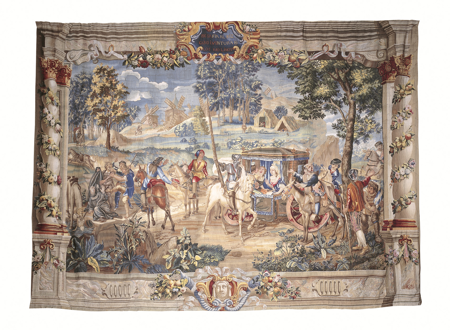
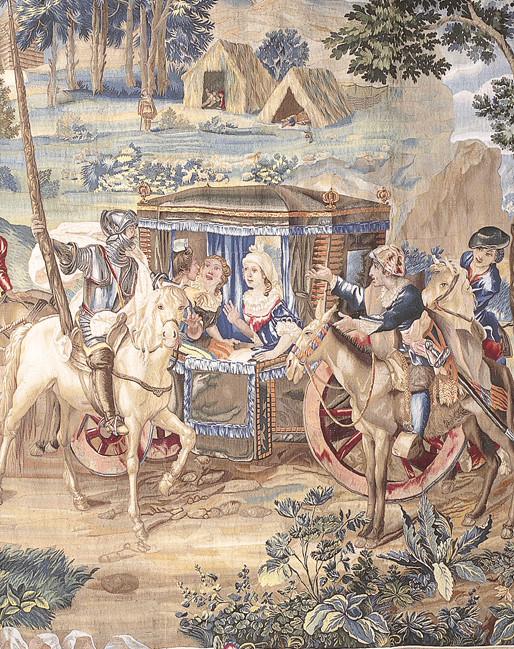
At the tapestry workshop of Santa Bárbara, he taught workers how to weave with a high warp loom, as he believed that this system would prevent the compositions from turning out upside down, as was the case with the low warp loom. For this, he personally trained a group of craftsmen and even moved to Seville for a brief period where he set up the tapestry workshop in the former La Lonja building, now the Archive of the Indies. However, the business was forced to shut down in later years, due to a lack of funds. During his stay in the Andalusian capital, he produced a series of cartoons to commemorate The Capture of Oran, which sought to compare the exploits of Philip V with those of his ancestor: Charles V.
Pleased with his work, the Royal Family invited the artist to one of their residences, La Granja de San Ildefonso, nestled in the hills of Segovia, where the architect Teodoro Ardemans had designed a small palace-fort with four corner towers and a chapel with frescoes painted by Procaccini himself. He also decorated the ceilings of the monarchs’ bedchambers in the palace, although the volume of work meant that he needed assistants to aid him, and who inherited their positions upon their master’s death, continuing to work for the Dowager Queen when she moved to the Royal Site.
The original La Granja complex was modified when construction of the collegiate church commenced, and for which he designed two paintings, the first depicting The Imposition of the Chasuble on Saint Ildephonsus, while the second painting, whose whereabouts are currently unknown,depicts Saint Fructus, the patron saint of Segovia.
Writings from this period state that the Italian artist also worked on the design of the stained glass windows and even the church bells, a clear sign of the monarchs’ trust in him. In 1724, he was appointed director general of the works at La Granja and palace chamberlain, in addition to his position as chamber painter.
His role as art advisor to the Royal Family has been less discussed, in fact he was responsible for the acquisition of a collection of Flemish paintings owned by the Marquess of Scotti, and the purchase of an important collection of art owned by Philip V's surgeon.
Subsequently Andrea Procaccini suggested to the King at Court that he purchase Carlo Maratta’s collection which had been put up for sale by his daughter Faustina in Rome. This valuable legacy was acquired by the Royal Academy of Fine Arts of San Fernando, which also acquired some 300 drawings by Procaccini years later that are still housed on its premises today. It consisted of a series of one hundred and twenty-four works that were finally acquired in 1723 with money from the American colonies.
Together, the three collections added up to more than two hundred paintings of the Flemish and Italian school, and constitute the core works of the art gallery at La Granja de San Ildefonso. The efforts of the artist and sculptor Camillo Rusconi to acquire the antique sculptures owned by Queen Christina of Sweden were equally successful. He was also responsible for arranging the arrival of the paintings owned by Houasse and the acquisition of several paintings by Murillo, Luca Giordano and other artists in Seville.
Andrea Procaccini died in June 1734. At the time he was completing the painting of the high altar of the collegiate church, to be placed on the altarpiece designed by Teodoro Ardemans. It was a painting of the Virgin and Child surrounded by the patron saints of the Royal Family, a work that was eventually modified by a disciple of the Italian artist, who introduced the figure of an angel holding a model of the Alcázar of Madrid, recently destroyed in a fire, as a symbol of its swift reconstruction.
Source: Royal Academy of History (https://www.rah.es)