Use of Cookies

The Royal Collections Gallery uses its own and third-party cookies, mainly for technical purposes, which are necessary to provide our services and provide you with relevant content. More information in our cookies policy. Cookies Policy.

ACCEPT to confirm that you have read the information and accepted their installation. You can change your browser settings.

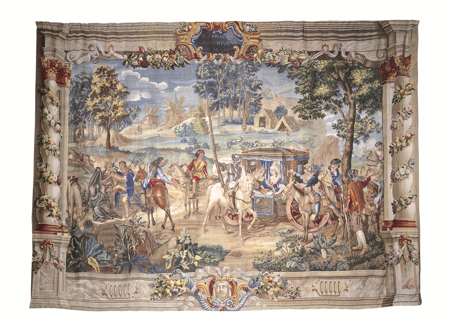
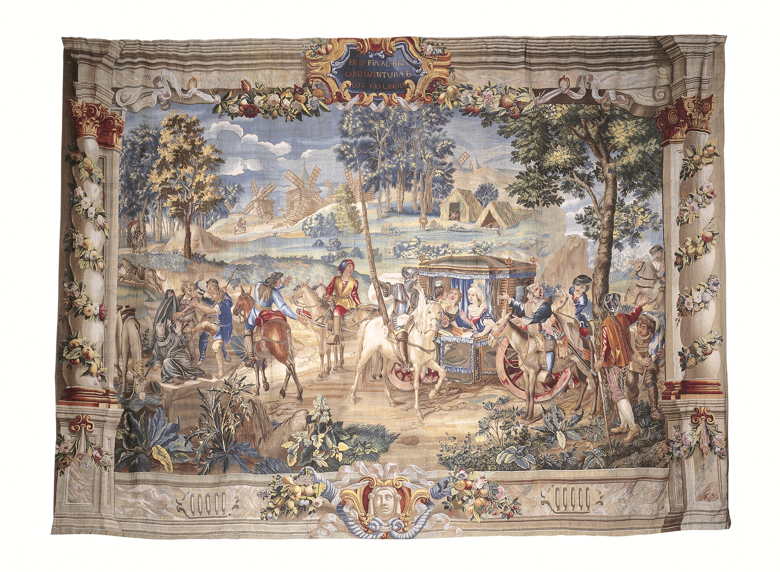
Desafío al vizcaíno y aventura de los molinos

Diseño: Procaccini, Andrea; Diseño: Sani, Domingo María; Tapiz: Vandergoten, Francisco; Tapiz: Real Fábrica de Tapices
1727-1746

Con la llegada al trono de España de la nueva dinastía Borbón, los gustos de la corte se transformaron, afectando de forma sustancial a las modas de los nuevos gobernantes. Estas modificaciones condicionaron en gran parte las necesidades de los palacios reales, que tuvieron que adaptarse y reformarse. Por ello, en época de Felipe V (1682-1746) se crearon una serie de fábricas para abastecer de objetos suntuarios a estos reales sitios.

Estas manufacturas no solo renovaron las formas, sino también los contenidos. En el caso de la tapicería, uno de los temas más utilizados, tanto en España como en otros países como Francia o Italia, fue la narración de las hazañas de don Quijote de la Mancha, insigne obra de Miguel de Cervantes. La utilización de este texto se había difundido ampliamente por Europa no solo en el ámbito literario, sino también en las artes plásticas. Sus temas, anecdóticos, divertidos e incluso jocosos eran idóneos para grandes decoraciones palaciegas, en detrimento de aquellas grandes gloriosas gestas militares del pasado.

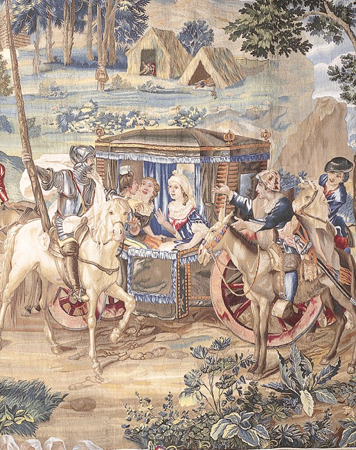
El episodio narrado en el tapiz es uno de los más famosos de la novela cervantina, el de la lucha contra los molinos de viento. Esta escena, sin embargo, se encuentra en un segundo plano de la composición, alejada del espectador. El centro del tapiz lo ocupa otro episodio, el del ataque del hidalgo manchego a los frailes que tenían «prisionera» a una dama vizcaína que se disponía a bajar al sur de España.

General Classification

Textiles

Type of Object

Tapiz

By

Diseño: Procaccini, Andrea; Diseño: Sani, Domingo María; Tapiz: Vandergoten, Francisco; Tapiz: Real Fábrica de Tapices

Title

Desafío al vizcaíno y aventura de los molinos

Collection or Series Title

Historia de don Quijote

Era / Cultural Context

Reinado de Felipe V; Barroco

Place of Production

Madrid

Date

1727-1746

Subject

Lana; Seda

Technical

Tapiz

Dimensions

Fondo completo: (Altura: 396 centímetros; Anchura: 535,5 centímetros)

Inventory

10007060

Credits

Texto: Roberto Muñoz Martín

Discover it at the Planta -2

Authors and Collectors

Procaccini, Andrea
The Author

Procaccini, Andrea

(Rome, 1671 - Royal Glass Workshop of La Granja, 1734)

Procaccini, Andrea. Rome (Italy), 1671 - La Granja de San Ildefonso (Segovia), 1734. Italian painter, architect and decorator.

He was born in a wealthy Italian family and began his training in the studio of Carlo Maratta, the most prestigious Roman artist of the times. Together with his master, he restored the frescoes painted by Raphael in the halls of the Vatican and also participated in the decoration of the Baptismal Chapel of Saint Peter’s, as did his master and Andrea Passeri. In 1719, Pope Clement XI appointed him supervisor of the Royal Tapestry Workshop of San Miguel, for which he produced a series of tapestry cartoons that made him famous. During this time, he began to teach younger artists at...

Read more
Sani, Domingo María
The Author

Sani, Domingo María

Domingo Maria Sanni (siglo XVIII) fue un pintor y arquitecto italiano del período barroco tardío, activo en España.

Confundido por algunos con el pintor toscano Sani di Pietro, lo era. Fue pintor de cámara del rey Carlos III de España, por lo que probablemente residió en Madrid. Vivió durante muchos años en el Palacio Real de San Ildelfonso, donde sirvió a la reina madre, Isabel Farnesio. Se le describe participando en la construcción de una galería de escultura en el Palacio La Granja. Sus pinturas en el Museo del Prado reflejan temas de Bamboccianti.

Read more
Vandergoten, Francisco
The Author

Vandergoten, Francisco

Read more
Royal Tapestry Workshop
The Author

Royal Tapestry Workshop

(1720 - )

The Royal Tapestry Workshop of Santa Barbara is one of the royal workshops for the manufacture of luxury items created by Spanish mercantilist policy during the Age of Enlightenment. It was founded in 1720 by Philip V, in the likeness of the French royal workshops under the Colbertist model, following the interruption of the imports of Flemish tapestries after the Peace of Utrecht, and it supplied the pieces intended for the royal chambers. Since 1889 it has been located in the district of Pacífico in Madrid, in a building constructed between 1889 and 1891. It continues to carry out the activity for which it was created.

Read more
Philip V
Monarch

Philip V

(Versalles (Francia), 1683 - Madrid, 1746)

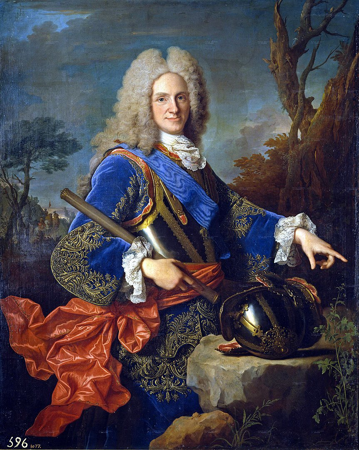
The second son of Louis of Bourbon (1661-1711), commonly known as the Grand Dauphin, heir to the French Crown, and Maria Anna Christine Victoria of Bavaria (1660-1690), the future Philip V grew up at the court of Versailles during the reign of his grandfather, Louis XIV of France. He was educated by François Fénelon, later Archbishop of Cambrai. Grandson of the Infanta Maria Theresa, eldest daughter of Philip IV, on his father’s side, he ascended the Spanish throne after the death of Charles II, who appointed him as his successor in his last will and testament dated 3rd October 1700. 

The first Spanish monarch of the House of Bourbon, Philip V's reign took place in two stages. The first lasted...

Read more

The work in context

View in Timeline