Loading...


Casa de los Borbones
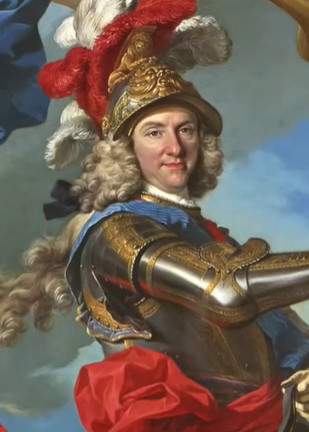
Philip V
Versalles (Francia), 19 de December de 1683 - Madrid, 09 de July de 1746
View in TimelineBiography
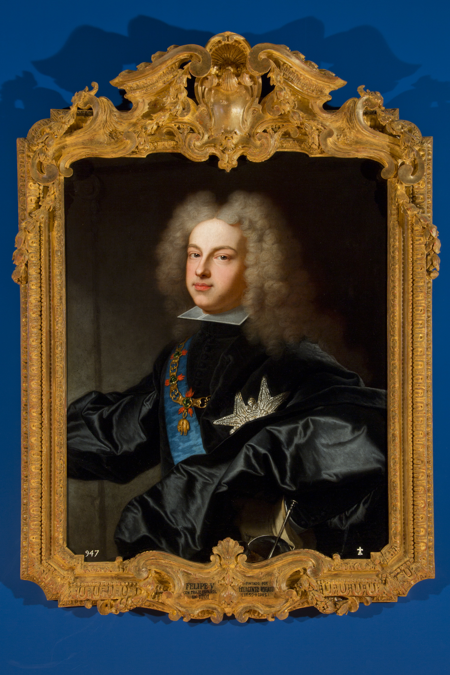
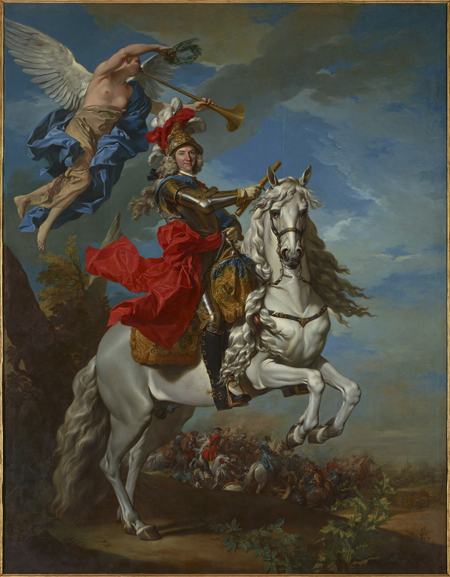
The second son of Louis of Bourbon (1661-1711), commonly known as the Grand Dauphin, heir to the French Crown, and Maria Anna Christine Victoria of Bavaria (1660-1690), the future Philip V grew up at the court of Versailles during the reign of his grandfather, Louis XIV of France. He was educated by François Fénelon, later Archbishop of Cambrai. Grandson of the Infanta Maria Theresa, eldest daughter of Philip IV, on his father’s side, he ascended the Spanish throne after the death of Charles II, who appointed him as his successor in his last will and testament dated 3rd October 1700.
The first Spanish monarch of the House of Bourbon, Philip V's reign took place in two stages. The first lasted from November 1700 until 10th January 1724, when the monarch abdicated in favour of his eldest son, Louis I. The second stage was from 6th September 1724, when King Louis died of smallpox, until 9th July 1746, the date of his own death.
Philip V was married twice. His first wife was Princess Maria Luisa Gabriella of Savoy (1688-1714), whom he married in Figueras (Gerona) on 3rd November 1701. The royal couple had four children: the future Louis I (1707-1724), who reigned briefly in 1724; the Infante Felipe (born and died in 1709); the Infante Philip Peter (1712-1719); and Ferdinand VI (1713-1759), who succeeded his father in 1746. After Queen Maria Luisa Gabriella of Savoy died on 14th February 1714, the King married Princess Elisabeth Farnese (1692-1766) of Parma, in Guadalajara on 24th December that same year. The couple had seven more children: the future Charles III of Spain (1716-1788); the Infante Francisco (born and died in 1717); the Infanta Mariana Victoria (1718-1781), Queen of Portugal by marriage to Joseph I (1714-1777); the Infante Philip (1720-1765), Duke of Parma; the Infanta Marie Thérèse (1726-1746), Dauphine of France by marriage to Louis, Dauphin of France (1729-1765); the Infante Luis Antonio (1727-1785), who was to become Archbishop of Toledo and Cardinal of the Holy See; and the Infanta Maria Antonia Ferdinanda (1729-1785), Queen of Sardinia by her marriage to Victor Amadeus III of Savoy (1726-1796).
The early years of Philip V's reign were marked by the outbreak of the War of the Spanish Succession (1701-1714), which pitted France and the Hispanic Monarchy against the powers of the Grand Alliance of The Hague: England, the Dutch Republic and the Holy Roman Empire, joined by Portugal and Savoy in 1703. Although the origins of the conflict lay in Leopold I's defence of the succession rights of his son, Archduke Charles of Austria, it was also influenced by political, economic and commercial factors. In Spain, the War of the Spanish Succession also resulted in a civil conflict. While there was widespread loyalty to Philip V amongst Castilians, Navarrese and the Basque, large sectors of society in Valencia, Aragón, the Balearic Islands and Catalonia, known as "Habsburgists", were in favour of Archduke Charles, who established his court in Barcelona in 1705.
Throughout 1713, all European powers, with the sole exception of Austria until 1725, recognised Philip V as King of Spain. However, under the Peace Treaty of Utrecht-Rastatt (1713-1714), the Hispanic Monarchy had to relinquish the Netherlands and its territories in Italy, as well as Gibraltar and Minorca to England, which also received certain trade privileges overseas. The end of the War of the Spanish Succession also meant the entry into force of the Nueva Planta Decrees in Valencia, Aragón, Mallorca and Catalonia. These decrees were enacted between 1707 and 1716 and proposed a complete overhauling of the prevailing political and administrative systems of the Hispanic Monarchy up to that time.
Post-1714, Spain’s foreign policy was dictated by the revisionism of the Treaties of Utrecht-Rastatt and by the Spanish government's interest in reconquering Minorca, Gibraltar and the Italian territories ceded after the peace. This prompted the signing of the first and second "Family Pact” on 7th November 1733 and 25th October 1743 respectively with France, as well as Spain's intervention in the Wars of the Polish Succession (1733-1735) and the Austrian Succession (1740-1748). Although it could not recover Minorca and Gibraltar, Spain managed to conquer the Kingdoms of Naples and Sicily, as well as the Duchy of Parma, granted to the King's sons, the Infantes Charles, the future Charles III, and Philip of Bourbon. Prior to this, the Spanish government had re-established relations with the Holy See by signing the Concordats of 1717 and 1737.
In terms of domestic policy, Philip V's reign was characterised by reform and administrative rationalisation, driven by the creation of the Secretaries of State and of the Office. Initially, foreigners such as the Frenchman Jean de Orry, the Parmese Cardinal Alberoni, and the Dutch Juan Guillermo Ripperdá shared power with ministers of Spanish origin such as José Grimaldo and Melchor de Macanaz. However, from the late 1720s onwards, the technocrats José Patiño and José del Campillo would become the most influential figures in the government. Improvements in tax administration, the introduction of intendants, restructuring the army and navy, stimulating the development of industry, establishing the Royal Manufacturers and chartered trading companies, and moving the House of Trade of the Indies from Seville to Cadiz (1717) were some measures adopted by Philip V's ministers after the War of the Spanish Succession.
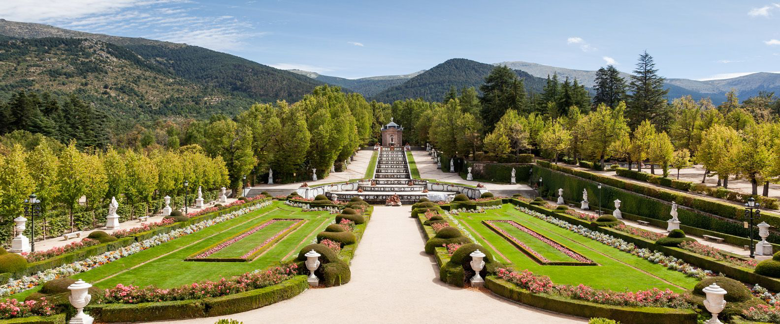
Within the cultural sphere, notable achievements include the foundation of the Royal Library in 1711, the precursor to the current National Library of Spain; the Royal Academies of Spanish and History in 1714 and 1738 respectively; the University of Cervera in 1717, and other scientific institutions such as the Royal College of Surgeons of Cadiz, for example. A lover of the fine arts, Philip V was also a patron of the Neapolitan singer Carlo Broschi, known as Farinelli, and the painters Miguel Jacinto Meléndez, Jean Ranc and Louis-Michel van Loo, among others. He was also responsible for the building of the Palace of La Granja de San Ildefonso (Segovia) and the Royal Palace of Madrid.
The King died in Madrid on 9th July 1746. His remains are buried alongside those of his second wife, Elisabeth Farnese, in the crypt of the Royal Collegiate Church of the Holy Trinity in the Palace of La Granja de San Ildefonso.
Source: Royal Academy of History (https://www.rah.es)
Royal Palace of La Granja de San Ildefonso
1717
The favourite palace, summer residence and retreat of Philip V
More Information