The Royal Collections Gallery uses its own and third-party cookies, mainly
for technical purposes, which are necessary to provide our services and provide you with
relevant content. More information in our cookies policy.
Cookies Policy.
ACCEPT to confirm that you have read the information and accepted their installation. You can change your browser settings.
We use own and third party cookies to improve your browsing experience. More information in Cookies policy.
About cookies on this website
close
About cookies on this website
Technical
Technical cookies are those essential and strictly necessary for the proper functioning of the Website and the use of the different options and services it offers, including those that the editor uses to enable the operational management of the website and enable its functions and services. For example, those used for session maintenance, response time management, performance or validation of options, use of security elements, sharing content with social networks, etc. The website cannot function properly without these cookies.
Social networks
Social network cookies
Marketing
Descripcion
Técnica
Las cookies técnicas son aquellas imprescindibles y estrictamente necesarias para el correcto funcionamiento del Sitio Web y la utilización de las diferentes opciones y servicios que ofrece, incluyendo aquellas que el editor utiliza para permitir la gestión operativa de la página web y habilitar sus funciones y servicios. Por ejemplo, las que sirven para el mantenimiento de la sesión, la gestión del tiempo de respuesta, rendimiento o validación de opciones, utilizar elementos de seguridad, compartir contenido con redes sociales, etc. La página web no puede funcionar adecuadamente sin estas cookies.
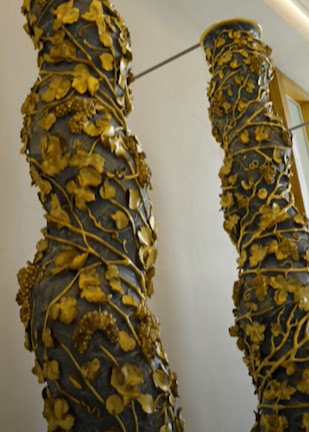
Six metres high and weighing 600 kg: the Gallery’s Solomonic columns
These are the first objects to be placed in their place of exhibition within the visit route, on Floor -1 of the Royal Collections Gallery, which is dedicated to the cultural heritage of the House of Habsburgs. Four 17th-century columns, almost 6 metres high and weighing 600 kg, made from 8 assembled planks of pine wood from the forests of Valsaín, in Segovia. They were carved by two essential figures of the Spanish Baroque: José de Churriguera and Francisco Herrera el Mozo. The columns have been lovingly restored over the last 5 months so they may be exhibited. And it is this process that has given them back their characteristic lapis lazuli blue, a true rarity, since such columns were often completely gilded. They were initially part of the high altar of the church of the Hospital Virgen de Montserrat, in Madrid's Antón Martín plaza. The church was demolished in 1903, but the altar was dismantled so it could be preserved. The columns then found a home at the Royal Palace in Madrid and from this summer onwards, visitors can see them on display at the Royal Collections Gallery. More information here: http://bit.ly/3Kohjss