Loading...

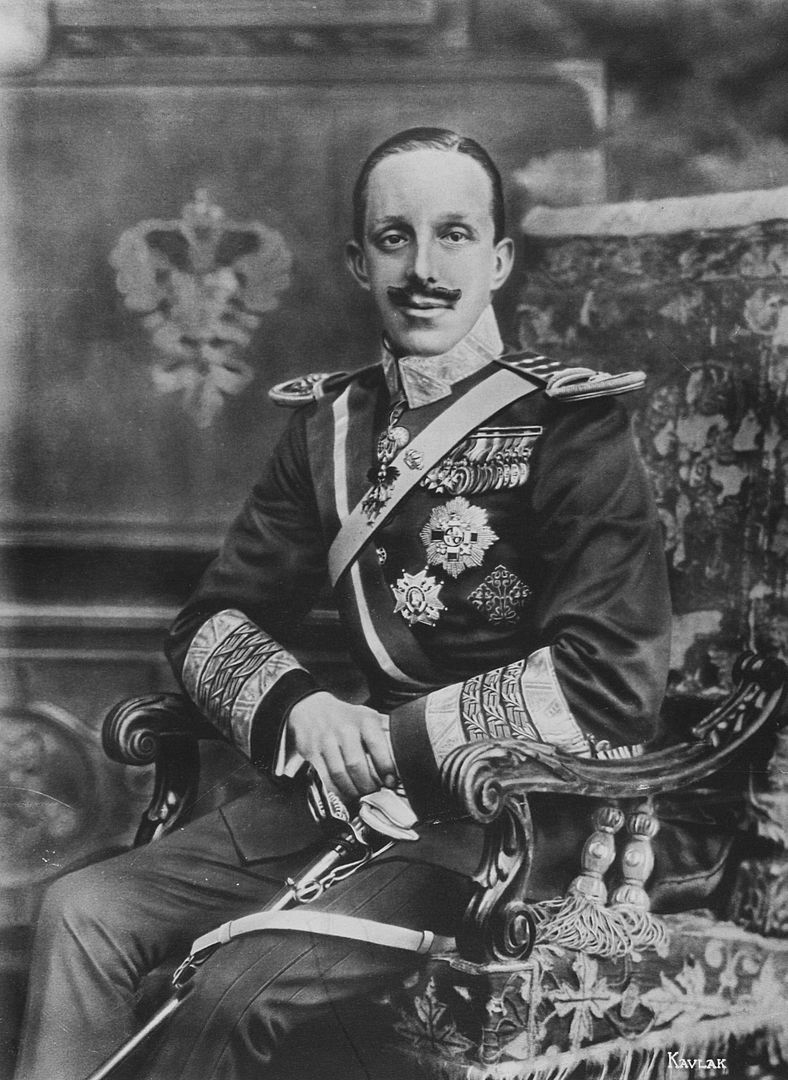
Biography
The last of three sons born to Alfonso XII (1857-1885) and his second wife, the Archduchess Maria Christina of Austria (1858-1929), Alfonso XIII was King at birth, due to his father's death on 25th November 1885. His mother, Queen Maria Christina ruled as Regent of Spain until 1902. The education of the child King was supervised by General Sanchiz and he was placed in the charge of, among others, the Jesuit priest José Fernández Montaña and the prestigious jurist Vicente Santamaría Paredes, who was his teacher of Constitutional Law. The King was proclaimed of age after he swore allegiance to the Constitution on 17th May 1902.
On 31st May 1906, he was married to Princess Victoria Eugenie of Battenberg (1887-1969), granddaughter of Queen Victoria I of England. The ceremony was held at the Church of San Jerónimo El Real in Madrid. The King and Queen had six children: Prince Alfonso (1907-1938) and the Infante Jaime (1908-1975), who renounced their succession rights in 1933; the Infanta Beatriz (1909-2002), Princess of Civitella-Cesi by marriage to Alessandro Torlonia, 5th Prince of Civitella-Cesi (1935-1986); the Infanta Maria Cristina (1911-1996), Countess Marone-Cinzano by marriage to Enrico Marone-Cinzano, 1st Count Marone; the Infante Juan (1913-1993), Count of Barcelona and his father’s successor as head of the Spanish Royal Household, and the Infante Gonzalo (1914-1934).
The first five years of Alfonso XIII's reign were marked by political instability due to the internal crisis in the two leading political parties, which was resolved in 1907 when Antonio Maura and Segismundo Moret took over the leadership of the Conservatives and Liberals respectively. Within the same period, the Spanish regime’s role on the international stage acquired greater significance. The King’s state visits to France and England, as well as the concession of a zone of influence in Morocco to Spain following the Algeciras Conference (16th January-7th April 1906) helped to enhance the nation’s international image after the crisis of 1898.
The next five years of his reign (1907-1912) oscillated between social unrest, exacerbated by the response of Antonio Maura's conservative government to the events of the "Tragic Week of Barcelona" (26th July - 2nd August 1909), and the Regenerationism movement and greater political democratisation encouraged by the liberal leader José Canalejas until his assassination on 12th November 1912. Less than two years later, World War I broke out in July 1914. Throughout the conflict, in which Spain remained neutral, the country underwent significant economic development that had a decisive effect on its modernisation. A noteworthy aspect of this period is Alfonso XIII’s humanitarian work on behalf of prisoners of war on both sides, which earned him widespread international recognition.
The end of World War I in November 1918 had important effects on Spain. The economic recession that hit the country after the cessation of hostilities increased social unrest within an international context that was moreover marked by the Russian Revolution of 1917 and the fear of the spread of Bolshevism. In order to deal with these problems, Alfonso XIII formed “concentration governments", following the assassination of the Conservative leader Eduardo Dato on 8th March 1921.
The early 1920s revealed the increasing breakdown of the political system of the Restoration and Spain’s difficulties in controlling the zone of influence in Morocco granted by the international powers in 1906. The “Moroccan problem” which culminated in the military disaster that was the Battle of Annual on 22nd July 1921, led to widespread social unrest and government difficulties, culminating in the coup d'état of General Miguel Primo de Rivera between 13th and 15th September 1923. The dictatorship of Primo de Rivera, which put an end to the Moroccan War after the successful landing at Al Hoceima on 8th September 1925, lasted until the general's resignation on 28th January. Alfonso XIII’s attempt to restore constitutional order by creating new "concentration governments”, the last of which was presided over by Admiral Juan Bautista Aznar-Cabañas, in an environment of political instability, social unrest and the effects of the 1929 global financial crisis, was ultimately unsuccessful.
After learning the results of the municipal elections of 12th April 1931, which were interpreted by Republicans, Socialists and even political leaders sympathetic to the regime as a referendum on the Monarchy, Alfonso XIII decided to leave Spain on 14th April 1931, the same day that the Republic was proclaimed, in order to avoid possible bloodshed. Exiled first in France and then in Rome where he remained during the Spanish Civil War (1936-1939), the King renounced his dynastic rights in favour of his son, Juan of Bourbon, Count of Barcelona, on 15th January 1941. Alfonso XIII died in Rome less than a month later, on 28th February that same year. He was originally buried in the Church of Santa María de Montserrat de los Españoles (Rome), but since 1980, his remains have been placed in the Pantheon of Kings and Queens in the Monastery of El Escorial.
Source: Royal Academy of History (https://www.rah.es)