Loading...

Casa de los Austrias
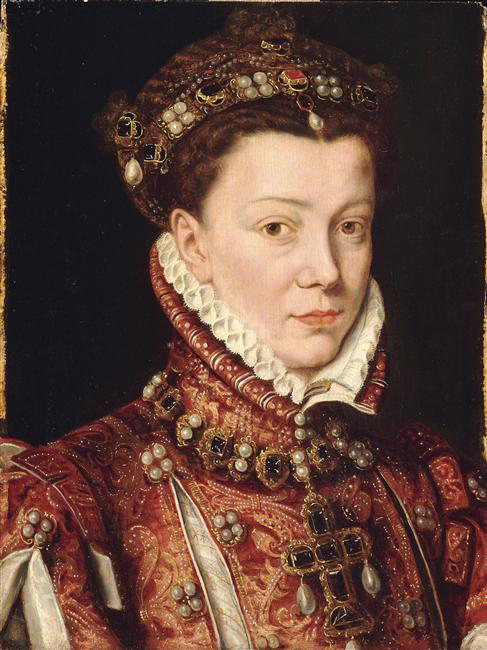
Elisabeth of Valois
Fontainebleau (Francia), 02 de April de 1546 - Aranjuez (Madrid), 03 de October de 1568
View in TimelineBiography
The second of ten children born to King Henry II of France (1519-1559) and Catherine de' Medici (1519-1589), Elisabeth of Valois was brought up at the Château of Blois together with her siblings including the future Kings Francis II, Charles IX and Henry III of France. She was first betrothed to the King of England, Edward VI, who died in 1553.
Four years later, Philip II's victory over the French army at the Battle of Saint Quentin (10 August 1557) precipitated peace negotiations between France and the Hispanic Monarchy. As on other occasions, it was to be ensured by means of a dynastic marriage. Initially, it was planned that Elisabeth of Valois would marry Prince Carlos (1545-1568), the first-born son of Philip II (1527-1598) and his first wife, Maria Manuela of Portugal (1527-1545). However, after the King was widowed for the second time on 17th November 1558, it was arranged that Elisabeth of Valois would become his third wife.
The Peace of Câteau-Cambresis between the two powers was signed on 3rd April 1559 and the marriage of the Kings was celebrated in Guadalajara on 2nd February 1560. Known as "Elisabeth of Peace" due to the circumstances in which her marriage to the monarch took place, her duty was to strengthen and facilitate relations between France and the Hispanic Monarchy. In this regard, one of her most important actions was participating as the head of the Spanish delegation at the 1565 Conference of Bayonne between the two Crowns. In addition to her political-diplomatic role, Elisabeth of Valois also fulfilled the dynastic duty of producing offspring. The Queen gave birth to two daughters: the Infanta Isabella Clara Eugenia (1566-1633), Archduchess of Austria and future Sovereign of the Spanish Netherlands married to Archduke Albert (1559-1621); and the Infanta Catherine Michaela (1567-1597), Duchess of Savoy, wife of Carlo Emanuele I of Savoy (1562-1630), in whose honour, a young Miguel de Cervantes, not yet twenty, wrote laudatory verses.
Fond of theatre and court festivities, her Royal Household accounts state that between 1561 and 1568, some forty-one comedies were performed in her private apartments, staged by several renowned literary figures of the time, such as Lope de Rueda. Elisabeth of Valois died on 3rd October 1568, due to an exacerbated kidney disease that triggered a premature birth. The Queen's remains are buried in the Pantheon of Infantes and Infantas at the Monastery of El Escorial.
Source: Royal Academy of History (https://www.rah.es)