Loading...

Reyes Católicos
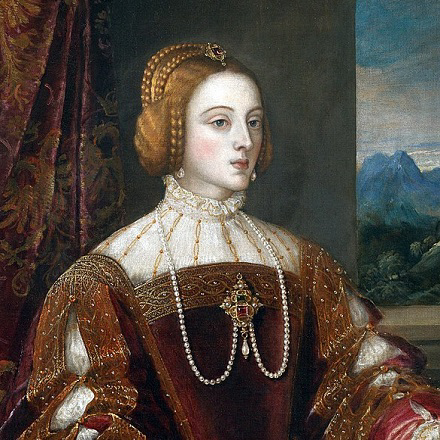
Isabella of Portugal
Lisboa, 24 de October de 1503 - Toledo, 01 de May de 1539
View in TimelineBiography
Second daughter of King Manuel I of Portugal (1469-1521) and the Infanta Maria of Aragón (1482-1517), Isabella of Portugal was brought up at the royal court in Lisbon, which was frequented, amongst other literary figures, by the great playwright Gil Vicente. Her education was supervised by her mother who was the fourth daughter of the Spanish Catholic Monarchs. In addition to various modern languages and Latin, which she translated and spoke fluently, Isabella of Portugal also learned to play several musical instruments and came into contact with the various intellectual currents of Renaissance humanism.
Her marriage to Charles I (1500-1558), arranged in 1525, was celebrated in Seville on 11th March 1526. Despite being separated for long periods of time due to the king's frequent political and military travels, they had a close and harmonious marriage. The royal couple had five children: the future Philip II (1527-1598); the Infanta Maria of Austria (1528-1603), Holy Roman Empress by marriage to Maximilian II of Austria; the Infante Fernando (1529-1530); the Infanta Joanna (1535-1573), Crown Princess of Portugal by marriage to Prince João Manuel - eldest son of the Portuguese king John III and Catherine, sister of Charles V; and the Infante Juan (1537-1538).
Isabella of Portugal played a highly prominent political role. After her marriage, she not only acted as intermediary between her husband's interests and those of her native Portugal, but from 1529 onwards, she also acted as Governor whenever Charles I was in Europe. The Queen's main political concerns included defending Spain’s borders with France, economic affairs, and mediating in court disputes, where she played the role of arbiter following the King's instructions. In addition to her dedication to governing, Isabella of Portugal was also directly involved in the education of her children, personally choosing their teachers and tutors.
Isabella of Portugal died in Toledo on 1st May 1539 from complications arising from her last childbirth while Charles I was in Madrid. Her remains are buried in the Pantheon of Kings and Queens in the Monastery of El Escorial. After her death, Charles I refused to remarry and remained a widower until his death.
Source: Royal Academy of History (https://www.rah.es)