Loading...

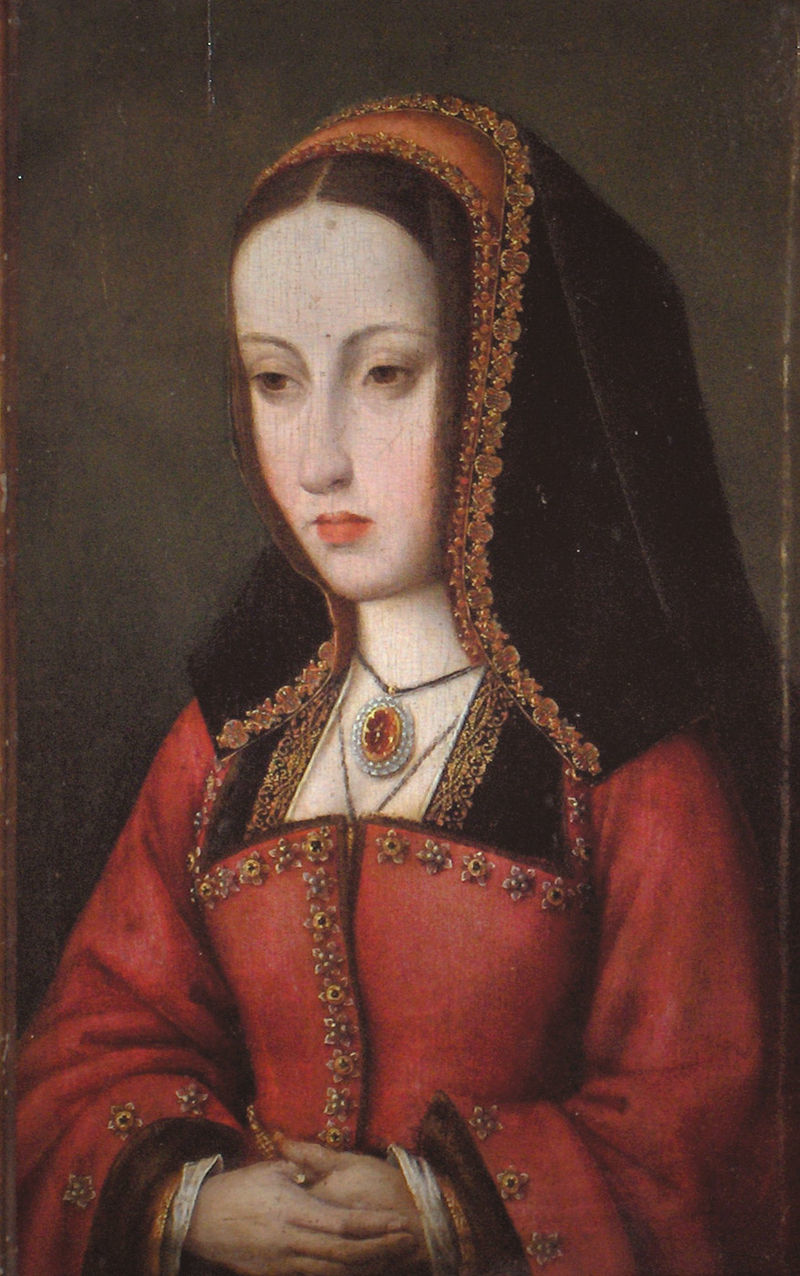
Reyes Católicos
Joanna I
Toledo, 06 de November de 1479 - Tordesillas (Valladolid), 12 de April de 1555
View in TimelineBiography
The third of five children born to the Catholic Monarchs Ferdinand (1452-1516) and Isabella (1451-1504), the Infanta Joanna was brought up in a humanist environment populated by intellectuals such as Lucius Marinius Siculus, Pietro Martire d'Anghiera, and the brothers Antonio and Alessandro Geraldini. Before she reached the age of seventeen, the Catholic King and Queen had arranged her marriage to the Archduke Philip of Austria (1478-1506), also known as Philip the Handsome, Sovereign of the Burgundian Netherlands and son of Maximilian I, Holy Roman Emperor.
The marriage arranged as a foreign policy measure by the Catholic Monarchs and conditioned at the time by Spanish-French rivalry, was solemnised in the Church of Saint Gummarus in Lier (Antwerp, Belgium) on 20th October 1496. The couple's marital relations were rather unstable due to the numerous infidelities of Philip the Handsome, and Joanna also found it difficult to adjust to her new court. Together they had six children: Eleanor (1498-1558), Queen of Portugal by marriage to Manuel I the Fortunate(1469-1521) and subsequently Queen of France by marriage to Francis I (1494-1547); the future Charles I of Spain and V, Holy Roman Emperor (1500-1558); Isabella (1501-1526), Queen of Denmark, Sweden and Norway by marriage to Christian II of Denmark (1481-1559); Ferdinand (1503-1563), King of Hungary and Bohemia, who succeeded his brother Charles as Holy Roman Emperor; Mary (1505-1558), Queen of Hungary by marriage to Louis II of Hungary (1506-1526), and future Governor of the Netherlands; and Catherine (1507-1578), born after her father's death, Queen of Portugal by marriage to John III (1502-1557).
The Infanta Joanna inherited the thrones of Castile and Aragón following the deaths of her elder brother and sister, Prince John and Princess Isabella, in 1497 and 1498 respectively, as well as that of the latter's son, the Infante Miguel da Paz of Portugal, in July 1500. Joanna and Philip the Handsome were sworn in as heirs before the Cortes of Castile and Aragón on 22nd May and 27th October 1502 respectively. Immediately afterwards, Philip the Handsome returned to the Netherlands while his wife, who was pregnant, remained at the court of the Catholic Monarchs. However, the couple would not be separated for long. Faced with the insistence of the now Princess Joanna in the absence of her husband, Isabella the Catholic allowed her to return to the Netherlands in the spring of 1504, after she had given birth to their fourth child, the Infante Ferdinand.
Joanna I became Queen of Castile after the death of her mother, Isabella the Catholic, on 26th November 1504. As stipulated in the Queen's will, her husband, Ferdinand the Catholic governed the Kingdom in the absence of the new King and Queen. Negotiations for the transfer of power in Castile commenced months before Joanna and Philip the Handsome arrived in A Coruña on 26th April 1506. After an initial agreement, known as the "Concord of Salamanca" (24th November 1505), on 27th and 28th June 1506, Ferdinand the Catholic and King Philip accepted the terms of the "Concord of Villafáfila", under which Ferdinand the Catholic renounced the governorship of Castile and accepted that his daughter Joanna was unfit to rule. The power struggle between the two monarchs was thus settled in favour of Philip the Handsome, who was interested in ruling alone and sought to have his wife who was the legitimate Queen of Castile, shut away on the grounds that she was mentally unbalanced. However, the Cortes and a large part of the Castilian nobility were hostile to the monarch’s intentions, who died suddenly in Burgos on 25th September 1506.
After the death of Philip the Handsome, Queen Joanna, who was pregnant with her last child at the time, delegated the affairs of state to Cardinal Cisneros, and ordered her father, Ferdinand the Catholic to return to Castile, while she embarked on a slow tour of different Castilian towns with the corpse of her husband. In August 1507, Ferdinand the Catholic returned to Castile and took over the reins of the government. After she refused to marry Henry VII of England, Queen Joanna was interned in Tordesillas in February 1509 at the behest of her father. Ferdinand's actions were dictated as much by his own ambitions as by his doubts regarding his daughter's mental equilibrium.
The Queen remained confined for the rest of her forty-six years of life. From her seclusion in Tordesillas, she learned of the death of Ferdinand the Catholic (January 1516) and the accession of her son, Charles I to the throne, with whom she would nominally reign. On 29th August 1520, the Communities of Castile rose up against Charles I on account of the policies set during his initial reign as King. The “comuneros” occupied Tordesillas, released the Queen, and called upon her to legitimise their rebellion. At this juncture however, the Queen refused to assume responsibility for the government and to injure her son's cause. After the failure of the revolt in February 1522, Joanna I lost all political prominence. She spent the rest of her days under the surveillance of the Marquesses of Denia. Joanna I, also called Joanna the Mad, died in Tordesillas on 12th April 1555. Her remains, and those of her husband and her parents, the Catholic Monarchs, are buried in the Royal Chapel adjoining the Cathedral of Granada.
Source: Royal Academy of History (https://www.rah.es)