Loading...

Casa de los Borbones
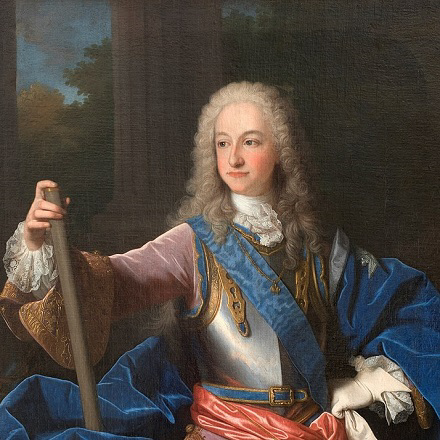
Louis I of Spain
Madrid, 25 de August de 1707 - Madrid, 31 de August de 1724
View in TimelineBiography
The eldest son of Philip V (1683-1746) and his first wife, Maria Luisa Gabriella of Savoy (1688-1714), Louis I was the first Bourbon monarch to be born in Spain. His birth was hailed with joy by the people, who had not witnessed the birth of an heir to the Crown for forty-six years. Christened Louis Ferdinand, his godparents were his great-grandfather, King Louis XIV of France, and his aunt, the Duchess of Orléans. Prince Louis' childhood coincided in part with the War of the Spanish Succession (1701-1714). On 7th April 1709, when he was not yet two years old, he was sworn in as Prince of Asturias at the Church of San Jerónimo El Real in Madrid. His early years were spent in the company of his mother, Queen Maria Luisa Gabriella of Savoy, his governess, the Princesse des Ursins, also the Queen's chief chambermaid, and the assistant governess, Maria Antonia de Salcedo y Chávarri, the future Marchioness of Montehermoso. After the death of Queen Maria Luisa Gabriella of Savoy, whereupon Philip V married Elisabeth Farnese (1692-1766) and exiled the Princesse des Ursins in 1714, the second stage of the Prince’s training began. The appointment of Cardinal del Giudice as the Prince's caretaker, followed later by the Duke of Popoli with the Marquess of Surco as assistant caretaker, and of the Jesuit priest Ignace de Laubrussel as tutor, not only formed a predominantly male circle around the heir but also ushered in a more rigorous and formal education in which courtly training and protocol carried considerable weight.
Negotiations for the marriage of Prince Louis commenced in 1721, within the context of a new diplomatic rapprochement between the French and Spanish courts. The Prince's bride was Louise Élisabeth d'Orléans (1709-1742), daughter of Philippe II, Duke of Orléans, then Regent of France during Louis XV's minority. The Prince and Princess of Asturias were married in the town of Lerma on 20th January 1722. On the occasion of their marriage, the first Prince's Household was established, a new step in his entry into adult life. By then, Prince Louis was described as a young man fond of hunting and riding, skilled in dancing and the sports of the time such as pall-mall, and given to hobnobbing with the sons of the palace servants, who were of a similar age as him. He was on good terms with his brothers, the Infante Philip, who died in 1719, and the future Ferdinand VI, as well as, contrary to what has sometimes been claimed, with his half-brothers, the Infante Charles, later Charles III, and the Infanta Mariana Victoria. The Prince was on equally good terms with his stepmother, Queen Elisabeth Farnese, who always treated him with the consideration due to his status as heir to the Crown.
Following the abdication of his father Philip V, Louis I became King of Spain on 10th January 1724. Given that the monarch had not yet reached the age of seventeen when he ascended the throne, Philip V ordered the creation of a Government Council to advise the new King in the exercise of his power. Consisting of the presidents of various Councils of the Kingdom who were loyal to the former monarch, the Government Council allowed Philip V to control his son’s actions regarding affairs of state from the Palace of La Granja de San Ildefonso (Segovia).
He was highly popular among his subjects, giving rise to the name of Well-Beloved. However, Louis I barely had any time to reign. Although a power group called the "Spanish party" had begun to form around the King, seeking to neutralise the pro-French policy hitherto pursued by Philip V, the influence of its members on the monarch was halted in the summer of 1724, when Louis I fell ill with smallpox. Despite the care he received from royal physicians and his wife, Queen Louise Élisabeth d'Orléans, the monarch died in Madrid on 31st August of the same year. The remains of Louis I are buried in the Pantheon of Kings and Queens in the Monastery of El Escorial. At the end of what became known as the "lightning reign” for its brevity, Philip V left the Palace of La Granja and was restored to the Spanish throne after consulting the Council of Castile and a Board of theologians.
Source: Royal Academy of History (https://www.rah.es)