Loading...

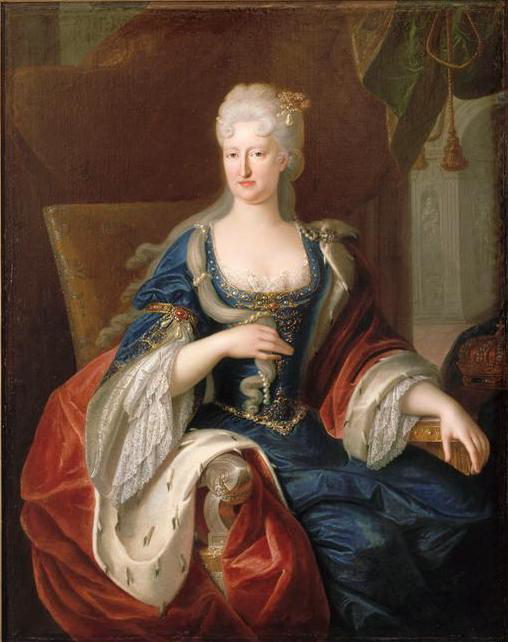
Maria Anna of Neuburg
Düsseldorf (Alemania), 28 de October de 1667 - Guadalajara, 16 de July de 1740
View in TimelineBiography
The twelfth of seventeen children born to Philip William (1615-1690), Elector Palatine and Duke of Neuburg, and Elisabeth Amalie of Hesse-Darmstadt (1635-1709), Maria Anna of Neuburg was chosen as the wife of Charles II, both because of her mother's remarkable fertility and her status as sister-in-law of Leopold I, Holy Roman Emperor (1640-1705). Their marriage was ratified in Valladolid on 4th May 1690.
The new Queen had a smooth beginning at the court in Madrid. Her relationship with Charles II (1661-1700) was cordial and it was hoped that she would soon provide an heir to the Crown. However, these expectations would not be fulfilled. The long-awaited pregnancy never happened and Maria Anna of Neuburg's political activities led to her enmity with both the Queen Mother, Mariana of Austria, and numerous Spanish courtiers and ministers. Moreover, the influence of the German “clique" that had settled in Madrid alongside the Queen also deprived her of much of her popularity among the people.
Having given up any hopes of birthing her own offspring, Maria Anna of Neuburg supported the nomination of her nephew, the Archduke Charles of Austria, as heir to Charles II. Although the Queen did all she could to persuade the King to appoint him, Charles II eventually named Philip V of Bourbon as his successor. Widowed on 1st November 1700, Maria Anna of Neuburg was forced to leave Madrid on 2nd February of the following year, shortly before the new King arrived in Madrid.
Exiled to Toledo, the dowager Queen lived there until 1706. That same year, to punish her for siding with the Archduke Charles of Austria during the War of the Spanish Succession, Philip V ordered the Queen to leave for Bayonne (France), where she spent the next thirty-two years of her life. In Bayonne, Maria Anna of Neuburg devoted herself to religion and music, of which she was very fond. In November 1714, she had the chance to meet her niece, Elisabeth Farnese, who was on her way to Spain to become the second wife of Philip V. Maria Anna of Neuburg remained in Bayonne until 1738, when at the initiative of Queen Elisabeth Farnese, she was permitted to reside in Guadalajara, where she died on 16th July 1740. The remains of Maria Anna of Neuburg are buried in the Pantheon of Infantes and Infantas at the Monastery of El Escorial.
Source: Royal Academy of History (https://www.rah.es)