Loading...

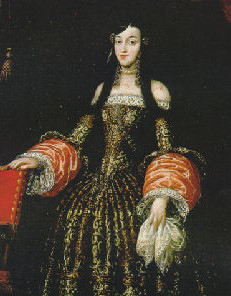
Marie Louise d'Orléans
París (Francia), 27 de March de 1662 - Madrid, 12 de February de 1689
View in TimelineBiography
The first-born daughter of Philippe of France, Duke of Orléans (1640-1701), brother of Louis XIV of France (1638-1715), and Henrietta Anne of England (1644-1670), Marie Louise d'Orléans received a careful education in horse riding, playing musical instruments such as the harpsichord, singing and dancing with ease, and holding conversations typical of the most select courtly circles.
Her marriage to Charles II (1661-1700) was celebrated in the village of Quintanapalla in Burgos on 18th November 1679, within the context of the signing of the Treaties of Nijmegen between France and the Hispanic Monarchy. The new Queen made her official entry into Madrid on 13th January 1680. Numerous public festivities such as bullfights and comedies were held in her honour, in addition to more solemn events such as the auto-da-fe immortalised in a painting by Francisco Rizi.
Fond of theatre, music and dance, Marie Louise d'Orléans' first years at the Madrid court were complicated by the fact that she had adjust to the rules of Spanish protocol, under the guidance of her chief chambermaid. In the political sphere, her uncle Louis XIV expected the Queen to defend France's interests to her husband Charles II. However, Marie Louise d'Orléans stayed away from court intrigues and only agreed to use her influence with the King to prevent the appointment of a member of the Viennese branch of the House of Habsburgs in Madrid. The Queen thus prevented Charles II from hastily recognising a son of Leopold I, Holy Roman Emperor, as his successor.
The lack of any signs of pregnancy during her ten years of marriage meant that the Queen lost a great deal of her initial popularity. Seriously ill after a fall from a horse that resulted in a blow to her chest and stomach, Marie Louise d'Orléans died in Madrid on 12th February 1689, when she was only twenty-six. She was buried in the Pantheon of Infantes and Infantas in the Monastery of El Escorial, after an autopsy was performed to quell rumours unleashed by France and which were completely without any basis, that she had been poisoned.
Source: Royal Academy of History (https://www.rah.es)