Loading...

Reyes Católicos
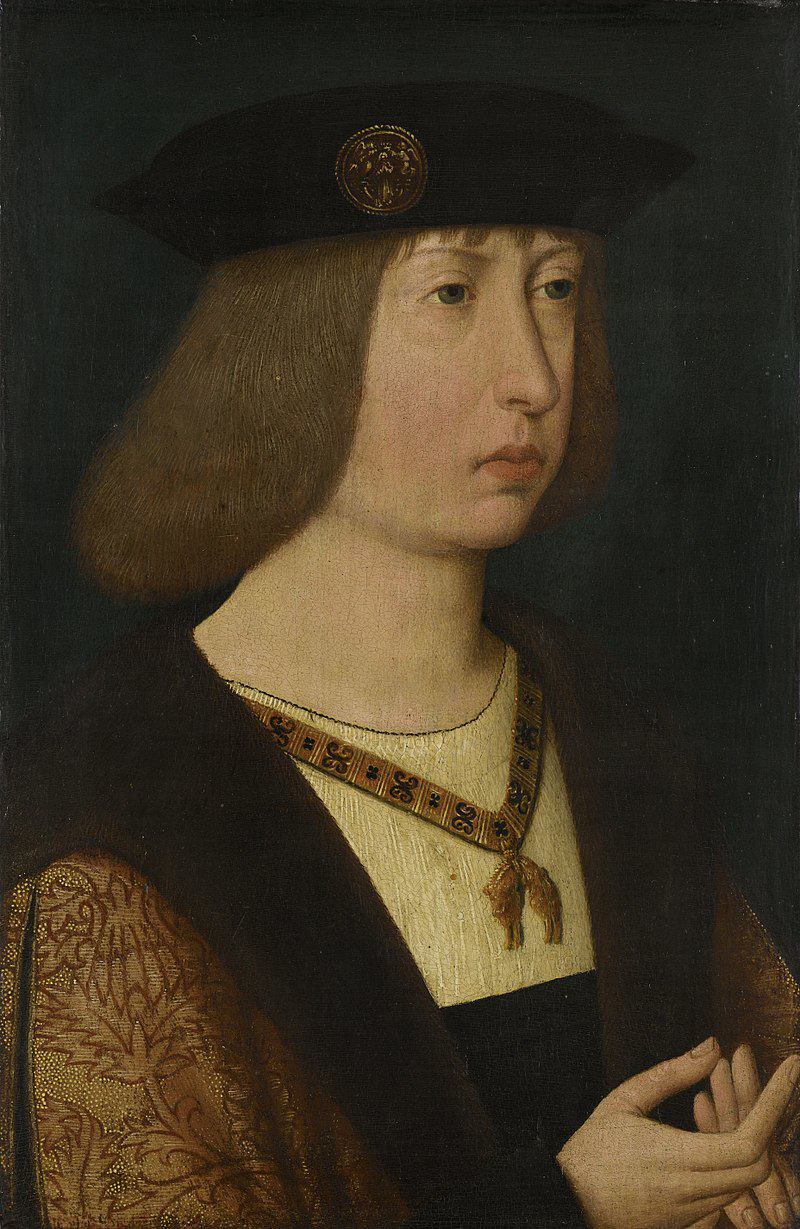
Philip I
Brujas (Bégica), 22 de June de 1478 - Burgos, 25 de September de 1506
View in TimelineBiography
The eldest son of Maximilian I, Holy Roman Emperor (1459-1519) and Mary of Burgundy (1457-1482), Philip of Austria inherited the Burgundian Netherlands on his mother's death in 1482, although a Council of Regency exercised power until he was proclaimed of age in 1494. Known as Philip the Handsome, his rule in the Netherlands was characterised by balance between the Sovereign’s authority and respect for local governmental institutions, as well as the promotion of economic activities. In terms of foreign policy, Philip the Handsome was in favour of maintaining cordial relations with France, reinstating trade with England, and exploring new diplomatic and commercial opportunities with other European powers. This was the case of the alliance he entered into, at the behest of his father Maximilian I, Holy Roman Emperor, with the Catholic Monarchs; an agreement that was consolidated by the marriage of Prince John, heir to Ferdinand and Isabella, and the Archduchess Margaret of Austria, and of Philip the Handsome to the Infanta Joanna, the third daughter of the Catholic Monarchs.
Joanna and Philip the Handsome were wedded in the Church of Saint Gummarus in Lier (Antwerp, Belgium) on 20th October 1496. The royal couple had an unstable marriage that produced six children: Eleanor (1498-1558), Queen of Portugal by marriage to Manuel I the Fortunate(1469-1521) and subsequently of France by marriage to Francis I (1494-1547); the future Charles I of Spain and V , Holy Roman Emperor (1500-1558); Isabella (1501-1526), Queen of Denmark, Sweden and Norway by marriage to Christian II of Denmark (1481-1559); Ferdinand (1503-1563), King of Hungary and Bohemia, who succeeded his brother Charles as Holy Roman Emperor; Mary (1505-1558), Queen of Hungary by marriage to Louis II of Hungary (1506-1526), and future Governor of the Netherlands; and Catherine (1507-1578), born after her father's death, Queen of Portugal by marriage to John III (1502-1557).
The successive deaths of Prince John and Princess Isabella in 1497 and 1498, as well as the latter’s son, the Infante Miguel da Paz of Portugal, in July 1500, placed Philip's wife, the Infanta Joanna directly in the line of succession to the thrones of Castile and Aragón. Joanna and Philip the Handsome were sworn in as heirs before the Cortes of Castile and Aragón on 22nd May and 27th October 1502 respectively. Immediately afterwards, Philip returned to the Netherlands. As heir to the thrones of Castile and Aragón, Philip the Handsome implemented certain initiatives that deviated from the foreign policy guidelines of his in-laws, the Catholic Monarchs, such as the signing of the Treaty of Lyons with France on 5th April 1503.
Joanna and Philip the Handsome became King and Queen of Castile after the death of Isabella the Catholic on 26th November 1504. Before leaving the Netherlands with his wife, Philip the Handsome conquered the Duchy of Gelderland, his first and only military campaign, while sending ambassadors to Castile to negotiate the transfer of power in the Castilian kingdom with Ferdinand the Catholic. The result of these negotiations was the "Concord of Salamanca", signed on 24th November 1505, by which Joanna and Philip the Handsome were sworn in as the King and Queen of Castile before the Cortes while Ferdinand the Catholic was recognised as Governor of the Kingdom in perpetuity.
The new monarchs left the Netherlands on 8th January 1506. After a complicated journey that led them to seek refuge in England, the King and Queen landed in A Coruña on 26th April 1506. Shortly after arriving in Castile, Philip the Handsome rejected the "Concord of Salamanca" with the support of some of the Castilian nobles who were opposed to Ferdinand the Catholic, and re-negotiated with the latter the "Concord of Villafáfila", which would be accepted by both parties at the end of June that same year. As a result, Ferdinand the Catholic gave up the governance of Castile government and recognised his daughter Joanna's inability to govern. At that time, Philip the Handsome had a single priority, to be recognised as sole King of Castile in flagrant violation of his wife’s dynastic rights. For this reason, the procurators in the Cortes, as well as sections of the Castilian nobility, were opposed to the King's pretensions and would only swear allegiance to him as King consort of the legitimate Queen, Joanna. Despite these signs of hostility, Philip the Handsome did not renounce his desire to be the sole monarch and to achieve the perpetual seclusion of his wife on the grounds of an alleged mental imbalance.
The King's effective rule in Castile, although brief, was extremely unpopular due to him granting bequests and public offices to his Flemish advisors, the changes he made in the composition of certain government and judicial institutions of the Castilian kingdom, and the serious economic crisis that affected Castile at that time. Philip the Handsome died in Burgos on 25th September 1506 for reasons that are not fully clear. The King’s remains are buried alongside those of his wife and his parents-in-law, the Catholic Monarchs, in the Royal Chapel adjoining the Cathedral of Granada.
Source: Royal Academy of History (https://www.rah.es)