Use of Cookies

The Royal Collections Gallery uses its own and third-party cookies, mainly for technical purposes, which are necessary to provide our services and provide you with relevant content. More information in our cookies policy. Cookies Policy.

ACCEPT to confirm that you have read the information and accepted their installation. You can change your browser settings.

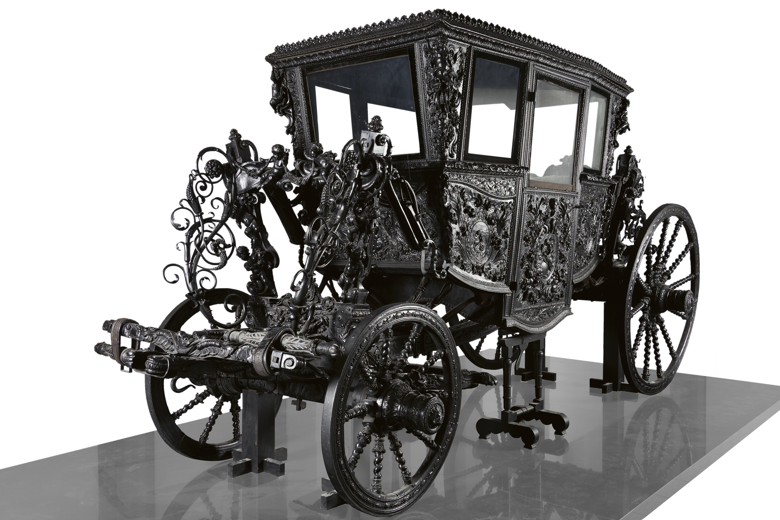
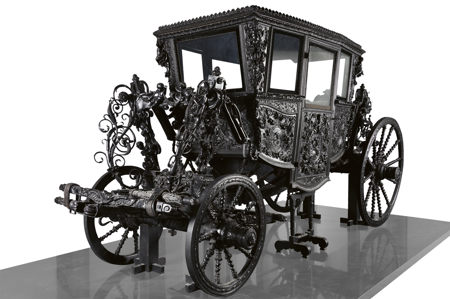
Carroza negra

1670-1680

La carroza negra es uno de los carruajes más antiguos que se conservan. Corresponde a la tipología francesa de «grand carrosse», surgida a mediados del siglo XVII en la corte de Luis XIV. Se trata de coches de caballos reservados a la realeza, por su gran riqueza decorativa y las comodidades que presentan con respecto a los vehículos anteriores.

Estas carrozas ofrecen como novedad una caja totalmente cerrada, con ventanas acristaladas y una lanza de cuello de cisne, que permite que el vehículo gire en ángulo recto, moviéndose así más fácilmente. La suspensión de la caja se hace mediante unos correones de cuero, denominados sopandas, que suavizan las vibraciones y traqueteo al que se someten los ocupantes de la carroza. Una restauración realizada entre 1877 y 1879 alteró algunos de estos elementos estructurales, como el cuello de cisne, aunque es posible verificar su estado previo a través de fotografías de Jean Laurent anteriores a esas fechas.

Durante el último tercio del siglo XVII, los muebles realizados con madera de ébano fueron muy apreciados y, por ello, la madera de nogal con la que se realizó la carroza fue teñida de negro, para imitar precisamente aquel material exótico tan valorado. Presenta una delicada talla de elementos vegetales, máscaras y angelotes, muy del gusto barroco, y divinidades de la mitología clásica, junto con símbolos de las cuatro partes del mundo entonces conocido, un programa iconográfico propio de una pieza destinada a un uso áulico.

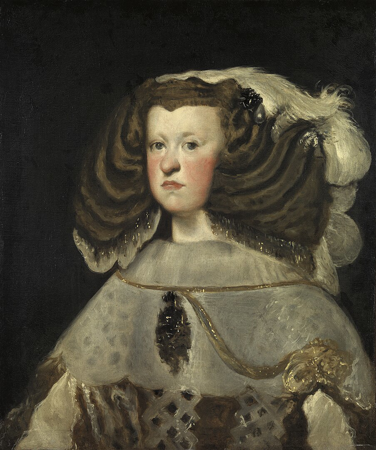
Según los inventarios, esta carroza perteneció a la segunda esposa de Felipe IV, la reina Mariana de Austria (1634-1696), que fue regente de España durante la minoría de edad de su hijo Carlos II. Tal vez fue un regalo de algún familiar de la reina y provendría, dada la altísima calidad de la talla, de Francia, Austria o Flandes (Bélgica).

General Classification

Vehículos terrestres

Type of Object

Coche de caballos

Title

Carroza negra

Era / Cultural Context

Reinado de Carlos II; Barroco

Place of Production

Austria

Date

1670-1680

Subject

Nogal; Palosanto; Hierro; Vidrio; Cuero; Textil

Technical

Tallado; Teñido; Terciopelo; Bordado

Dimensions

Fondo completo: (Altura: 265 centímetros; Anchura: 501 centímetros; Profundidad: 191 centímetros)

Inventory

10008001

Credits

Texto: Isabel María Rodríguez Marco; Foto: Mario Sedeño

Discover it at the Planta -1

Authors and Collectors

Mariana of Austria
Monarch

Mariana of Austria

(Viena (Austria), 1634 - Madrid, 1696)

The second of six children born to Ferdinand III, Holy Roman Emperor (1608-1657) and the Infanta Maria Anna of Spain (1606-1646), the younger sister of Philip IV, Mariana of Austria was initially betrothed to Prince Balthasar Charles (1627-1646), the heir to the Hispanic Monarchy. The Prince’s sudden death on 9th October 1646 left Philip IV without male heirs and he sought the Archduchess’s hand in marriage. The royal marriage, arranged to ensure the succession to the Crown and to strengthen the ties between the Madrid and Viennese branches of the House of Habsburgs, was celebrated in Navalcarnero on 7th October 1649. The King and Queen had five children: the Infanta Margaret Theresa (1651-1673), Holy Roman Empress by marriage to Leopold I...
Read more
Charles II
Monarch

Charles II

(Madrid, 1661 - Madrid, 1700)

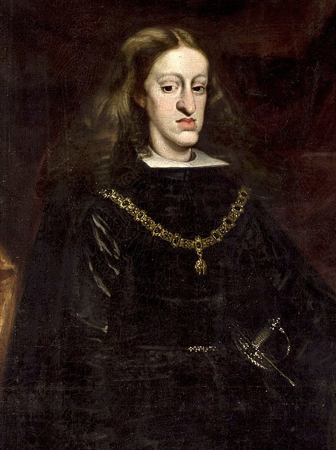
The last of five children born to Philip IV (1605-1665) and his second wife, Mariana of Austria (1634-1696), the future Charles II was born just five days after the death of his older brother, Prince Felipe Prospero, then heir to the Spanish throne. A frail child, the Prince nonetheless managed to survive against all odds and succeed his father, Philip IV, to the throne on 17th September 1665. He was less than four years old when he became King of Spain, and his mother, Mariana of Austria, ruled as Regent until he was officially declared of age in November 1675. The infant King's education was entrusted to Francisco Ramos del Manzano and included elementary education, Catholic dogma, Latin, Italian and French,...

Read more

The work in context

View in Timeline