Loading...

Casa de los Austrias
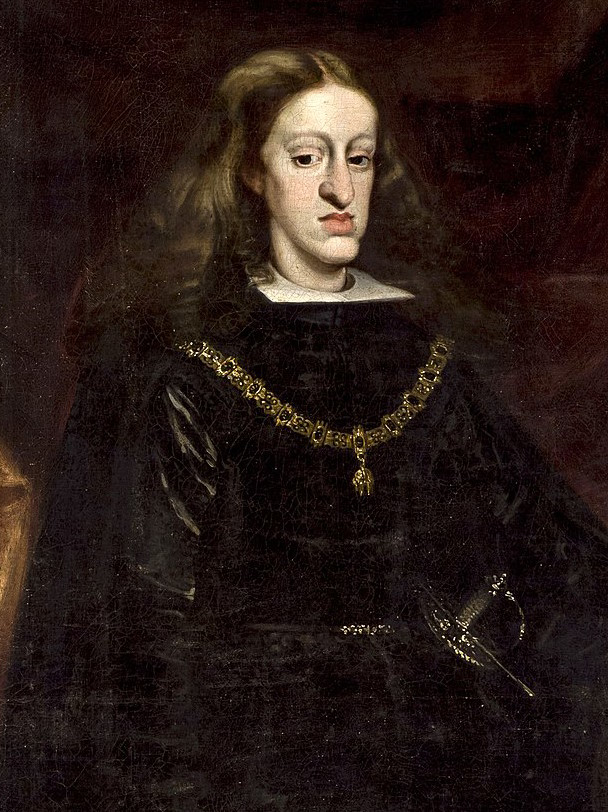
Charles II
Madrid, 06 de November de 1661 - Madrid, 01 de November de 1700
View in TimelineBiography
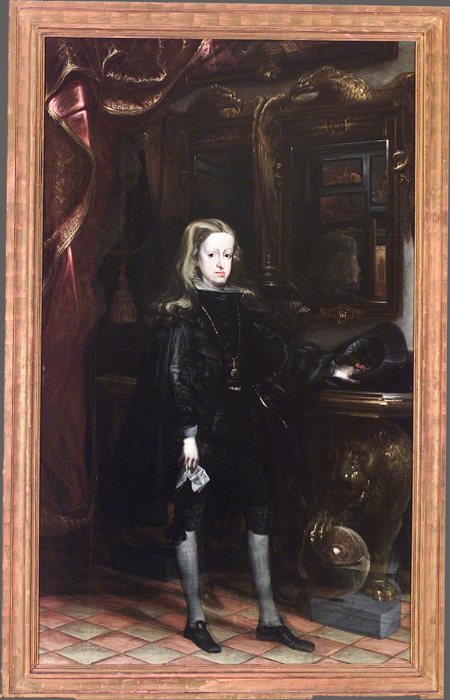
The last of five children born to Philip IV (1605-1665) and his second wife, Mariana of Austria (1634-1696), the future Charles II was born just five days after the death of his older brother, Prince Felipe Prospero, then heir to the Spanish throne. A frail child, the Prince nonetheless managed to survive against all odds and succeed his father, Philip IV, to the throne on 17th September 1665. He was less than four years old when he became King of Spain, and his mother, Mariana of Austria, ruled as Regent until he was officially declared of age in November 1675. The infant King's education was entrusted to Francisco Ramos del Manzano and included elementary education, Catholic dogma, Latin, Italian and French, as well as geography and history.
Throughout his youth, Charles II witnessed the political struggles of his mother's Regency, largely due to the conflict between the Regent and John Joseph of Austria, the illegitimate son of Philip IV, who seized power in January 1677 with the help of a group of nobles. In the role of prime minister to Charles II, John Joseph encouraged a reformist policy in economic, financial and administrative spheres. In the short term, his plans had mixed success, not only because they were opposed by the Spanish Grandees, but also because they were proposed at a time of severe economic crisis. His successors, the Duke of Medinaceli and the Count of Oropesa, continued to pursue the reformist path laid down by John Joseph until his death on 17th September 1679. During this period in which both men remained at the helm of power (1679-1689), several measures were implemented, such as the monetary reform of 1680, aimed at limiting inflation; modernising fiscal management by creating the post of superintendent general of the Treasury, and reinforcing the position of the Secretary of the Universal Office as liaison between the monarch and government institutions.
Foreign policy during the reign of Charles II was characterised by the Hispanic Monarchy's weak response to French expansionism, with the financial, human and territorial costs that this entailed, and by its participation in various coalitions of European powers against Louis XIV’s France. As a result of the wars which it joined from 1665 onwards, the Monarchy was forced to cede Franche-Comté and various strongholds in the Spanish Netherlands to France. Moreover, under the Treaty of Lisbon of 23rd February 1668, Madrid recognised Portugal's independence.
Charles II was married twice. His first wife, whom he married in Quintanapalla (Burgos) on 18th November 1679, was the French Princess Marie Louise d'Orléans (1662-1689), niece of Louis XIV. Widowed in February 1689, the monarch's second marriage to Maria Anna of Neuburg (1667-1740) was ratified in Valladolid on 4th May 1690. Charles II had no heirs from either marriage. This led to an international succession crisis. The three main candidates to the succession were Philip of Bourbon, grandson of Louis XIV of France and the Spanish Infanta Maria Theresa, eldest daughter of Philip IV; Archduke Charles of Austria, second son of Leopold I, Holy Roman Emperor and great-grandson of Philip III; and Prince Joseph Ferdinand of Bavaria, who died in February 1699, grandnephew of Charles II through his sister the Infanta Margaret. Each potential heir to the Crown had different supporters in Madrid, including the Queen Mother, Mariana of Austria, who defended the rights of the House of Bavaria; the pro-French Cardinal Portocarrero; and Queen Maria Anna of Neuburg, supporter of the House of Habsburgs. At the same time, France, England and the United Provinces were in favour of splitting up the Hispanic Monarchy after the death of Charles II, excluding Spain from the negotiations known as the "First Partition Treaty".
The last years of the monarch's life were marked by his deteriorating health for which he was subjected to several exorcisms in the belief that he was bewitched, hence the name “Bewitched” by which he is remembered in history, as well as the pressure to designate an heir to the Crown by various members of his entourage. In his last will and testament, signed on 3rd October 1700, Charles II named Philip of Bourbon as his successor. The King died in Madrid on 1st November of the same year. His remains are buried in the Pantheon of Kings and Queens in the Monastery of El Escorial. Charles II was the last Habsburg King of Spain.
Source: Royal Academy of History (https://www.rah.es)