Use of Cookies

The Royal Collections Gallery uses its own and third-party cookies, mainly for technical purposes, which are necessary to provide our services and provide you with relevant content. More information in our cookies policy. Cookies Policy.

ACCEPT to confirm that you have read the information and accepted their installation. You can change your browser settings.

Turquesa

1750-1800

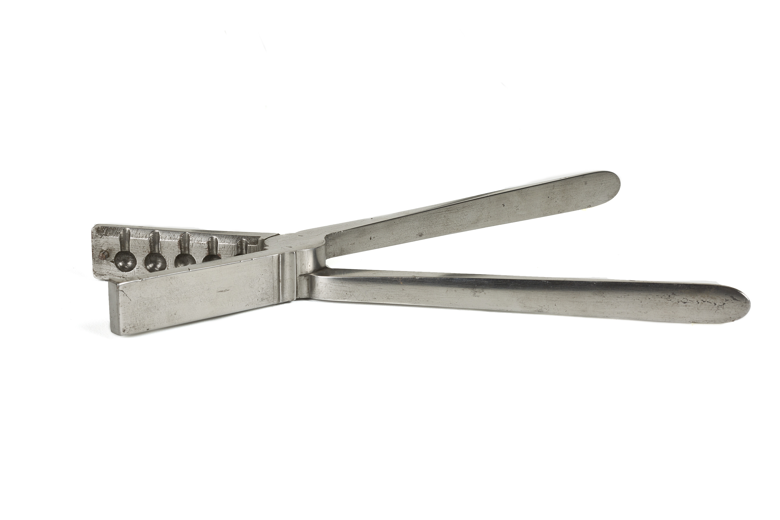
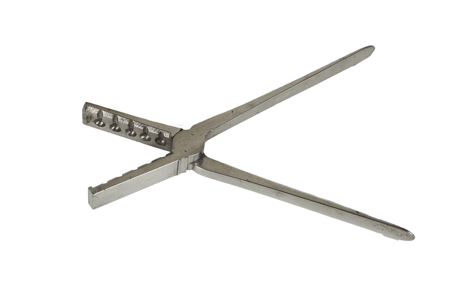
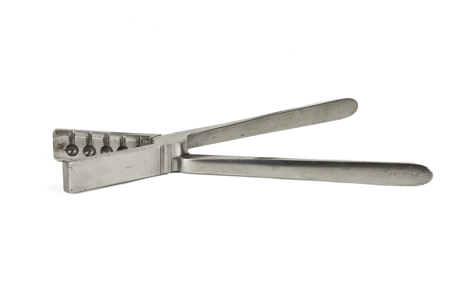
Las turquesas eran parte imprescindible del equipo de un arcabucero, junto con los frascos de pólvora. Esta turquesa se compone de cinco cavidades semiesféricas de 7 milímetros de diámetro cada una de ellas, dispuestas en línea, abiertas hacia uno de sus lados mediante una pequeña chimenea, cuya embocadura se sitúa en un plano inclinado que da lugar a un receptáculo rectangular, destinado a facilitar la introducción del plomo fundido. El extremo de uno de los brazos presenta un pequeño pitón cilíndrico, que se aloja en un orificio del contrario con el fin de asegurar su cierre. El diámetro de sus cavidades sugiere que estaba destinada a la elaboración de munición para pistolas.

General Classification

Proyectiles; Utensilios y herramientas

Title

Turquesa

Era / Cultural Context

Reinado de Fernando VI; Reinado de Carlos III; Reinado de Carlos IV

Date

1750-1800

Subject

Acero

Technical

Forjado

Dimensions

Fondo completo: (Anchura: 2,2 centímetros; Profundidad: 23,2 centímetros)

Inventory

10000496

Credits

Texto: Álvaro Soler del Campo; Foto: Mario Sedeño

Discover it at the Planta -2

Authors and Collectors

Charles III
Monarch

Charles III

(Madrid, 1716 - Madrid, 1788)

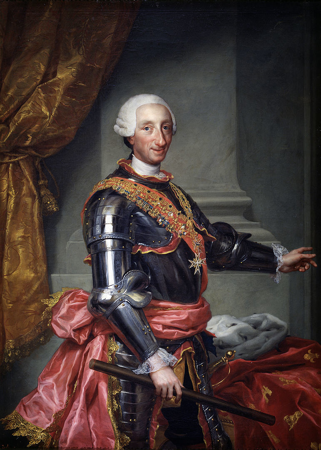
The first-born son of Philip V (1683-1746) and his second wife, Elisabeth Farnese (1692-1766), the future Charles III was educated by Joseph Arnaud, the Jesuit priest Ignace de Laubrussel, and Father Saverio de la Conca. Together with learning to read and write, his training included knowledge of geography, history, religion, military tactics, Latin and modern languages, as well as other disciplines of a more social nature such as horse riding, hunting, dancing and music. 

Charles III was not originally destined to reign, as his older brothers, the future Louis I and Ferdinand VI, preceded him in the line of succession to the Spanish throne. However, in early 1731, he was recognised as Duke of Parma and Piacenza, following the death...

Read more
Maria Amalia of Saxony
Monarch

Maria Amalia of Saxony

(Dresde (Alemania), 1724 - Madrid, 1760)

The fourth of fourteen children born to Augustus III (1696-1763), King of Poland and Elector of Saxony, and Maria Josepha of Austria (1699-1757), Maria Amalia of Saxony spent her childhood between Dresden, Pilnitz and Warsaw, where she moved after her father's accession to the Polish throne. Described by a contemporary witness as a "tall and robust" young woman, she had a strong personality, was noted for her religious piety and fondness for animals, especially exotic ones such as monkeys and parrots.

Her marriage to the future Charles III (1716-1788), then King of Naples and Sicily, was ratified in Portella (Naples) on 19th June 1738, when Maria Amalia of Saxony had not yet reached the age of fourteen. The King and...

Read more

The work in context

View in Timeline