Use of Cookies

The Royal Collections Gallery uses its own and third-party cookies, mainly for technical purposes, which are necessary to provide our services and provide you with relevant content. More information in our cookies policy. Cookies Policy.

ACCEPT to confirm that you have read the information and accepted their installation. You can change your browser settings.

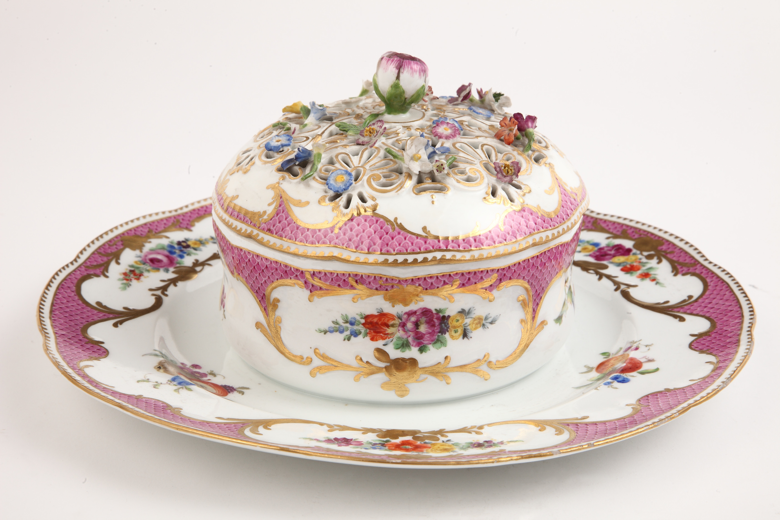
Vajilla de orla malva con escamas y flores

1774-1778

Durante la primera mitad del siglo XVIII, la manufactura sajona de porcelana de Meissen, la más antigua de Europa, se convirtió en un referente para el resto de las fábricas europeas y sus producciones, entre las que sobresalen grandes servicios de mesa, modelos y diseños muy imitados. Este mantequillero, de cuerpo cilíndrico con tapadera calada y unido a un plato, forma parte de un servicio de mesa del monarca Carlos III, conocido como la «Vajilla de orla malva con escamas y flores», en alusión a los colores, los motivos florales y las escamas que decoran cada uno de los elementos que la integran y que estilísticamente responden a cánones barrocos. Este conjunto fue realizado en el periodo académico de esta manufactura, cuando estaba bajo la dirección del conde Camilo Marcolini (1774-1814).

General Classification

Servicio de mesa

Type of Object

Mantequillero

Title

Vajilla de orla malva con escamas y flores

Collection or Series Title

Vajilla de orla malva con escamas y flores

Era / Cultural Context

Emperador José II

Place of Production

Meissen

Date

1774-1778

Subject

Porcelana

Technical

Técnica pictórica; Dorado; Esmaltado; Moldeado; Modelado

Dimensions

Fondo completo: (Altura: 10 centímetros; Diámetro: 25 centímetros)

Inventory

10015109

Credits

Texto: Mª José Suárez Martínez

Discover it at the Planta -2

Authors and Collectors

Charles III
Monarch

Charles III

(Madrid, 1716 - Madrid, 1788)

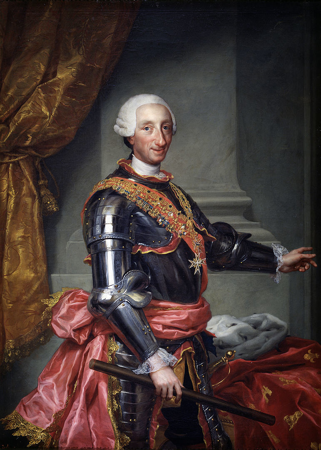
The first-born son of Philip V (1683-1746) and his second wife, Elisabeth Farnese (1692-1766), the future Charles III was educated by Joseph Arnaud, the Jesuit priest Ignace de Laubrussel, and Father Saverio de la Conca. Together with learning to read and write, his training included knowledge of geography, history, religion, military tactics, Latin and modern languages, as well as other disciplines of a more social nature such as horse riding, hunting, dancing and music. 

Charles III was not originally destined to reign, as his older brothers, the future Louis I and Ferdinand VI, preceded him in the line of succession to the Spanish throne. However, in early 1731, he was recognised as Duke of Parma and Piacenza, following the death...

Read more
Maria Amalia of Saxony
Monarch

Maria Amalia of Saxony

(Dresde (Alemania), 1724 - Madrid, 1760)

The fourth of fourteen children born to Augustus III (1696-1763), King of Poland and Elector of Saxony, and Maria Josepha of Austria (1699-1757), Maria Amalia of Saxony spent her childhood between Dresden, Pilnitz and Warsaw, where she moved after her father's accession to the Polish throne. Described by a contemporary witness as a "tall and robust" young woman, she had a strong personality, was noted for her religious piety and fondness for animals, especially exotic ones such as monkeys and parrots.

Her marriage to the future Charles III (1716-1788), then King of Naples and Sicily, was ratified in Portella (Naples) on 19th June 1738, when Maria Amalia of Saxony had not yet reached the age of fourteen. The King and...

Read more

The work in context

View in Timeline