
Use of Cookies

The Royal Collections Gallery uses its own and third-party cookies, mainly for technical purposes, which are necessary to provide our services and provide you with relevant content. More information in our cookies policy. Cookies Policy.

ACCEPT to confirm that you have read the information and accepted their installation. You can change your browser settings.

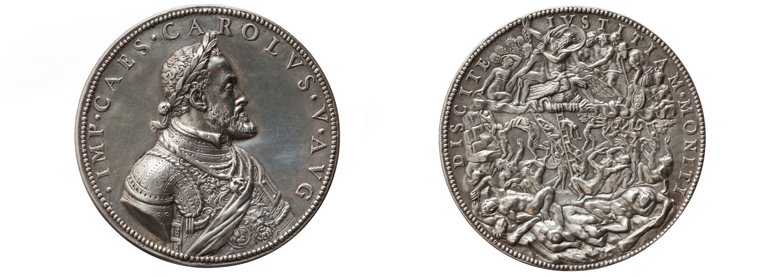
Victoria de Mühlberg

Grabado: Leoni, Leone
1547-1549

El artista Leone Leoni (1509-1590), nacido en Arezzo, realizó en 1549 una medalla para conmemorar la victoria del emperador Carlos V (1500-1558) en la batalla que se libró a las puertas de la ciudad alemana de Mühlberg (1547). La efigie del emperador que adorna el anverso de esta medalla -en la que se aúnan la calidad técnica con la belleza estética del pleno Renacimiento- constituye un verdadero retrato de aparato del soberano, que se difundirá por todo territorio entonces conocido, fuera o no gobernado por él. Así, tanto el anverso como el reverso inciden en demostrar la vigencia de la Casa de Austria como heredera del Sacro Imperio Romano Germánico.

Coronado por laurel, vestido de peto de parada y luciendo la condecoración de mayor importancia de la época -el Toisón de Oro-, la imagen del hombre más poderoso de la tierra está cargada de simbolismo al enlazar directamente con las representaciones clásicas de los emperadores romanos. Por otra parte, en su reverso se observa una escena mitológica en la que Júpiter, con quien se va a identificar el emperador, acompañado de otros dioses y sentado sobre un águila, fulmina con su rayo a los Titanes, impidiéndoles escalar el monte Olimpo, en clara alusión a los príncipes protestantes que se habían rebelado contra él, su legítimo emperador.

General Classification

Medallística

Type of Object

Medalla

By

Grabado: Leoni, Leone

Title

Victoria de Mühlberg

Era / Cultural Context

Reinado de Carlos I; Emperador Carlos V; Renacimiento

Place of Production

Milán

Date

1547-1549

Subject

Plata

Technical

Fundido

Dimensions

Fondo completo: (Diámetro: 73 milímetros; Grosor: 6 milímetros; Peso: 87,15 gramos)

Inventory

10233303

Credits

Texto: Roberto Muñoz Martín; Foto: Mario Sedeño

Discover it at the Planta -1

Authors and Collectors

Leoni, Leone
The Author

Leoni, Leone

(1509 - 1590)

Leoni (1509 — 22nd July 1590) was a renowned Italian sculptor who travelled in Italy, Germany, Austria, France, the Habsburg Netherlands, and Spain where he created most of his works.

Leoni is regarded as the finest medallist of the Cinquecento. He built his reputation on the basis of commissions received from Habsburg monarchs such as Charles I of Spain and his son Philip II.

His medium of preference was bronze, although he also worked with marble, alabaster, carved precious gems, as well as leaving some finished works in wax (the material used to model many of his sculptures), as well as designing coins. He mainly created portraits and allegorical compositions.

Read more
Charles I of Spain and V, Holy Roman Emperor
Monarch

Charles I of Spain and V, Holy Roman Emperor

(Gante (Bélgica), 1500 - Yuste (Cáceres), 1558)

The second of six children born to Joanna I (1479-1555) and Philip the Handsome (1478-1506), the future Charles I of Spain and V, Holy Roman Emperor spent his childhood in Mechelen (Belgium). Count of Flanders and Lord of the Netherlands since the death of his father in September 1506, his aunt, Archduchess Margaret of Austria (1480-1530) –the widow of Prince John (1478-1497), second son of the Catholic Monarchs, and younger sister of Philip the Handsome– ruled as Regent until he attained his majority in 1515. He was educated by Adriaan Florensz Boeyens, the future Pope Adrian VI. Although Prince Charles had a Spanish tutor, Luis Cabeza de Vaca, his childhood and early youth were spent in a predominantly French-speaking cultural environment.

Read more

The work in context

View in Timeline