Loading...

Castillo, José del
(Madrid, 1737 - Madrid, 1793)
Castillo Aragonés, José del. Madrid, 14.10.1737 – 05.10.1793. Painter.
José del Castillo was born in Madrid in 1737.
The son of Juan Tomás Castillo and Melchora Aragonés, he began his studies when he was barely ten years old, joining the drawing classes at the Preparatory Council of the Academy of San Fernando under José Romeo.
His excellent qualities brought him to everybody’s notice, and in 1751 he received a grant from José de Carvajal y Lancáster to study in Rome under Corrado Giaquinto (1703-1766), with whom he would also return to Spain in 1753. The Italian had been summoned by Ferdinand VI to continue the decorations of the Royal Sites following the death of Jacopo Amigoni the previous year.
Once in Madrid, the young painter continued his drawing classes and in 1755 he entered the triennial competition, winning the First Prize and the Gold Medal for his painting of Saint Hermenegild stripped of his clothes in the presence of his father Leuvigild and his brother Reccared, for the "de pensado" or non-timed test; and of Lot and his daughters leaving Sodom accompanied by angels, for the "de repente” or timed test. There are several preparatory sketches of both works (Madrid, Academy of San Fernando) that indicate the artist’s close connection to his master’s style and models.
In 1756, Giaquinto was commissioned to create the tapestry cartoons for the king's chamber at the Royal Palace in Madrid, depicting the story of Solomon, David and Joseph, based on the paintings of Luca Giordano at the palace of Buen Retiro. Eventually, the tapestry was adapted for the Queen's chamber, and during the reign of Charles III, it was placed in the Palace Antechamber. Under Corrado's direction, Castillo prepared the models for the borders and the Judgement of Solomon. The great series took more than two decades to be completed, including the Solomon and David completed by Solimena and the History of Joseph which Giaquinto himself had painted for the Grand Dining Hall of the Aranjuez Palace. It also includes the painting of David fighting the bear, which was gifted to Cardinal Lorenzana for the Cathedral of Toledo together with other tapestry cartoons of the series, the paintings of David and Abigail, and The Triumph of Joseph, now in the Prado Museum.
In December 1758, the Academy awarded him a new grant to go to Rome, where he remained until 1764 under the tutelage of Preciado de la Vega.
His Italian Notebook (1761-1762, Madrid, Prado Museum) dates from this period and contains annotations and drawings of works from Antiquity - notably the designs for the Ara Pacis - and of the 16th and 17th-century great masters; it also includes a Self-portrait of the artist. On his way back to Spain he visited Naples with Juan de Villanueva in order to see the excavations at Herculaneum. Once in Madrid, he joined the team of painters led by Giaquinto at the Royal Tapestry Workshop to decorate the Royal Palace of El Pardo. Andrés de la Calleja, Guillermo L'Anglois and Antonio González Velázquez were already a part of this project. A decade later, Goya (1775), Ginés Andrés de Aguirre (1776), Anton Giuseppe Barbazza (1776) and Mariano Nani (1777) would also join the project.
From then onwards, Castillo’s career took a downturn, with few independent commissions from the Tapestry Workshop, such as the large painting of Saint Augustine Helping the Poor at the Convent of La Encarnación in Madrid (a sketch of the painting is held at the Museum of Fine Arts in Santander). A related drawing of Saint Augustine meditating on the mystery of the Holy Trinity is held at the Prado Museum where the artist derives inspiration from the Holy Trinity painted by Giaquinto in Rome and in the chapel vault at the Royal Palace of Madrid.
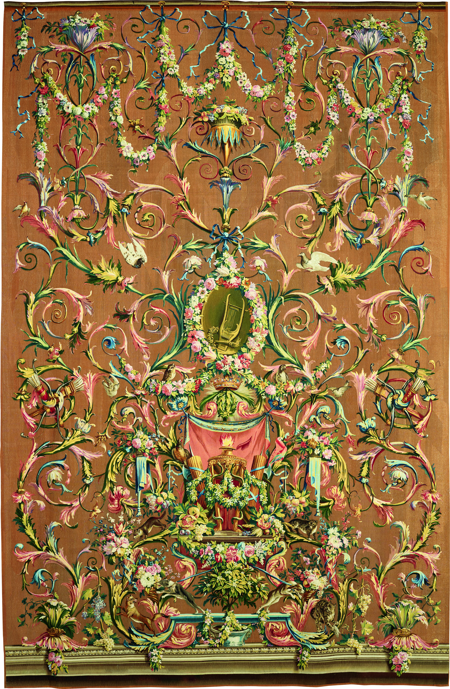
Between 1770 and 1773, he completed the tapestry cartoons for the King's bedchamber started by Guillermo Anglois for the Royal Palace of Madrid. After these works were completed, he was tasked with creating the cartoons for the new tapestries in the Prince’s Chamber at El Escorial in 1773. The success of the Royal Palace tapestry gave him the opportunity to paint in 1775 the cartoons for fourteen tapestries intended for the Princess's private chamber in the Palace of El Pardo, and which still hang there. In contrast to other narrative series, a Pompeiian style with birds, garlands and flowers on a blue background, complemented by allegorical figures - Fame, Geography, Poetry and Painting - on the doors was requested for the private chamber. For this work, which is perhaps reminiscent of the Roman paintings he saw in Herculaneum during his second stay in Italy, he was assisted by Antonio Carnicero, José Beratón, Manuel Cruz and Gaspar Illofrío.
In 1776, he was commissioned to paint the cartoons for the new tapestries of the Princess’s private chamber in El Escorial, which he completed a year later.
At the same time he was asked to restore Luca Giordano’s frescoes at the Buen Retiro palace, probably due to his success restoring the former Queen’s Gallery at the Palace of El Pardo the previous year -the room had been painted between 1607 and 1609 by Patricio Cajés- and which at that time housed the bedchamber of the Infante Antonio Pascual. This was after the publication of Volume VI of Antonio Ponz's Journey Around Spain in which the writer criticised the dilapidated condition of the palace, leading to the painter being approached in July 1777. Castillo, Andrés de la Calleja and Ponz himself visited the site to decide how best to commence the works, which would focus on the central vault and the Works of Hercules on the walls of the hall. At the same time, Castillo copied this cycle in a series of paintings —now hanging in the Academy of San Fernando— to serve as a model for the prints to be executed by Juan Barcelón and Nicolás Barsanti between 1777 and 1785.
That same year, he was commissioned to paint the cartoons for the Prince's Dressing Room in the Palace of El Pardo, completed in April 1780.
The series is possibly the most famous of those executed by Castillo, and represents everyday matters of aristocratic life in Madrid. It has two large central compositions placed horizontally: The Garden of Buen Retiro and the Lake of Buen Retiro; and five vertical compositions: The Cake Seller at the Puerta de San Vicente, The Curd Seller, The Orange Seller by the Fuente del Abanico, The Sweet Seller and The Flower Girl at the Puerta del Sol. It is completed with six overdoors depicting scenes of children playing, similar to compositions by González Velázquez and Goya in the same palace. It has been noted these paintings depict a series of clearly recognisable monuments, such as the Retiro Palace, the Casa de Correos, and the Abanico and Mascarones fountains, which were the main landmarks on the road linking the Madrid palace to El Pardo. Another significant event in 1780 was the publication of the edition of Don Quixote by Joaquín Ibarra under the auspices of the Royal Academy of Language. Antonio Carnicero, Pedro Antonio Arnal and José del Castillo were asked to contribute illustrations for the work, among others.
Between 1784 and 1787, he painted the last series of cartoons for the Royal Workshop of Santa Bárbara, intended for the bedchamber of the Infante Antonio Pascual at El Pardo —it should be noted that years ago, he had also restored the paintings on the chamber’s ceiling—. In July 1785, he completed The Pilgrimage of Saint Isidore, perhaps his most elaborate composition as well as the largest one (342 x 780 cm). Unlike Goya, who would paint the same subject three years later, Castillo focused on the groups of majos and majas, relegating the landscape to the background. This series also includes Strolling Along the Fountain of Las Damas, which depicts courtiers; A Hunter Drinking; and A Gentleman Walking with a Lady, all of which are now hanging in the Prado Museum. The death of Charles III in 1789 cut short this series and others that were being executed for the palace at the time.
His financial difficulties increased in his last years. In 1776, he had applied for a position with Ramón Bayeu and Goya as painter of cartoons for the Royal Tapestry Workshop.
Ten years later, after the economic crisis caused by the war against England, Francisco Bayeu again forwarded Castillo and his brother Ramon’s application for the position of painter to the King, with the exclusive task of painting cartoons for the Santa Bárbara workshop. However, the aforesaid Bayeu and Francisco de Goya were instead appointed to these posts and Castillo relegated to the background. His situation at the Academy of San Fernando was no better. In 1785 he had been appointed Academician of Merit for his sketch of The Embrace of Saint Francis and Saint Dominic for the Royal Basilica of San Francisco el Grande.
In spite of this, he did not obtain the post of deputy director of painting, which eventually went to Gregorio Ferro. As a consolation, he was only granted "the honors" of the position.
At this time, in 1787, the Count of Floridablanca commissioned him and Gregorio Ferro, to paint the ceilings of his residence in Madrid, with a series of Pompeiian-style decorations with alternating allegorical and mythological figures. The minister’s dismissal in 1792 deprived him of the monthly allowance he had received. Towards the end of his life he worked on the remodelling of the church of the Saints Justo and Pastor in Madrid, for which he executed the high altar painting showing Saints Justo and Pastor being led to martyrdom, known today only from the sketch available in the Lázaro Galdiano Museum.
He died on 5th October 1793, poverty-stricken, and having suffered a further setback: the appointment of Cosme de Acuña to the position of painter that had fallen vacant after the death of Ramón Bayeu and to which Antonio del Castillo had applied:
Source: Royal Academy of History (https://www.rah.es)